Gravity and Vanilla Black Holes

Einstein’s theory of general relativity, which includes gravity, predicts that black holes have a tricky feature: a singularity. This is a point where space and time are squeezed so tightly that the laws of physics break down—think of it as a cosmic “error message.” To fix this, scientists often turn to exotic matter—hypothetical substances with bizarre properties like negative energy—to smooth things out. However, a team from the University of Barcelona, led by Pablo Bueno, found an alternative. They didn’t need exotic matter at all. Instead, they tweaked Einstein’s gravity by adding an infinite series of extra “rules” (higher-curvature corrections) to the math.

Their solution works in spacetimes with more than four dimensions—beyond our usual height, width, depth, and time. In these higher-dimensional worlds, black holes can exist without singularities. This “smooths out” black holes, making them less mysterious and more like regular objects in spacetime—no weird stuff required.

The presence of extra dimensions doesn’t just fix singularities—it can also change how black holes behave. In higher-dimensional spacetimes, black holes might have different event horizon shapes (the boundary beyond which nothing escapes) or other structural quirks. The Barcelona team’s work shows that these altered properties emerge naturally from gravity in more than four dimensions, offering a fresh perspective on these cosmic giants.

Thinking outside the box, is it possible that these extra dimensions link black holes to “a reality outside regular spacetime,” like wormholes (tunnels through spacetime), braneworlds (parallel universes on higher-dimensional “membranes”), or even gateways to white holes (theoretical opposites of black holes that spit stuff out)? Theories like string theory and braneworld scenarios suggest that extra dimensions might allow such connections. For example, a wormhole could theoretically bridge two distant points in our universe—or even lead to a completely different universe.

While the math of higher dimensions opens the door to these possibilities, it’s all conjecture. The Barcelona team’s work is a major step forward in understanding black holes in higher dimensions, but it doesn’t directly prove connections to other realities.

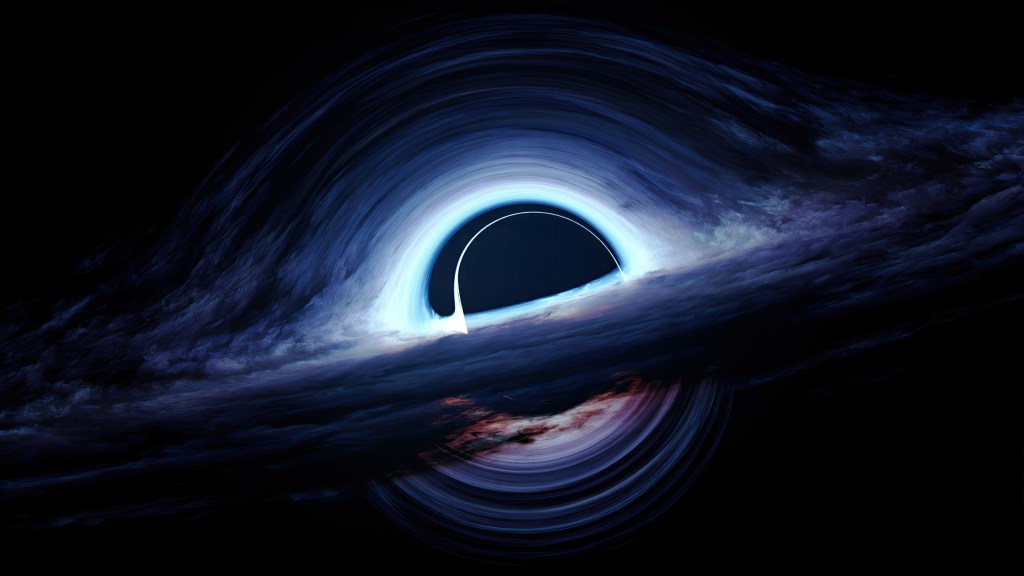
Source: Grok 3. Regular Black Holes… by Bueno, P. et al., Physics Letter B, February 2025. Graphic: Black Hole Rendering, iStock licensed.
Alien Proof

We are an advanced species; we’ve learned how to blend.” — Ra, Stargate (1994)

Where are the aliens? UFOs, Area 51, aliens—oh my! It’s a swirling bucket of murky fun, brimming with conspiracies, starry-night tales, and probing delights. What’s real? What’s surreal? What counts as proof of life beyond Earth? There’s a flood of chatter out there—grainy videos, “as God is my witness” accounts—but sifting it for substance is like panning for gold in a litterbox.

Speculation about UFOs and Area 51 is a roaring mix of rumors, secrecy, and sci-fi vibes. Take the 1947 Roswell crash: the U.S. military first claimed they’d recovered a “flying disc,” only to pivot hours later, insisting it was just a weather balloon. The rancher who found it, Mac Brazel, described a sprawl of tinfoil, rubber, and sticks—hardly spaceship material. Yet alternate theories snowballed, spinning every extraterrestrial possibility into gospel. Alien wreckage, bodies, anti-gravity tech, even “element 115” (later synthesized by Russia as moscovium)—it’s all been tossed into the pot. Bob Lazar, since 1989, has been the loudest voice pushing these wild claims, though he’s got little beyond his word to prop them up.

More recently, posts on X have revived whispers of an egg-shaped craft allegedly hauled to Area 51 in the ‘80s. A supposed witness linked to EG&G—a firm founded by three MIT grads with deep ties to classified projects, including Area 51—claimed it was so advanced they couldn’t cut it open or X-ray it, hinting at extraterrestrial origins. This comes secondhand, under oath, but there’s no photos, no artifacts—just testimony.

What the government has declassified carries weight but lacks dazzle. The CIA’s 2013 Area 51 release confirmed it as a test site for spy planes like the U-2 and A-12 Oxcart, likely explaining many ‘50s and ‘60s UFO sightings. In 2017, the Pentagon’s Advanced Aerospace Threat Identification Program (AATIP) fessed up to studying UFOs—or UAPs, to dodge the tinfoil-hat vibe. Leaked Navy videos, like the 2004 Tic Tac encounter, show objects defying known tech: no visible propulsion, jaw-dropping acceleration. The 2021 UAP report to Congress didn’t shout “aliens” but didn’t slam the door either—144 cases, one pinned as a balloon, the rest labeled “we don’t know.”

So, where’s the slam-dunk proof of aliens? Not much holds up under a bright Tesla LED. Lazar’s stories are big on panache and spirit, short on bones. Government reports and videos tease the imagination, but never-ending psyops muddy the waters, and nothing crosses the finish line. We’re left with 90% noise—mental candy, heavy on sugar, light on meat. Until ET shakes your hand, it’s probably best to treat the evidence as entertainment.

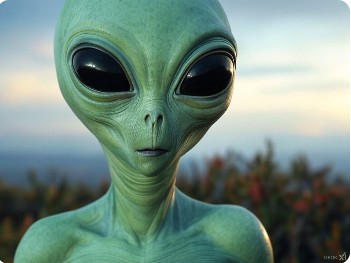
Source and Graphic: Grok 3.

Seeking God

95% of the universe is a mystery. About 68% is dark energy, which is believed to drive the accelerated expansion of the universe, though its exact nature is unknown. 27% is dark matter, which holds galaxies together and is believed to consist of one or more massive, yet unknown, particles.

Science Daily reports that researchers at the University of Michigan and five other institutions “have strengthened the case that matter becomes dark energy when massive stars collapse and become black holes.” This suggests that the universe’s expansion may be partly explained by the expansion of black holes through cosmological coupling. It also implies that black holes can gain mass without consuming matter, directly challenging the Standard Model of particle physics.

This either leads to the Big Freeze—infinite expansion through not quite infinite time—or the Big Crunch, where gravity eventually says ‘Enough!’ and collapses everything back into an infinitesimal point.

To sum up, we may or may not understand 5% of the universe, while the remaining 95% aligns with Socrates’ axiom from 6th century Greece—we essentially know nothing.

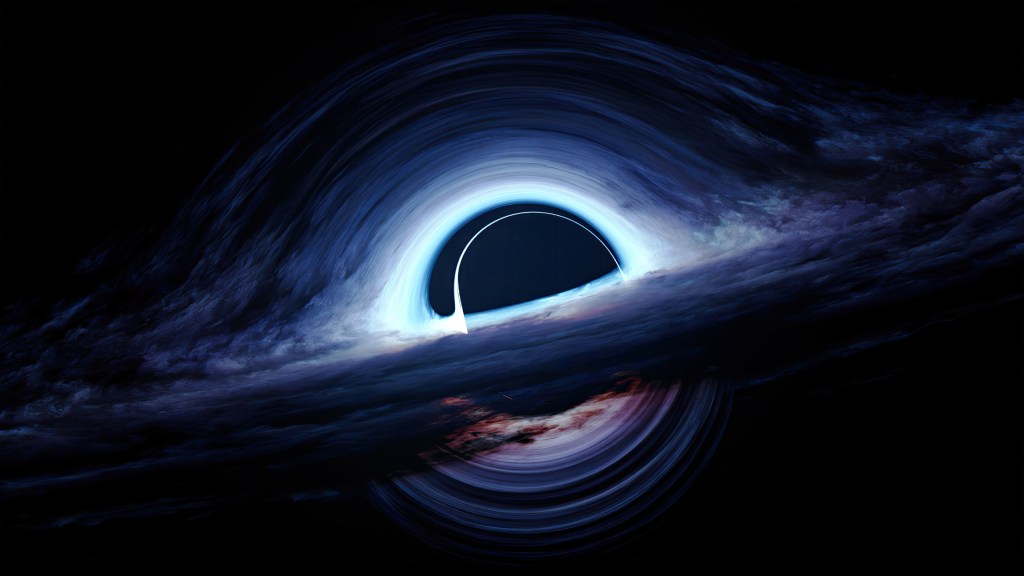
Source: University of Michigan. “Evidence Mounts for Dark Energy from Black Holes.” Science Daily. 2024. Graphic: Black Hole.

Runaway Black Hole

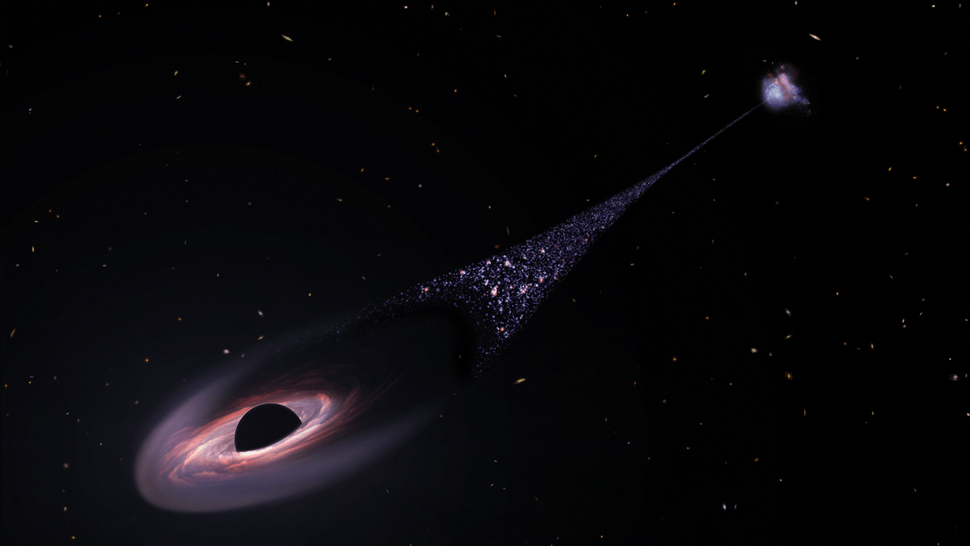
Brandon Specktor with LiveScience reports that ‘in 2023 astronomers reported the detection of something never seen before: a “runaway” black hole…’

The observed black hole with a mass of 20 million suns, is not gravitationally locked to any galaxy. It was spotted streaking darkly through space at more than 3 million miles per hour, or approximately 0.5% the speed of light, dragging a 200,000 light year long string of stars behind it like Christmas lights tied behind Santa’s sleigh.

Possible scenarios that may have sent the black hole on its merry way include various interactions with other massive objects, such as galactic collisions or gravitational recoil of merging black holes.

Source: 5 Space Discoveries that Scientists are Struggling to Explain by Brandon Specktor, LiveScience, 2024.  Graphic: NASA, ESA, Leah Hustak (STScl)

Priorities

NASA has farmed out a considerable portion of its science and engineering programs to the private sector so it can concentrate on the critical issues that will get some of humanity’s eggs off this planet.

NASA’s budget for 2023 was $25.4 billion.

Source: Briley Lewis, Popular Science, 22 May 2024. Graphic: DALL.E 3 generated.