Exploits in Dying

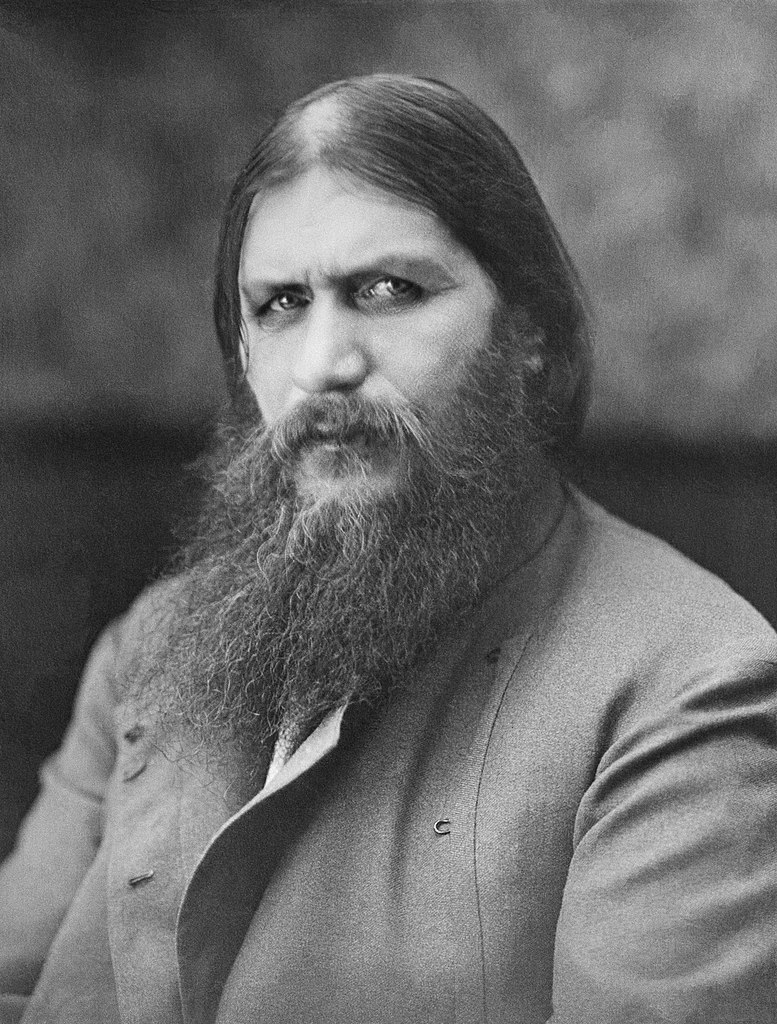
Grigori Rasputin, a Russian mystic, met an inglorious, improbable, and inexplicable end in 1916 at his assassin’s Moika Palace in Saint Petersburg. Although accounts vary, Rasputin’s executioners ostensibly made multiple attempts to murder him. They began with cyanide-laced cakes, which did not achieve their desired outcome. Next, in an attempt to reach a different result with the same measures, they offered him wine fortified with more cyanide. This attained the same result as the first attempt.

Following this, they shot him multiple times, but he continued to move, eventually attacking his would-be murderers. Finally, they wrapped him up in a carpet and tossed him into a freezing river, where he supposedly died of hypothermia.

A less imaginative account of his death suggests that he died from a single bullet to the head.

Rasputin supposedly left a letter, which was read by Alexandra, the wife of Tsar Nicholas II, prophesizing that if he was killed by Russian nobles, the Russian Tsar’s family would be executed within a few years.

Source: Biography, 2021. Graphic; Rasputin, c1910, Russian Empire, public domain. 
The Statue of Zeus at Olympia

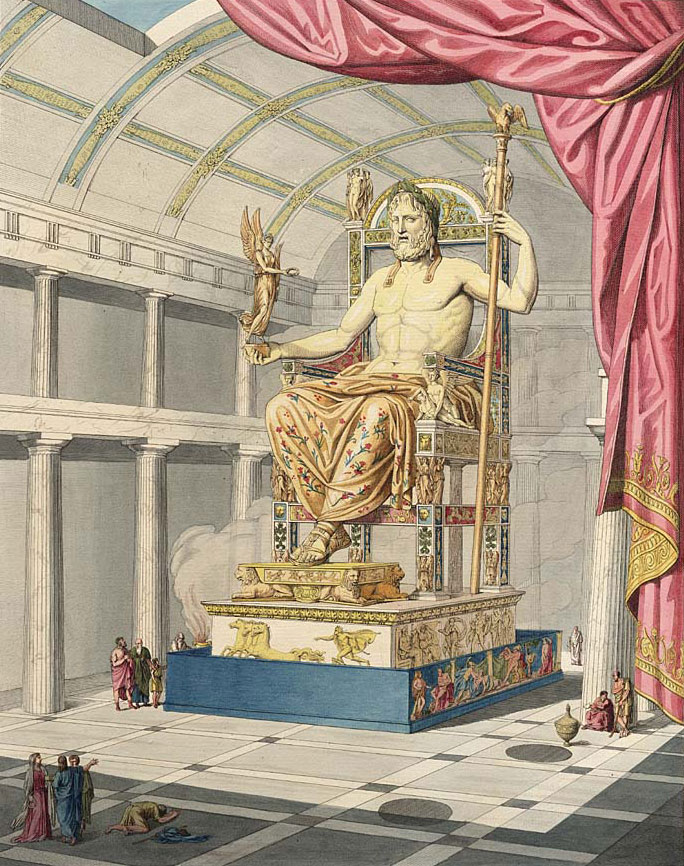
The 40’ tall statue, considered one of the seven wonders of the ancient world, was constructed by the Greek sculptor Phidias around 435 BC during the Golden Age of Athens and the time of Pericles.

The statue was composed of what the ancients called ‘chryselephantine’ or ivory, depicting flesh, and gold, which defined Zeus’ robes and ornaments. The ornaments included his scepter in his left hand and in his right hand he held a statue of Nike, Greek goddess of victory (Bulfinch reverses the hand order in his book on Greek mythology). He is seated on a throne of cedar encrusted with gold and precious stones.

Detailed descriptions of the statue come from the Greek geographer Pausanias and from numerous Greek and Roman coins and engraved gems.

The statue was housed in the Temple of Zeus at Olympia near the western coast of the Peloponnese peninsula and hasn’t been seen since the 5th or 6th century AD. It is believed to have been destroyed by an earthquake and or fire at Temple of Zeus or it was transported to Constantinople and destroyed by a fire there in 474 AD.

Source: Bulfinch’s Mythology edited by Richard Martin, 1991. Statue of Zeus by Britannica, 2024. Graphic: Olympian Zeus Statue as drawn by de Quincy, 1815, Public Domain.

King Arthur’s World

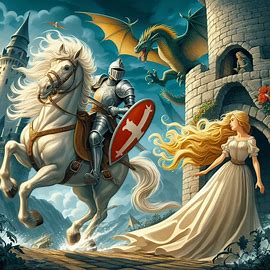
Chivalry ‘framed an ideal of the heroic character, combining…strength and valor, justice, modesty, loyalty to superiors, courtesy to equals, compassion to weakness, and devotedness to [God],’ as defined by Bulfinch in his 1858 ‘The Age of Chivalry, or Legends of King Arthur’.

Chivalry in the Middle Ages was a lifestyle and a philosophy. A lifestyle that guided a knight’s actions and decisions backed-up by a philosophy that defined chivalrous principles and virtues.

Every year the Knights of the Round Table renew their oaths of chivalry as proclaimed by the King Arthur during the Christian holiday of Pentecost.

The time of Pentecost was likely chosen because it was a time of renewal and commitment for Christians.

Source: Bulfinch’s Mythology, 1991. Graphic: Knight Rescuing a Maiden, AI generated.