Brunelleschi’s Dome

Filippo Brunelleschi, a goldsmith, engineer, and relatively inexperienced architect, completed the largest masonry dome in the world in 1436—a record that has never been broken. The world now knows it as Brunelleschi’s Dome, which sits atop the Cathedral of Saint Mary of the Flower in Florence, Italy.

When completed, the dome was 52 meters (171 feet) high, with an exterior diameter of 45.5 meters (149 feet) and an interior diameter at its base of 41 meters (135 feet). The base of the dome sat above the crossing of the Cathedral, which was 55 meters (180 feet) above the ground. Atop the dome was a lantern measuring 21 meters (69 feet) in height, bringing the entire Cathedral structure to a remarkable 128 meters (420 feet). While it was not the tallest structure in the world at the time—Lincoln Cathedral in England, at 160 meters (525 feet), held that distinction—it was certainly an impressive architectural feat.

Trivia: Brunelleschi developed an ingenious mechanical lift to raise materials up to the dome. The modern world knows what that device looked like and how it worked because a young Leonardo da Vinci sketched the hoist when he was apprenticed to the Florentine painter Verrocchio beginning in 1466. Due to that sketch, Leonardo was sometimes mistakenly given credit for inventing the hoist.

Source: Brunelleschi’s Dome by Ross King, 2000. Graphic: Brunelleschi’s Dome by National Geographic, 2013-2019.
Four Women of the Renaissance

Leonardo da Vinci, who died on May 2, 1519 at the age of 67, began around 40 paintings in his lifetime, of which fewer than 20 survive. Of those that survive, only about 15 are believed to be complete.

The artist painted only four known portraits of women:

  • Ginevra de’ Benci at the National Gallery of Art in Washington, D.C.
  • La Belle Ferronnière at the Louvre Museum in Paris.
  • Mona Lisa also at the Louvre Museum in Paris.
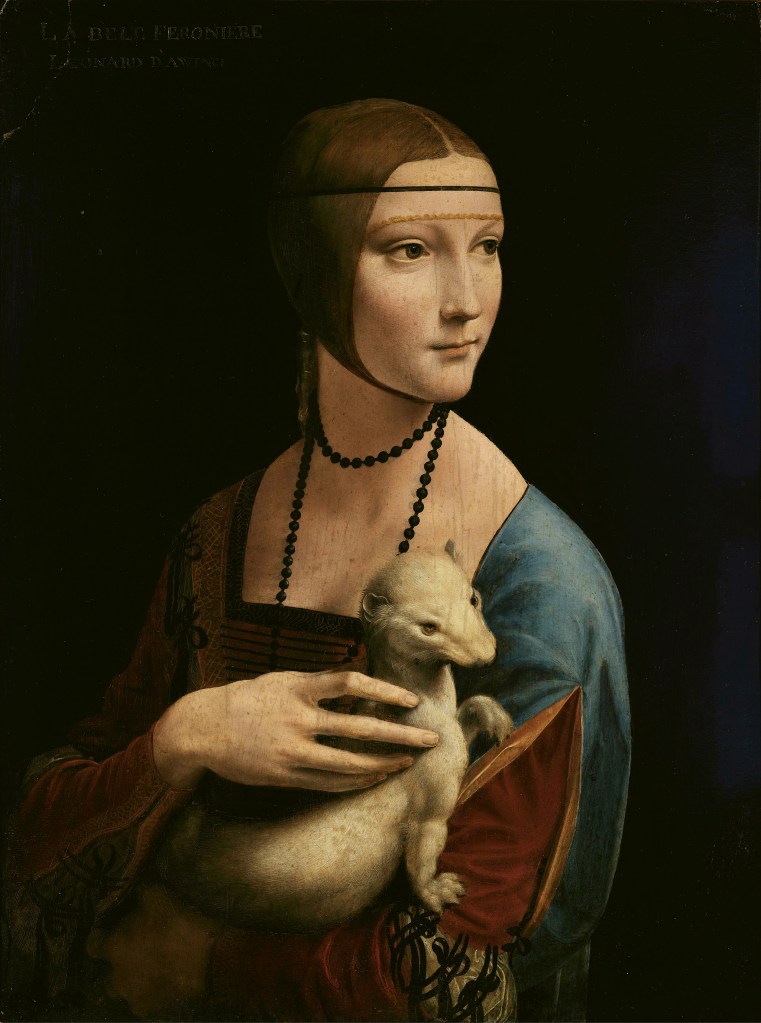
  • Cecilia Gallerani (known as “Lady with an Ermine“) at the Czartoryski Museum in Krakow, Poland.

Cecilia Gallerani was the mistress of Ludovico Sforza, Duke of Milan, and was painted while da Vinci worked in the Duke’s court in Milan, Italy. The Polish government paid 100 million Euros for the painting in 2016.

Trivia: Many believe that Leonardo da Vinci continuously reworked the Mona Lisa throughout his life; it was still in his possession when he died. The fact that the Mona Lisa does not have eyebrows suggests, to me, that the painting was still unfinished. The absence of eyebrows in the Mona Lisa has led to other theories as well:

  • Others argue that da Vinci might have intentionally left them out for artistic reasons.
  • There’s also the theory that the eyebrows might have faded over time due to the varnish or other conservation issues.

Source: Leonardo da Vinci by Walter Isaacson, 2017. Graphic: Lady with and Ermine by da Vinci, public domain.

Flowers for Purpose:

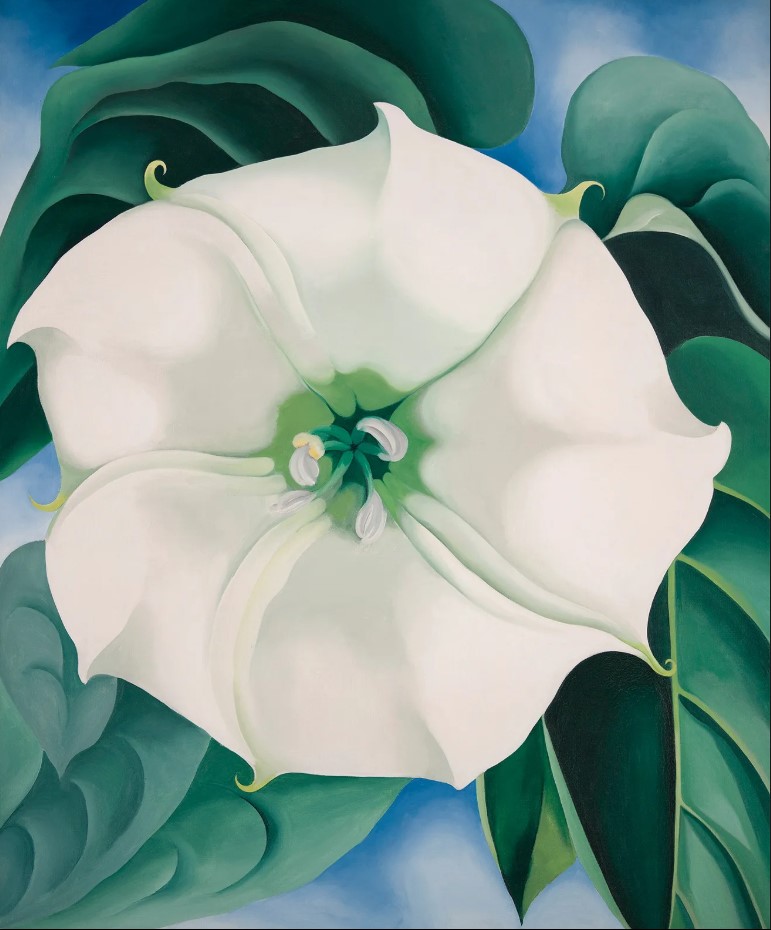
Georgia O’Keeffe, a major influence and definer of early 20th-century American Modernism, was an exemplar of the natural world, painting flowers, desert landscapes, and skyscrapers with precision, coated with a veneer of the sublime and a touch of the surreal.

Her flowers were her gifts and instructions to the world. In the May 16, 1946, issue of the New York Post, she articulated her artistic purpose: “When you take a flower in your hand and really look at it, it’s your world for the moment. I want to give that world to someone else. Most people in the city rush around so, they have no time to look at a flower. I want them to see it whether they want to or not.”

The American Modernism movement is difficult to define, though O’Keeffe seems to have taken the movement a step back from the light and color of French Impressionism to a more classical form, incorporating precision of shape with the synthesis of modern abstraction.

When she abandoned precision for immersion in total abstraction, she sometimes found herself lost in amateurish erotica or unending interpretive babbling, enigmatically and essentially labeling these works as meaning whatever she wanted them to mean.

Source: Georgia O’Keeffe Edited by Barson, 2016.  Graphic: Jimson Weed/White Flower No. 1, oil on canvas by Georgia O’Keeffe, 1932; in the Crystal Bridges Museum of American Art, Arkansas. 121.9 × 101.6 cm. Edward C. Robison III/ © 2016 Georgia O’Keeffe Museum/DACS

Know Thyself

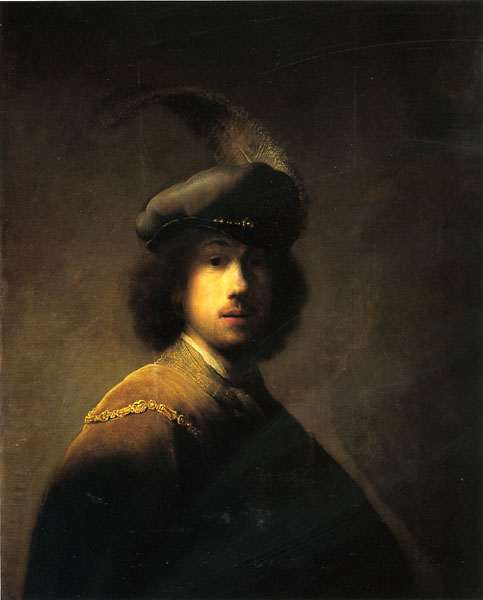
Draughtsman, etcher, painter, Rembrandt van Rijn, fascinated with the expressive face, inclined to acting out different character roles, inserting himself into the crowds to witness his subjects, shaping his public persona through his art, uncertain in youth, self-assured by mid-life, reflective towards the end, it is believed, with scholars still counting, that he created 40 to 50 paintings, 31 or 32 etchings, and 7 drawings of himself over a period of 44 years.

It is believed to be a record for self-portraits by a renowned artist.

The curator at the Museum of Fine Arts, Boston, C.S. Ackley writes that: “The artist used himself as a cheap model, studying his contorted features in the mirror.

A student of Rembrandt wrote in 1678 that a young budding artist should use a mirror to aid in the representation of the passions or emotions in order “to be at once performer and audience.”

To paraphrase the Delphic maxim: Know your art by studying yourself.

Source Rembrandt’s Journey by C.S. Ackley, 2003. ThoughtCo. 2019. Graphic: Rembrandt, Self-Portrait, Oil on Panel, 1629, Isabella Stewart Gardner Museum, Boston.

Versailles

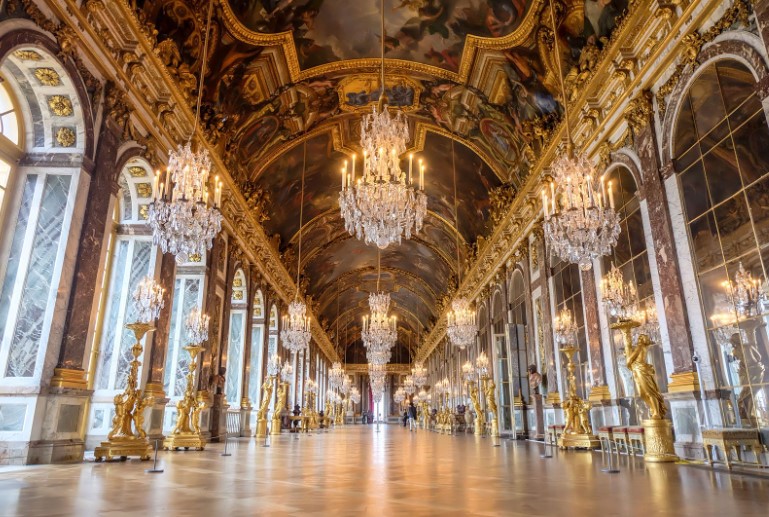
The Palace of Versailles is the modern definition of grand opulence. Opulence beyond the comprehension of the common man. Built as a tribute to, and glorification of, himself, King Louis XIV, who stood at the apex of the world stage in the 17th century.

He built the palace to move his court out of Paris, supposedly so he could exert more control over the French nobility.

Initial construction began in 1661 with the Grand Palace and its surrounding gardens and culminated in 1710 with the completion of The Royal Chapel. The entire estate covers about 2000 acres and various estimates suggest that Versailles would cost $2-50 billion to construct today.

The Hall of Mirrors, shown in the graphic, was added, along with the wings to the Grand Palace from 1678-1684.

Source: Versailles by Perouse de Montclos, 1991. Graphic: Hall of Mirrors, Britannica.

Western Taste–Georgian Style

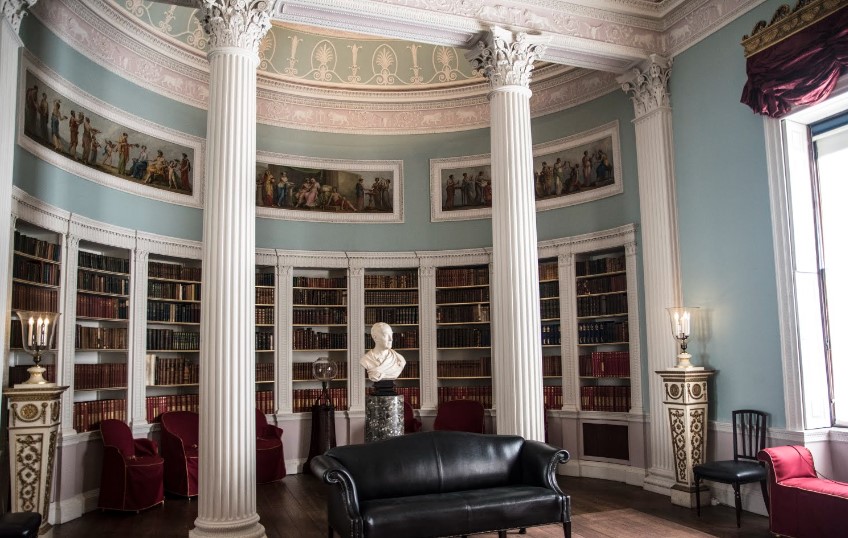
The Great Room or Library at Kenwood House in London, built from 1767-1770, was and still is considered the creme de la crème of English interior architecture during the reign of the Hanoverian Kings.

The designer of the Great Room, Robert Adam was a Scottish neoclassical architect during the Georgian Era. (All the Hanoverian Kings were named George.) This period spanned most of the 18th and early 19th centuries and Adam was singularly responsible for the revival of classical architecture throughout the west from 1760 till the end of the 18th century.

Trivia: Hanoverian King, George III, prime American Revolutionary War antagonist, ruled England during the height of Robert Adam’s influence on architecture and interior design.

Source: Robert Adam by Jeremy Musson and Paul Barker, 2017. Graphic: The Adam Library, Kenwood House on Hampstead Heath, Joe Adamczewski photo, copyright English Heritage.

The Hand of God

Guillaume de Laubier and Jacques Bosser in their book ‘Sacred Spaces: The Awe-Inspiring Architecture of Churches and Cathedrals’ capture the artistic wonderment and engineering marvels that sprang from the last two millennia of Christian faith. From St. Peter’s Basilica in Rome to St. Paul’s Cathedral in London and back to Barcelona’s Basilica de la Sagrada Familia, the authors showcase the magnificent architectural monuments to Christ that are unsurpassed in our contemporary world of concrete and steel. The beauty presented in these ‘Sacred Spaces’ were constructed with flesh and blood but only God could have provided the inspiration and the will to create them.

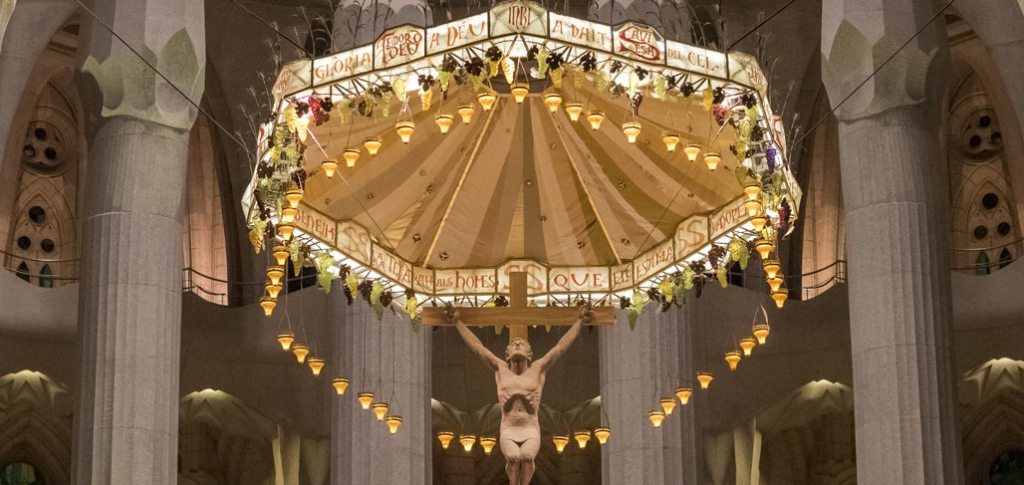
The photo is the baldachin, or canopy, which hangs in the Barcelona Sagrada Familia. It represents the Holy Spirit covering the cross of Christ and hangs below the representation of the Father (not shown), which taken together represent the Holy Trinity of Christian faith.

Source: Sacred Spaces: The Awe-Inspiring Architecture of Churches and Cathedrals by Jacques Bosser and Guillaume de Laubier, 2018. Graphic: The Baldachin: Representation of the Holy Spirit at the Sagrada Familia by Blog Sagrada Familia, 2018.

The Statue of Zeus at Olympia

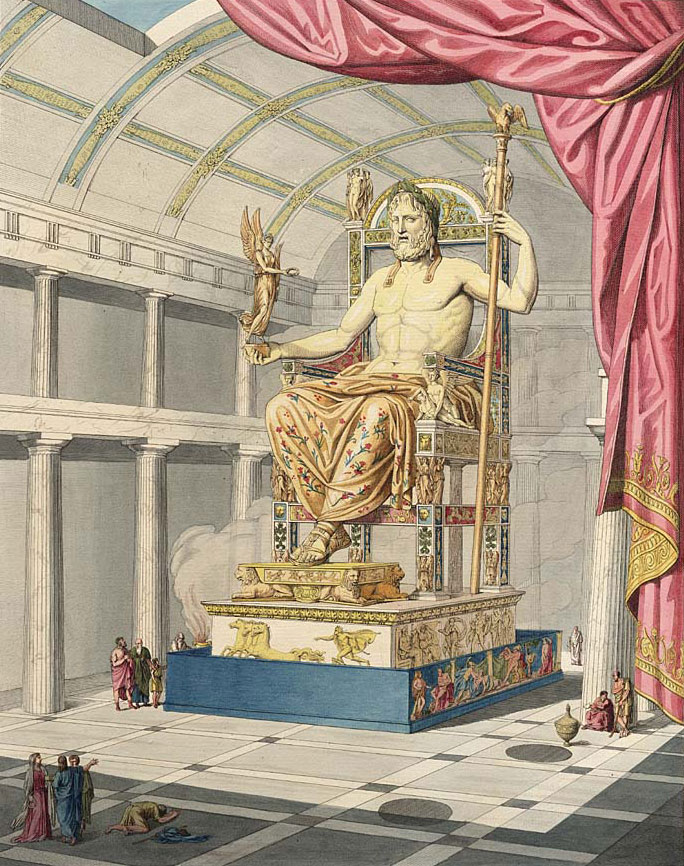
The 40’ tall statue, considered one of the seven wonders of the ancient world, was constructed by the Greek sculptor Phidias around 435 BC during the Golden Age of Athens and the time of Pericles.

The statue was composed of what the ancients called ‘chryselephantine’ or ivory, depicting flesh, and gold, which defined Zeus’ robes and ornaments. The ornaments included his scepter in his left hand and in his right hand he held a statue of Nike, Greek goddess of victory (Bulfinch reverses the hand order in his book on Greek mythology). He is seated on a throne of cedar encrusted with gold and precious stones.

Detailed descriptions of the statue come from the Greek geographer Pausanias and from numerous Greek and Roman coins and engraved gems.

The statue was housed in the Temple of Zeus at Olympia near the western coast of the Peloponnese peninsula and hasn’t been seen since the 5th or 6th century AD. It is believed to have been destroyed by an earthquake and or fire at Temple of Zeus or it was transported to Constantinople and destroyed by a fire there in 474 AD.

Source: Bulfinch’s Mythology edited by Richard Martin, 1991. Statue of Zeus by Britannica, 2024. Graphic: Olympian Zeus Statue as drawn by de Quincy, 1815, Public Domain.

Monet and Water

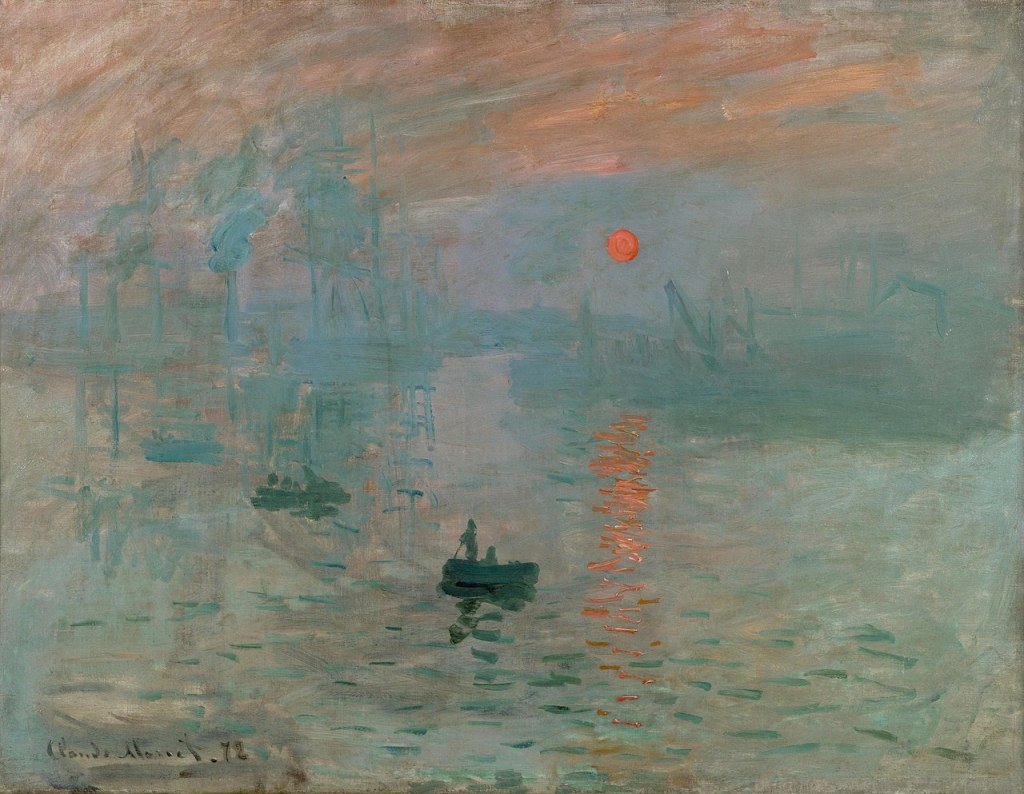
Monet loved water, the sea, lakes, rivers, mist, fog, it didn’t matter. He searched it out and painted it. Plants, people, buildings were extensions of his water.

His 1872 seascape, Impression: Sunrise, from which the style ‘Impressionism’ is derived, is a study of the morning light unsuccessfully trying to break through the mist of solitude surrounding the boaters. Water fills the painting from top to bottom.

Taillandier in his monograph, ‘Monet’ wrote, “His fascination with water was such that he painted leaves, grass, and meadows as he painted water, the brushstrokes like so many quivering waves in the air”.

Monet painted water. Houses were painted like so many waves. The sky rippled. Skin erupted with steam and stones dissolved into mist.

Source: Monet by Yvon Taillandier, 1987. Graphic: Impression: Sunrise by Monet, 1872, Public Domain.

Burial of the Count of Orgaz

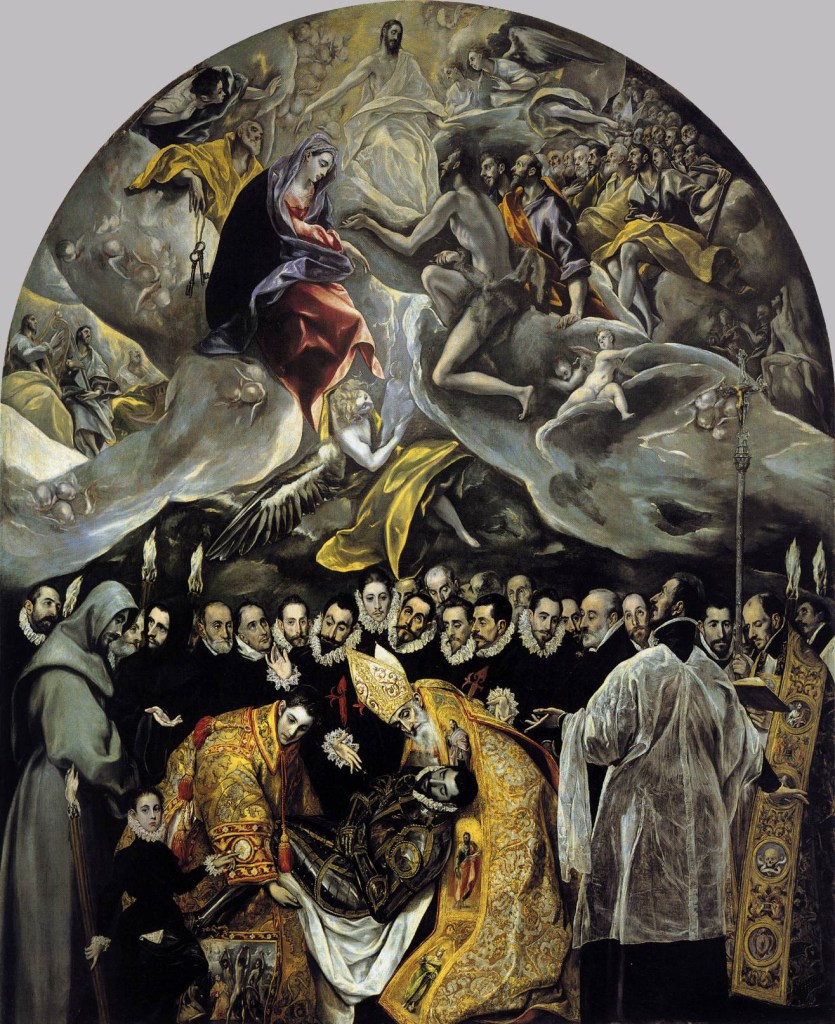
The 1586 painting, Burial of the Count of Orgaz is considered El Greco’s greatest work, which he created during his later mannerist phase of the High Renaissance. Mannerist paintings are known for their exaggerated proportions of figures and structures and the use of very intense colors.

The painting is large, almost 16’ by 12’, oil on canvas divided into two halves with the Count being buried by Saints Stephan and Augustine, per local legend, in the lower half and in the upper half his soul, depicted as a child, is transported to heaven.

The painting was commissioned by El Greco’s parish priest, Andres Nunez de Madrid, to remind Orgaz’s relatives that they were obligated by the Count’s will to provide a yearly donation to his church in Toledo, Spain.

Source: El Greco by Michael Scholz-Hansel, 2016, Taschen. Graphic: Burial of the Count of Orgaz by El Greco, Public Domain