Kinder Surrealism

I feel the need of attaining the maximum of intensity with the minimum of means. It is this which has led me to give my painting a character of even greater bareness.” Joan Miro.

Joan Miró (zhwahn mee-ROH, 1893–1983), a Catalan artist, began his career exploring Expressionism and Cubism before rejecting the rational world, which he found suffocating possibly depressing. He turned inward, merging an abstract dreamworld with Surrealism, ultimately evolving into a minimalist, conveying deep meaning through sparse, naïve brushstrokes and colors.

Symbolism became his hallmark; for Miró, the image was secondary to the message which was always open to interpretation. Initially inspired by Van Gogh and Cézanne, he later grew enamored with Picasso and Dalí, but it was Sigmund Freud who awakened his subconscious, plunging him into the mysteries of dreams and hallucinations. In pursuit of these visions, Miró intentionally induced states of hunger and exhaustion, risking madness to capture the fleeting essence of his dreamscapes. His dreams produced a primitive, childlike, whimsical innocence, with no explicit instructions for interpretation.

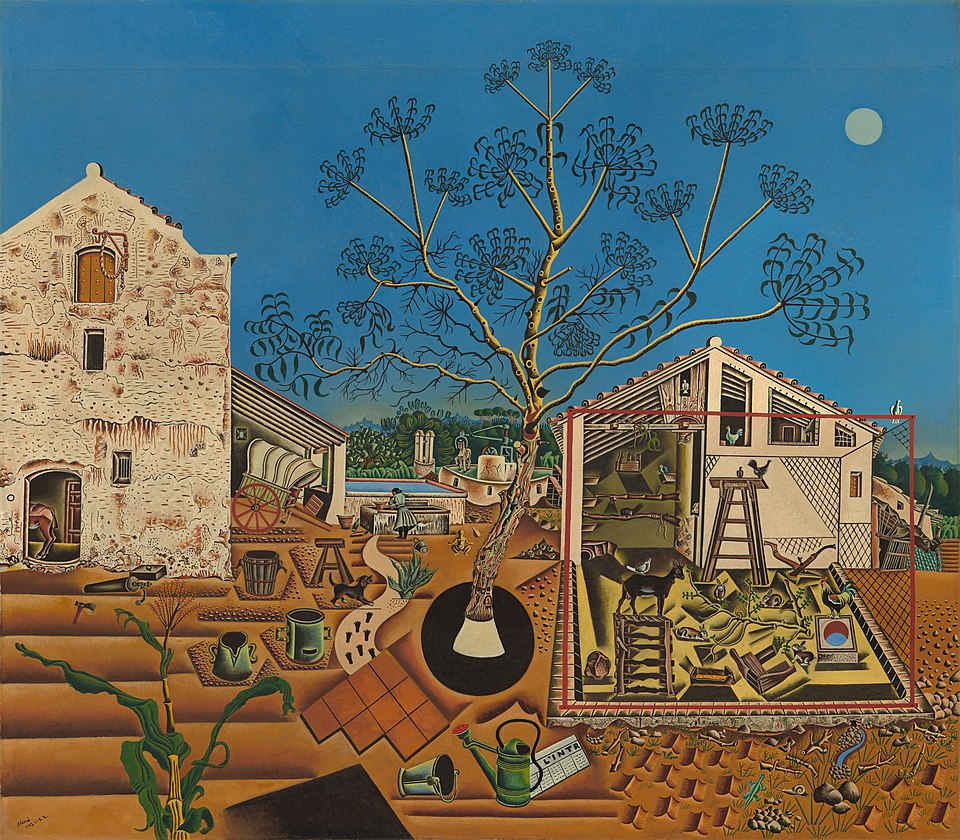
Miró’s early masterpiece, The Farm (1921–22), serves as a biographical snapshot of his life at 29, capturing the essence of his Spanish countryside upbringing and young adult life. This highly detailed precursor to his later Cubist and abstract works was purchased by Ernest Hemingway for 5,000 francs as gift to his wife.

By 2024, Miró’s works continue to command prices that place him among the top 25 most valuable artists worldwide. His Peinture (Étoile Bleue), or Painting (Blue Star), one of his best-known dreamscapes, sold for £23.6 million at a London Sotheby’s auction in 2012, equivalent to $37 million at the time, or approximately $31.5 million in today’s dollars.

Source: Miró by Gaston Diehl, 1979.  Graphic: The Farm (1921–1922), National Gallery of Art, Washington D.C. (Public Domain)
Real Not Real

Have no fear of perfection; you’ll never reach it.” – Dali.

Salvador Dalí was the entertaining, surrealist voice of the masses. His dreamlike spectacle of melting clocks and flamboyant persona captivated popular culture, injecting eccentric brushstrokes into the lives of the disengaged and disinterested. Dalí spoke directly to the public’s fascination with dreams and absurdity, transforming art into a theatrical experience and a giggly poke at the eminent egos on high altars.

Dalí was a 20th-century Spanish artist who drew from influences such as Renaissance art, Impressionism, and Cubism, but by his mid-twenties, he had fully embraced Surrealism. He spent most of his life in Spain, with notable excursions to Paris during the 1920s and 1930s and to the United States during the World War II years. In 1934, he married the love of his life, Gala. Without her, Dalí might never have achieved his fame. She was not just his muse but also his agent and model. A true partner in both his art and life. Together, they rode a rollercoaster of passion and creativity, thrills and dales, until her death in 1982.

Dalí had strong opinions on art, famously critiquing abstract art as “inconsequential.” He once said, “We are all hungry and thirsty for concrete images. Abstract art will have been good for one thing: to restore its exact virginity to figurative art.” He painted images that were real and with context that bordered on the not real, the surreal. For those who believed that modern abstract art had no life, no beauty, no appeal, he provided a bridge back to a coherent emotional foundation with a dreamlike veneer. Incorporating spirituality and innovative perspectives into his dreams and visions of life.

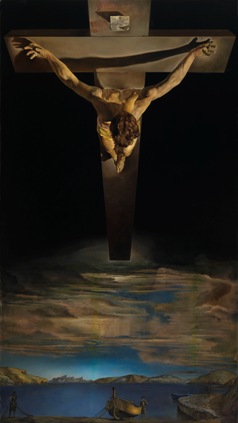
The Persistence of Memory (1931) is Dalí’s most recognizable and famous painting, but his 1951 work Christ of Saint John of the Cross is arguably his most autobiographical and accessible piece. A painting dripping with meaning and perspective, Dalí claimed it came to him in a dream inspired by Saint John of the Cross’s 16th-century sketch of Christ’s crucifixion. The perspective is indirectly informed by Saint John’s vision, while the boat and figures at the bottom reflect influences from La Nain and Velázquez. The triangular shape created by Christ’s body and the cross represents the Holy Trinity, while Christ’s head, a circular nucleus, signifies unity and eternity: “the universe, the Christ!” Dalí ties himself personally to the crucifixion by placing Port Lligat, his home, in the background. He considered this painting a singular and unique piece of existence, one he likely could never reproduce because the part of him that went into the painting was gone forever.That part is shared with his viewers, offering a glimpse into Christ’s pain, Dalí’s anguish, and his compassion: an emotional complexity that transcends mortal comprehension.

Source: Salvador Dali by Robert Descharnes, 1984. Graphic: Christ of Saint John of the Cross, Dali, 1951. Low Res. Copyright Glasgow Corporation.

Swollen Caricatures

Fernando Botero Angulo, 1932-2023, was a Columbian practitioner of figuraism in paint and sculpture, a style where reality is discernable but changed to reflect the artist’s interpretation of his or her world. His unique style has taken on a life of its own and has become known as Boterismo where he exaggerates reality by inflating his objects, mimicking a fat farm on a carbo diet, injecting, according to some, a humor inherent in his plus sized models but it all seems so melodramatic. A melancholic need to explore life’s downsides, forcing the viewer to share not the beauty of life but its complexities and vulnerabilities. There is no happiness in his paintings, just a humorless life.

His style, not far removed from Legar’s Tubism, was the artist’s attempt to find himself and to relieve the self-inflicted anxiety that came from his mode of outward expression not matching his inward vision. He states that “…the moment comes when the painter manages to master the technique and at the same time all of his ideas become clear: at that point his desire to transpose them faithfully onto the canvas becomes so clear and compelling that painting becomes joy itself.”

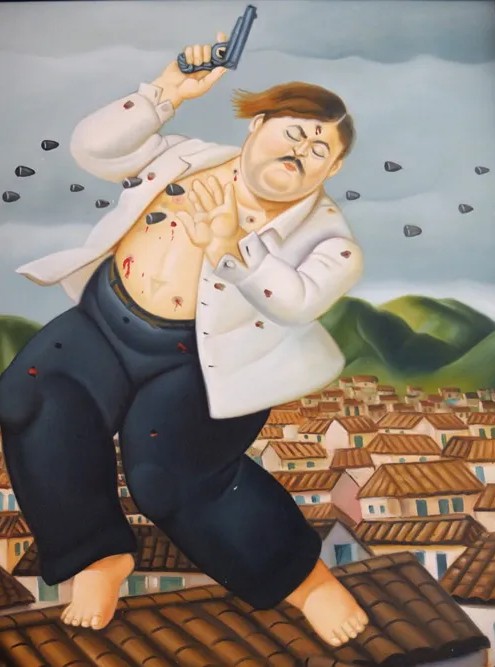
Botero’s 1999 painting, “The Death of Pablo Escobar”, a mafioso interpretation of Chagall’s “Fidler on the Roof”, was an attempt to capture the violence that the drug kingpin brought to Columbia and the world. Standing atop Columbian society, Escobar was laid low by his chosen swordian method of rule: bullets. The artist’s son Juan Carlos Botero states that his father wanted to reflect on the magnitude of the tragedy that Escobar’s actions meant for Columbia, but he also magnified the beast in the man, reminding the world that Columbia and Escobar were once synonymous. A cruel man ruling over a dysfunctional society that he created.

Source: Botero by Rudy Chiappini, 2015. Graphic: The Death of Pablo Escobar by Botero, 1999.

Paris in the Evening

Henri Toulouse-Lautrec, born in 1864, was a unique figure among French nobility and artists. Despite his diminutive stature and aristocratic lineage tracing back to Charlemagne, Lautrec defied conventional expectations with his eccentric, mischievous character, and individualistic style. While influenced by the Impressionists, exemplified by masters like Monet and Degas, he later embraced the Post-Impressionist movement alongside Gauguin and Cézanne, leaving a distinctive mark on the art world. Post-Impressionists diverged from their predecessors by infusing their work with deeper emotion, personal experiences, and greater individualism. Their bold brushwork, exaggerated colors, and unconventional techniques laid the groundwork for the future, anticipating Expressionism.

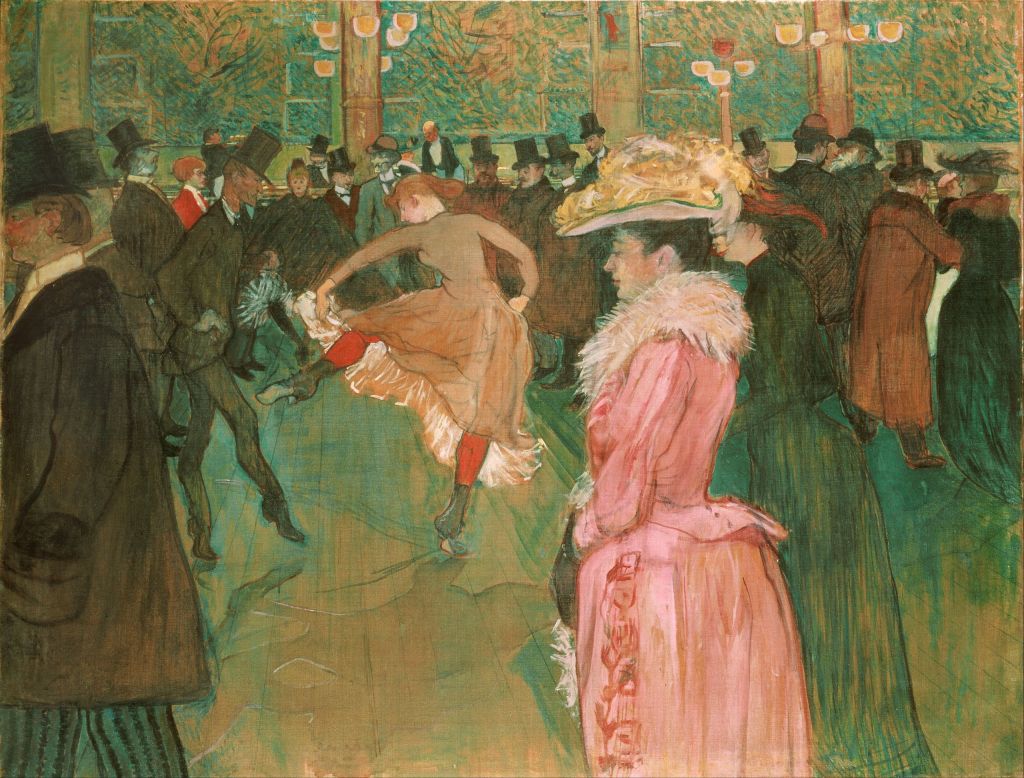
Parisian nightlife was a cornerstone of Lautrec’s art, and At the Moulin Rouge: The Dance stands as his most famous painting, portraying fashionable society and featuring many of his friends and family in a composition of overlapping planes with a perspective that subtly defies reality and logic. The artwork is divided into three distinct planes. The static background features figures such as Lautrec’s father, the poet Yeats, and Jane Avril, a renowned can-can dancer nicknamed “Crazy Jane,” who was both a close friend of Lautrec and a frequent model. In the center, the action unfolds as Valentin le Désossé, a gentleman in a top hat, instructs a cabaret dancer in new steps. The foreground is a detailed study of a contrasting passivity from the central swirl. The viewer’s eye swings between the galloping dancer in earthy tones accented by orange stockings and the quiet, introspective woman in pink.

Lautrec intentionally distorted the painting’s perspective, evident in the mismatched linear lines of the floorboards and fluid, swaying shadows that resemble a confused liquid more than lighting effects. These artistic choices enhance the surreal atmosphere of the scene, amplifying the contrast between the hyper-dynamic dancer and the passive, tranquil surroundings. Through At the Moulin Rouge: The Dance, Lautrec masterfully evokes the opposing vibrant activity and a ‘to be seen’ spirits of Parisian nightlife, providing a vivid outline while inviting viewers to interpret the finer details themselves.

Source: Toulouse-Lautrec by Doughlas Cooper, 1982. Graphic: At the Moulin Rouge: The Dance, Toulouse-Lautrec, 1890. Philadelphia Museum of Art. Public Domain.

Chagall and Expressionism

Art critic Raimond Cogniat described Marc Chagall as an artist of opposites, a painter who thrived in the interplay of form and color, color and meaning. Chagall infused his paintings with love and happiness, crafting worlds that felt both fantastical and deeply alive. He shaped reality from his feelings, “making it conform to his inner spiritual logic,” even if, as he once confessed, he wasn’t entirely conscious of his process.

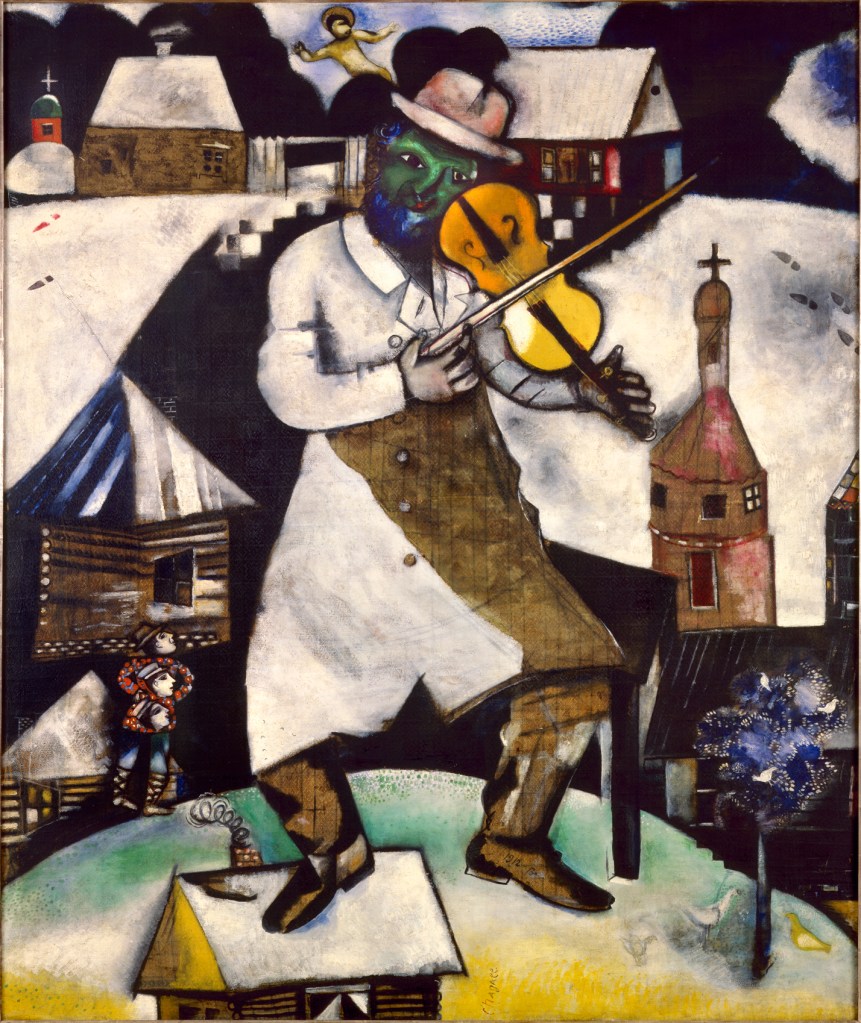
Born Moishe Shagal in 1887 in Vitebsk (now Belarus), Chagall grew up in a Jewish enclave within the Russian Empire. He later embraced France as his adoptive home, blending his Eastern European roots with French artistic flair. Though he briefly explored Cubism during its peak in the early 20th century, he thankfully abandoned that style to carve his own path as an expressionist. Vivid, otherworldly colors, and exaggerated forms defined his style, while his Jewish heritage, evident in depictions of shtetl life, fiddlers, and biblical scenes, remained his anchor. His 1912–1913 painting The Fiddler is said to have inspired the title of the musical Fiddler on the Roof.

In a 1963 speech to an American audience, Chagall reflected on his philosophy: “Any moral crisis is a crisis of color, texture, blood and the elements, of speech, vibration, etc.—the materials with which art, like life, is constructed. Even when mountains of color are piled on a canvas, if one can discern no single object even through great sound and vibration, this will not necessarily give authenticity.” To Chagall, authenticity was more than paint; it demanded the infusion of human experience, blood, and the essence of nature.

Source: Chagall by Raimond Cogniat, translated by Ann Ross, 1977. Graphic: The Fiddler, Chagall, 1912-1913. Public Domain

Light, Color, Sisley

Great art is the interpretation of great beauty. Art without aesthetic is something rawer, more fleeting, an attempt to conjure emotions that challenge the intellect but not necessarily feed the soul. Picasso and Pollock jolted the mind, often with a visceral, nihilistic force. Alfred Sisley, though, honored the soul, developing and refining an impressionistic palette of light and color on landscapes that captured nature’s beauty and humanity’s place in it throughout his career.

Alfred Sisley was born in Paris in 1839 to a prosperous English expatriate family. At 20, in 1859, he left for London to study business, prepping to succeed his aging father, then 58. But over four years there, he skipped lectures, haunting museums instead, captivated by art. Back in Paris by 1862, his parents relented, letting him trade commerce for canvas. Soon after, he met Monet, Renoir, and Bazille, and together they took to painting ‘en plein air’, in the open air, chasing light, color, and atmosphere over precision. From these outings, Impressionism took root.

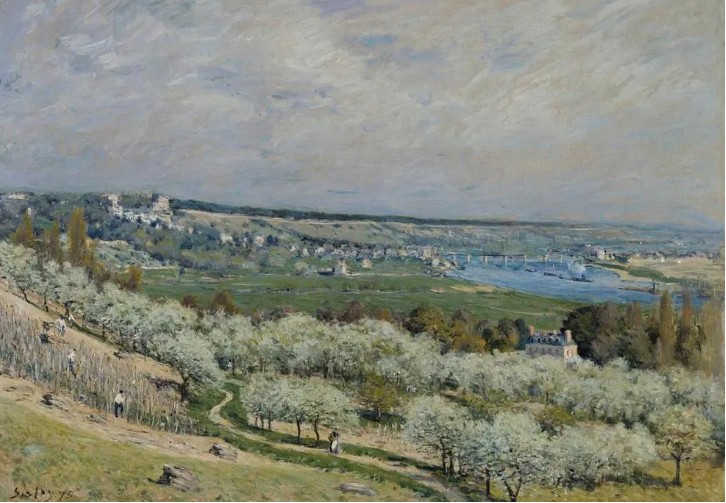
Sisley found inspiration and tranquility in the rural Seine Valley, just tens of miles from Paris, where he painted some of his most enduring landscapes. In The Terrace at Saint-Germain, Spring (1875), near his home, he bathes the valley in a tender, radiant light, blending nature and humanity into a soul-soothing vista. His works, unwavering in their beauty, stand as a testament to art’s power to nourish the spirit, a tribute to life’s grace.

Source: Sisley by Cogniat, translated by Sachs, 1979. Graphic: The Terrace at Saint-Germain, Spring by Sisley, 1875. Walters Art Museum, Baltimore.

Americana

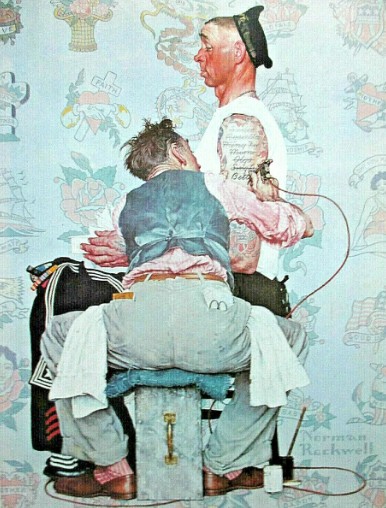
Norman Rockwell, a name synonymous with American Realism, was a master of meticulous detail, yet he never failed to brush a thread of whimsy and rustic existence onto the canvases of his iconic paintings.

Norman Rockwell, an iconic painter of American life, was born on 3 February 1894 into a comfortable New York City family. His father, a lover of Charles Dickens, often sketched illustrations from books, planting early seeds of creativity in young Norman. His mother, overprotective yet proud of her English heritage, spoke often of her artistic but unsuccessful father, whose unrealized dreams seemed to echo in the household. Art wasn’t just a pastime for Rockwell; it pulsed through him, and by age 12, he had resolved to draw for a living, though painting would come later in his journey as an artist.

As a teenager, Rockwell pursued artistic training at the National Academy of Design and later at the Art Students League, where he studied under the influence of Howard Pyle, the renowned illustrator of boys’ adventure tales. Pyle, who had founded the school’s philosophy through his own teachings and legacy, left an indelible mark on Rockwell, shaping his lifelong passion for weaving narrative into art. Before he turned 16, Rockwell landed his first commission—four Christmas cards—a modest start for a boy already dreaming big. By 18, he was painting professionally full-time, his talent unfolding with the quiet determination of youth finding its purpose.

In 1916, Rockwell began his legendary run with The Saturday Evening Post, creating covers that would grace the magazine for the next 47 years. Over that span, 322 of his paintings became what the Post proudly dubbed “the greatest show window in America.” Through these works, Rockwell offered a mirror to the nation—sometimes nostalgic, often tender, always human—reflecting everyday moments that resonated deeply with millions.

While his career soared with the Post, city life never suited him. In 1939, he traded New York’s clamor for the rolling hills of Vermont, and later, in 1953, settled in Massachusetts. These rural landscapes became his muse, dominating his canvases for the first three decades of his career. Rockwell was no haphazard artist; he was methodical, even obsessive, following a rigorous six-step process to bring his visions to life: brainstorming ideas, sketching rough outlines, photographing staged scenes with real people, crafting detailed drawings, experimenting with color studies, and only then committing paint to canvas. Each step was a labor of love, a tip of the hat to the America he loved.

At the heart of his art was a simple, profound drive. As Rockwell himself put it, “Without thinking too much about it in specific terms, I was showing the America I knew and observed to others who might not have noticed.” His paintings weren’t just pictures, they were invitations to see the beauty in the ordinary, the dignity in the overlooked; we see not just an artist, but a storyteller who believed in the quiet goodness of people, brushstroke by brushstroke.

Source: The Norman Rockwell Treasury by Thomas S. Buechner, 1979. Norman Rockwell Museum. Graphic: The Tattooist by Norman Rockwell, 1944, The Brooklyn Museum.

Engraver of Wood:

Gustave Doré, widely regarded as the greatest illustrator of the 19th century, produced meticulous and exquisite works that continue to captivate audiences today, particularly his illustrations for the Bible and Dante’s Divine Comedy. Born, raised, and deceased in France, Doré began his artistic pursuits at the age of six and started illustrating classic literature at twelve using lithography. By nineteen, he embarked on his lifelong mission to illustrate the world’s greatest books, transitioning to woodblock engravings. It is estimated that he created over 10,000 engravings during his lifetime.

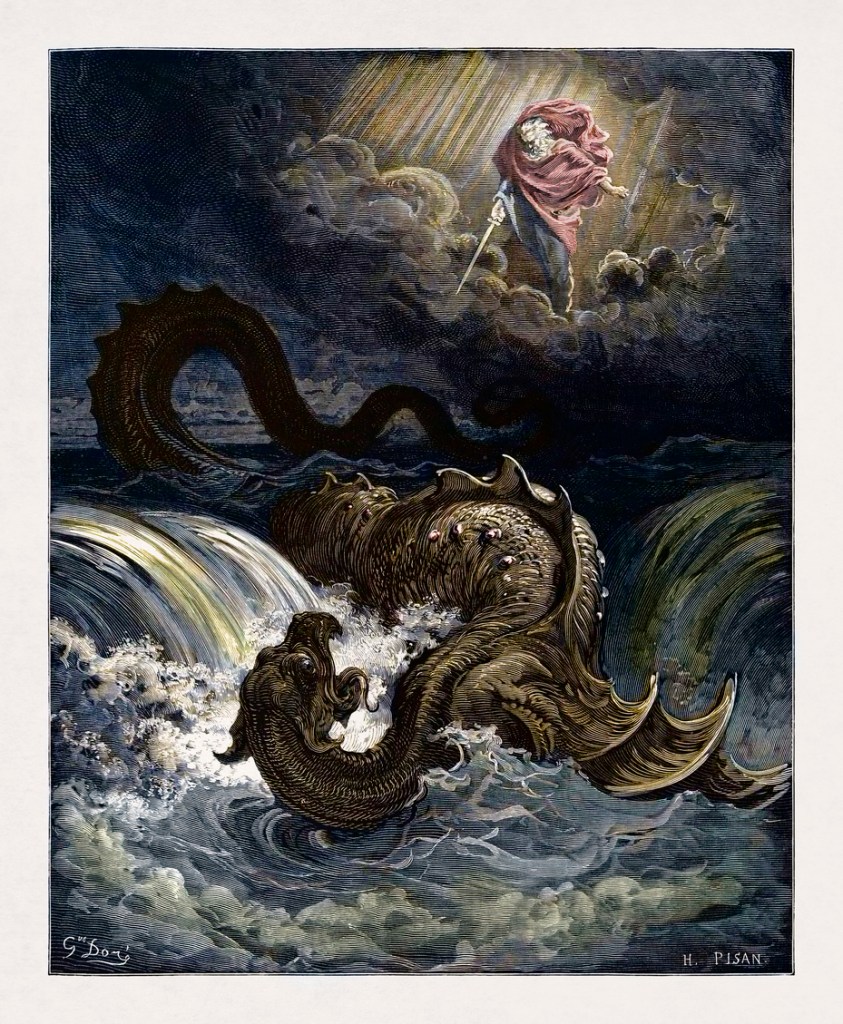
Among his most celebrated works are the engravings for the Vulgate Bible, also known as La Grande Bible de Tours. This collection includes 139 plates depicting scenes from the Old Testament and 81 plates from the New Testament. Featured in the attached graphic is his illustration of Isaiah 27, portraying God (often interpreted as Jesus in Christian theology) slaying Leviathan, symbolizing the ultimate triumph of good over evil.

Source: Gustave Doré Engravings by Alpine Fine Arts, 1995. Graphic: Destruction of Leviathan (Isaiah 27, colorized) by Gustave Doré, 1866, licensed by Gwengoat.

Michelangelo, Medici, and Florence

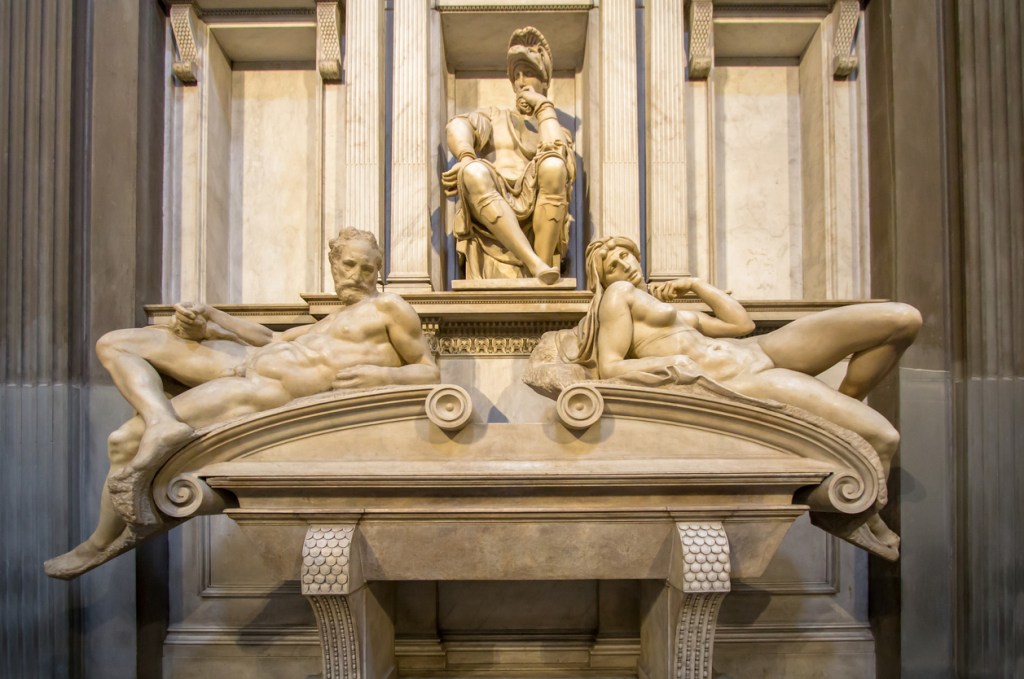
Tomb of Lorenzo II de Medici and below lying on the sarcophagus two sculptures ‘Dawn and Dusk’ in Medici Chapel, Florence, Italy

Florence, the Medici family, and the Renaissance are inextricably linked, forming a vibrant nexus of world-shaping brilliance and energy. After Lorenzo the Magnificent’s death in 1492, Michelangelo emerged as the towering figure of art and beauty during the High Renaissance, spanning the late 15th and early 16th centuries.

Michelangelo’s unparalleled artistic mastery endured for nearly fifty years beyond his death in 1564, yet with the passing of Ferdinando I de’ Medici in 1609, Baroque masters like Caravaggio and Bernini ascended as Europe’s preeminent talents.

Michelangelo navigated a delicate balance with the shifting demands of his Medici patrons, fiercely defending his artistic vision while securing payment, often with friction. The expectations of the Medici popes, Leo X (1513–1521) and Clement VII (1523–1534), frequently clashed—both in timing and creative intent—with his ambitions. This tension, happily, fueled his masterpieces, including the Sistine Chapel ceiling (1508–1512) and the Last Judgment (1536–1541).

The image depicts the Tomb of Lorenzo II de’ Medici, a work Michelangelo sculpted between 1524 and 1531.

Source: The Medici, Michaelangelo…Florence, Essays by Acidini…2002. Graphic: Tomb of Lorenzo II de Medici, Michelangelo, 1524-1531. CAHJKT iStock Photo Licensed.

Painter of the Real

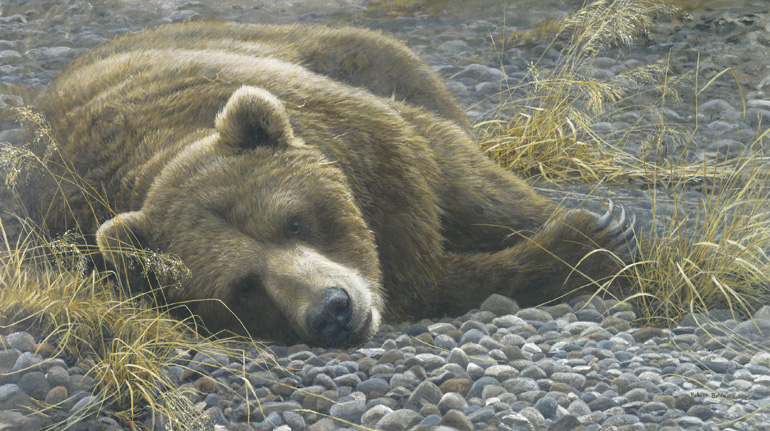
Robert Bateman, a Canadian artist from the school of Realism, paints wildlife with the precision of a photographer, leaving the viewer to ponder reality as it is rather than relying on the interpretation of the man with a brush. Bateman, explaining his motives, says, “I try to portray an animal living its own life independent of man.”

His paintings often place the subject tangentially, guiding the line of sight from the center to an edge where the action occurs. This composition suggests a reality beyond all living things, implying that we are all bit players, regardless of our size.

Bateman’s style is reminiscent of fellow Realist Andrew Wyeth, whom he acknowledges as a significant influence. However, Wyeth never entirely let go of his early impressionistic impulses. Roger Tory Peterson noted that while Wyeth froze his subjects in the moment, Bateman’s “subjects are ready to go somewhere else, to fly away,” allowing the reality of the moment to transition to another point in time, to a different reality.

Edgar Degas, an Impressionist Realist who combined realistic details of life with the softening blur of Impressionism, commented that one of the past masters of Realism, Jean-François Millet, painted so realistically that his work almost destroyed the profession. Wallace Stevens, a 20th-century modernist poet, took a different and somewhat counterintuitive view, stating that Realism is a corruption of reality. He believed that Realism reduced the complexity and beauty of the universe to the literal, leaving no room for the experience of humanity.

Both criticize Realism for its lack of emotion and interpretation, failing to observe that a gift from God is perfect as presented.

Source: The Art of Robert Bateman by Ramsay Derry 1981. Graphic: Grizzly at Rest by Robert Bateman, 2006.