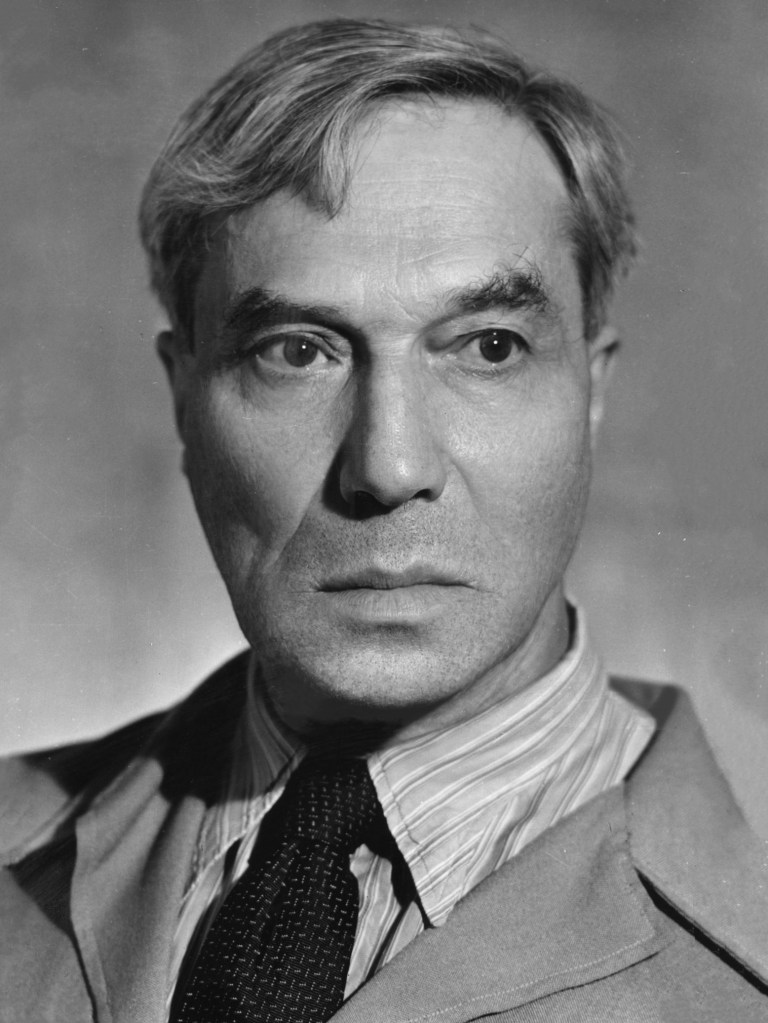
Boris Pasternak (1890–1960), Russian poet and novelist, spent a decade creating his singular opus, Doctor Zhivago, completed in 1956. More than a historical narrative, it is a philosophical cathedral, a novel constructed of haunted Romanticism, moral reckoning, and symbolic renewal. Set against the dissolution of Tsarist Russia and the disillusionment of revolutionary aftermath, the book crosses the bridge from imperial decay into the intoxicating dream of collective transformation, only to watch that dream unravel into a black hole of exile, violence, and starvation.
This arc of collapse recalls the spiritual bargain Thomas Mann dramatizes in Doctor Faustus, but where Mann’s protagonist descends into metaphysical madness, Doctor Zhivago journeys through the quiet but unrelenting erosion of the soul. He does not perish; he endures, but with dimming strength and drive. The rails he rides are not toward damnation but disillusionment. And still, beams of light pierce the fog: rays of love, recollection, and art that suggest the possibility of meaning and rebirth.
As Nikolai Nikolaievich says early in the novel, “the whole of life is symbolic because it is meaningful.” In this way, the prose becomes Pasternak’s metaphorical terrain, thick with fog, fractured history, and spiritual yearning. The appended poetry, by contrast, is a sudden clearing. Here, the truth is not narrated but sung as parables: psalms.
Pasternak stands in conversation with his literary ancestors, not in imitation but in integration. Tolstoy’s presence is unmistakable, the historical sweep as personal crisis, the aching attention to moral choice. But where Tolstoy moves with structural precision, Pasternak drifts with mystical defiance. His narrative resists symmetry. His characters do not seek ideology, they search for grace.
Symbolist in sensibility if not in allegiance, Pasternak paints with metaphysical hues. As Nikolai Nikolaievich reflects, it is not commandments but parables that endure, not doctrine but symbol. Life, for Pasternak, is sacred not by design but because of its trembling unpredictability.
It is no accident that Hamlet opens Zhivago’s verse collection. The parallels run deep: both Hamlet and Zhivago move through time like exiles from history itself, cast adrift in worlds too cruel for their contemplative souls. When Pasternak writes, “I consent to play this part therein,” he evokes both the tragedy and transcendence of bearing witness. Zhivago performs his role, but lives another life, internal, poetic, unreachable: above the fray, but corrupted by the psychosis below.
His poems chart this existential divide: March, an ode to ugliness and beauty; Holy Week, a quiet redemption; Parting, remembrance caught in an unfinished gesture. In Garden of Gethsemane, Pasternak, born Jewish, philosophically Christian, offers the novel’s spiritual heartbeat and epitaph: “To live is to sin, / But light will pierce the Darkness.”
Perhaps nowhere is Pasternak more intentional, and more misunderstood, than in his use of coincidence. Critics have dismissed the improbabilities: chance meetings, reappearances, entwined fates that strain believability. Yet, viewed symbolically, they form a system. These moments are not narrative indulgences; they are metaphysical punctuation marks, appearing when a character risks dissolution and irrelevance, summoning memory, recognition, or spiritual breath.
These recurring events hint at resurrection, not just personal but societal. Pasternak suggests life moves not in straight lines but in spirals and cycles. Coincidence becomes a kind of syntax for recurrence, for unfinished conversations rekindled in new voices. Meaning doesn’t unfold; it echoes amplified.
Again and again, children appear, observers, inheritors, blank slates. In them lies the novel’s quiet eschatology: renewal not through revolution, but through the uncorrupted eye. These youths do not argue ideology. They carry memory unwittingly. They are the future poets whose truths will be elemental and free, like wind through the trees.
If Doctor Zhivago is a Passion, then its resurrection comes not in fire, but in continuity. Not in triumph, but in scattered verses, remembered, revived. Pasternak’s salvation is lived: grace through endurance, beauty through suffering, renewal through remembrance.
Banned in the Soviet Union upon completion, Doctor Zhivago was smuggled to Italy and published in 1957, igniting an international phenomenon. The CIA distributed the book behind the Iron Curtain as a weapon of quiet revolt. Pasternak was awarded the Nobel Prize in 1958, then compelled to decline it under state pressure. And still, by 2003, the novel had found its way into Russian classrooms.
This was not just a novel. It was a voice buried and reborn.
Pasternak’s opus is not a chronicle of a man or an era, but a symbolic landscape of what it means to remain human in the machinery of history. A tale not of revolution’s glory, but of the soul’s refusal to be mechanized. It rejects dogma in favor of parable, certainty in favor of consequence, ideology in favor of grace.
Doctor Zhivago teaches us that life may be coincidence, but not accident. That beauty may falter, but goodness moves quietly. And that sometimes, when all else falls away, it is poetry that remains, whispering its eternal truths into the trembling heart of history.
Source: Dr. Zhivago by Boris Pasternak, 1957. Graphic: Boris Pasternak, 1959. Public Domain.
“Nessun Dorma,” (No One Shall Sleep) an aria by Giacomo Puccini from the final act of his opera Turandot, is performed by an enigmatic tenor prince who seeks the hand of Princess Turandot. The Princess decrees that any suitor must solve three riddles to win her consent for marriage. The unknown prince answers all the riddles correctly, but the Princess still defers. He then proposes a counteroffer: if she can guess his name, she can have him executed, but if she cannot, she must marry him. In response, the Princess commands that none of her subjects shall sleep until they uncover his name.
Puccini’s opera, left incomplete at his death in 1924, offers a unique interpretation of Carlo Gozzi’s 18th-century play of the same name, which, in turn, drew inspiration from a 12th-century Persian fairy tale by Nizami as part of his poem collection titled Haft Peykar. In the fairy tale, a princess sets impossible riddles for her suitors.
Puccini retains three riddles from Nizami’s tale but alters the third one:
What is born each night and dies each dawn? (hope)
What flickers red and warm like a flame, but is not a flame? (blood)
What is like ice but burns? (Princess Turandot)
(Nizami’s original 3rd riddle: What echoes with countless voices, yet has no voice of its own? (a letter))
Source: Grove Book of Operas edited by Stanley Sadie, 2006. Wikipedia. Graphic: Nessun Dorma by Pavarotti, 2023 copyright Warner Classics.
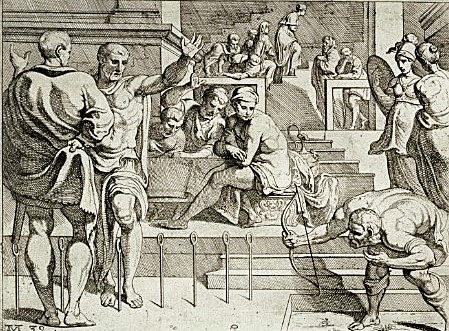
Ulysses upon leaving Troy traveled for 10 years before returning home to his wife Penelope only to find she doesn’t recognize him, and he has a house filled with suitors seeking his wife’s hand in marriage.
To prove he is the rightful husband and king he shoots an arrow through the rings of 12 axe heads. Upon completing the quest, he kills all suitors for his wife’s hand.
An Excerpt from Book 21 of Homer’s Odyssey:
So the great master drew the mighty bow, And drew with ease. One hand aloft display’d The bending horns, and one the string essay’d. From his essaying hand the string, let fly, Twang’d short and sharp like the shrill swallow’s cry. A general horror ran through all the race, Sunk was each heart, and pale was every face, Signs from above ensued: the unfolding sky In lightning burst; Jove thunder’d from on high. Fired at the call of heaven’s almighty Lord, He snatch’d the shaft that glitter’d on the board (Fast by, the rest lay sleeping in the sheath, But soon to fly the messengers of death).
Now sitting as he was, the cord he drew, Through every ringlet levelling his view: Then notch’d the shaft, released, and gave it wing; The whizzing arrow vanished from the string, Sung on direct, and threaded every ring.
Source: Bulfinch’s’ Mythology, 1867. Odyssey by Homer. Graphic: Ulysses by Theodore van Thulden, 1632, Public Domain.
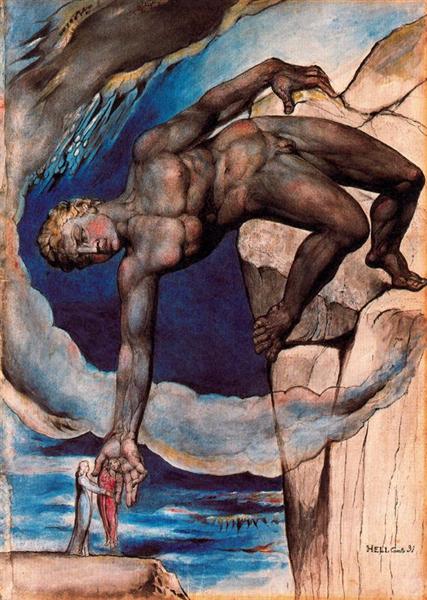
William Blake (1757-1827), in the final years of his life created 102 watercolors and 7 copper plates, most unfinished, for Dante’s ‘The Divine Comedy’. One of the more profound and captivating of these paintings is ‘Antaeus Setting Virgil and Dante into the Ninth Circle of Hell’.
The giant Antaeus, son of Neptune and Gaia, was invincible as long as he remained attached to his mother. Hercules, for his 11th task, had to defeat Antaeus but couldn’t if he touched the Earth, so he lifted him off the ground and strangled him to death.
The Ninth Circle is reserved for the treacherous and is subdivided into 4 rings. The first part is reserved for familial traitors and is named Caina as in Cain and Abel. The second ring, Antenora for Antenora of Troy is for national traitors. Ptolomaea for Ptolemy is the third ring for those who betray their guests. Finally, the inner ring is called Judecca for Judas Iscariot betrayer of Christ and is for the worst traitors: those who turn on their masters. At the center of the Ninth Circle resides Satan.
Finally, as an aside, Dante’s ‘The Divine Comedy’ shouldn’t be interpreted as The Divine Humor, but as The Divine Outcome. The author meant that comedy was the opposite of tragedy. Tragedies begin well and end badly, but Dante’s Comedy begins badly, in Hell, and ends well with Dante reaching his desired destination: Heaven.
Source: Will Blake, The Divine Comedy by David Bindman, 2000. The Divine Comedy by Dante Alighieri, circa 1321. Bulfinch’s Mythology, 1867. Graphic: Antaeus Setting Down Dante and Virgil in the Last Circle of Hell, Blake, 1827, Public Domain.
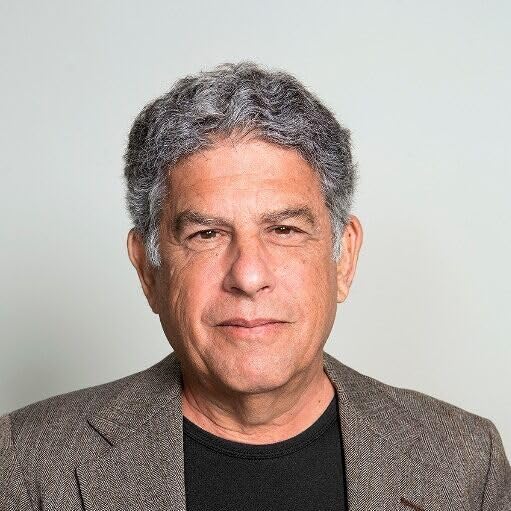
Stephen Mitchell was born in Brooklyn in 1943 (80ish), educated at ‘Ivy League’ schools in the US and France, and, quoting his words, “de-educated through intensive Zen practice“. That may be just a spoonful of humor, it is though a spoonful of humility, and a large serving of Zen-Socratic wisdom. A wisdom that becomes one that reflects upon his life and realizes his education has granted him neither knowledge nor wisdom. He does not say what the Ivy League has instilled in him, but the derivation of any real value from those hallowed halls, as seen from the Zen rear-view mirror, appears minimal.
In an interview with the Los Angeles Times, he ruminates that “If I’m a scholar, I’m an amateur“. A humble observation in the truest form of the personal quest for fulfillment and enlightenment. In the same interview, elaborating on Chuang-tzu in Mitchell’s ‘The Second Book of the Tao‘, he says: “I have no pretensions to scholarship. I just love to play with the Taoist masters. For them, nothing is sacred. The best tribute is contradiction.” Again, humility before all, all before self.
In a separate interview with Scott London also discussing ‘The Second Book of the Tao‘ Mitchell relates the teachings of Chuang-tzu as a philosophy of the unassuming and the simple life. “There was nothing to live up to,” he says. “There was only a passion for the genuine, a fascination with words, and a constant awareness that the ancient Masters are alive and well in the mind that doesn’t know a thing.” Mitchell personifies and lives that philosophy.
Mitchell has translated and authored many books including the bestselling Tao Te Ching, Gilgamesh, The Gospel According to Jesus, and his latest book, The First Christmas released in 2021. He is also the coauthor of three of his wife Byron Katie’s bestselling books: Loving What Is, A Thousand Names for Joy, and A Mind at Home with Itself and numerous children’s books.
The Discovery of the Story of Gilgamesh:
The Epic of Gilgamesh was, in the beginning, a series of Sumerian poems/stories likely passed down through the ages as oral histories before being written down in Akkadian 700-1000 years after the reign of the mythical/historical King of Uruk: Gilgamesh.
Mitchell may have been introduced to the literary stature of Gilgamesh while translating the Austrian mystic poet, Rainer Marie Rilke. Rilke wrote at the end of 1916. “I … consider it to be among the greatest things (the poem Gilgamesh) that can happen to a person. I have immersed myself in [it], and in these truly gigantic fragments I have experienced measures and forms that belong with the supreme works that the conjuring Word has ever produced.”
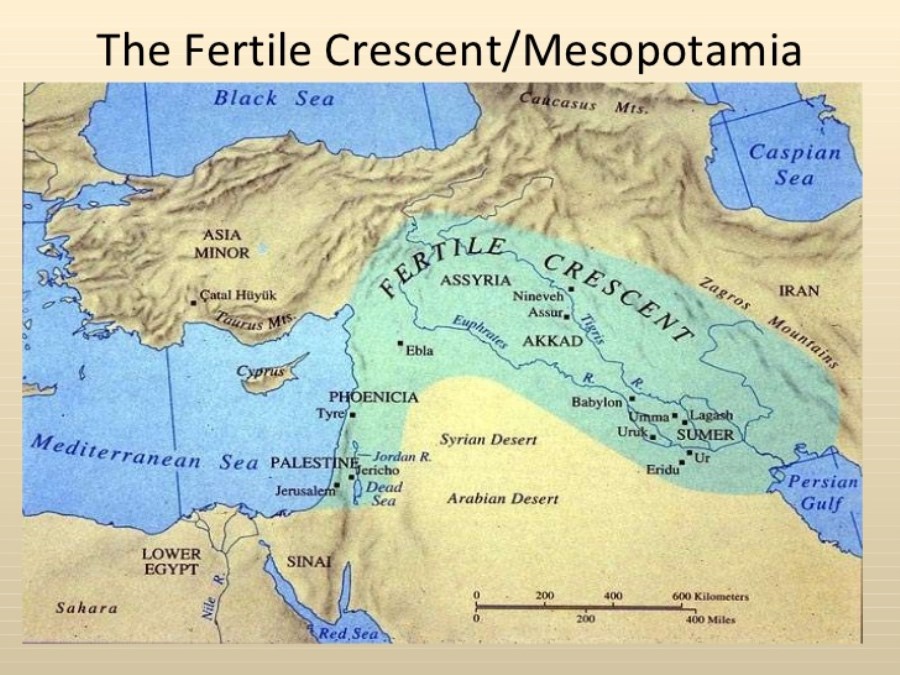
The poem, written in Assaryian cuneiform script, on clay tablets, was discovered by Austen Henry Layard while excavating mounds, beginning in 1844, around what is now known as the city of Mosul. The mounds turned out to be the remains of the ancient Assyrian capital palaces of Nineveh including the library of King Ashurbanipal or Ashur Banipal (668-627 BC) depending on the source. Over 25,000 clay tablets from the library, twelve of which contained the poem, were shipped back to the British Museum. It took until 1872 before the poem was discovered among this immense trove of tablets and in 1872 George Smith translated and published the poem. These twelve tablets contain the fullest version of the poem found to date.
The first surviving version of the combined epic is known as the Old Babylonian version and dates from the 18th century BC. The longer and more complete copy of the poem, from King Ashurbanipal’s library is from the 10th to the 13th centuries BC and is known as the Standard version. Currently seventy-three fragments, possibly more, of the Standard version have been discovered containing some two thousand lines of the original, which is surmised to be three thousand lines long.
Mitchell mainly adapts the Standard version into a contemporary English language poem with gap filler supplied by the Old Babylonian version. Where there is no original material to complete known gaps, Mitchell has contributed original work to provide clarity and to maintain continuity.
The Man of Gilgamesh:
Gilgamesh is accepted as being the 5th king of Uruk, possibly reigning roughly in the 26th century BC (2800-2500 BC) for 126 years. Some believe the long reign of 126 years may actually be a number in base six which would equate to 54 years in base ten. Very little is known of his reign with the exception that he built the walls Uruk, is listed in the Sumerian King list, and is mentioned as a contemporary of Aga, son of King Enmebaragesi of Kish.
Aga, who ruled over Sumer for 625 years, is the antagonist in the Sumerian poem ‘Gilgamesh and Aga‘, recording the King of Kish’s siege of Uruk after Gilgamesh refused to submit to him. From the poem Aga commands Gilgamesh and the citizens of Uruk to work forever as slaves on Kish’s irrigation projects.
There are wells to be finished. There are wells in the land to be finished. There are shallow wells in the land to be completed. There are deep wells and hoisting ropes to be completed
Gilgamesh is made King of Uruk for his defiance and resistance to Aga’s demands. King Gilgamesh captures Aga on the 10th day of the siege but sets him free to return to Kish.
The Land of Gilgamesh:
Uruk was a Sumerian city-state established in the southern reaches of Mesopotamia and was located on the east bank of the Euphrates River. The river today, through the process of river channel migration, is much further to the west. The city and its surrounding area were home to about 40,000-125,000 people, who during the time of Gilgamesh controlled the entire Sumer area.
The Sumerian area and Uruk lay claim to the beginnings of civilization, urbanization, laws, and writing. Cuneiform, wedge shaped writing on clay tablets and the earliest known system of writing, dates to the fourth millennium BC with the oldest examples being inventories of goods stored and transported in and out of the Sumer area.
The oldest known surviving law code, the Code of Ur-Nammu, in the world comes down through the ages from the Sumerian king Ur-Nammu or his son Shulgi of Ur during the last half of 21st century through the beginning of 20th century BC. The Code of Urukagina is older but is known only through references in other ancient writings. The better-known Babylonian Code of Hammurabi is younger and dates from the eighteenth-century BC.
The greatest architectural monument of Uruk was the White Temple built upon the Anu Ziggurat during the fourth millennium. The temple was thirteen meters high and 22.3 x 17.5 meters in depth and width. It stood upon a ziggurat with dimensions of 50 x 46 x 10 meters in depth, width, and height, respectively. On the flat plains surrounding Uruk it was visible in the distance for kilometers.
German archaeological excavations in 2003, conducted in and around the old riverbed of the Euphrates, have reportedly revealed garden enclosures, specific buildings, and structures described in The Epic of Gilgamesh, including Gilgamesh’s tomb. According to The Death of Gilgamesh, he was buried at the bottom of the Euphrates when the waters parted after he died. There is debate whether these excavations and discoveries exist or are a hoax. These discoveries have not been confirmed and no updates from the original can be found but one of the original authors of the 2003 study is Jorg Fassbinder, a geophysical archeologist associated with the University of Munich.
Uruk is also recognized as the city of Erech, founded by Nimrod, great-grandson of Noah, as mentioned in Genesis 10:10:
8And Cush begat Nimrod: he began to be a mighty one in the earth.
9He was a mighty hunter before the LORD: wherefore it is said, Even as Nimrod the mighty hunter before the LORD.
10And the beginning of his kingdom was Babel, and Erech, and Accad, and Calneh, in the land of Shinar.
11Out of that land went forth Asshur, and builded Nineveh, and the city Rehoboth, and Calah
The Legend of Gilgamesh:
Gilgamesh in Sumerian possibly means ‘The Old Man Is a Young Man’ or ‘The Ancestor Was a Hero’. An immortal Hero, a synthesis that brings us to the story and plot of Gilgamesh.
Gilgamesh is the epic hero of the times. Dashing, brave, adventurous; a seeker of immortality and wisdom but not much in the way of kingly benevolence. The gods knowing Gilgamesh lacked wisdom sent him his twin and his opposite: Enkidu. Enkidu became Gilgamesh’s brother and constant companion. Thus begins the quest of Gilgamesh to find himself. It is far more than that, though, as Mitchell explains:
“Part of the fascination of Gilgamesh (the story and person) is that, like any great work of literature, it has much to tell us about ourselves. In giving voice to grief and the fear of death, perhaps more powerfully than any book written after it, in portraying love and vulnerability and the quest for wisdom, it has become a personal testimony for millions of readers in dozens of languages.“
Gilgamesh, as with some of his readers of today, is slow to learn the lessons of life, slow to acquire wisdom even when it is given to him/us for free. From the old Babylonian Version in Book X, Siduri, a wise matron brewer of beer offers Gilgamesh an opiate of advice for his pain brought on through the death of his brother Enkidu.
“Gilgamesh, where are you roaming? You will never find the eternal life that you seek. When the gods created mankind, they also created death, and they held back eternal life for themselves alone. Humans are born, they live, then they die, this is the order that the gods have decreed. But until the end comes, enjoy your life, spend it in happiness, not despair. Savour your food, make each of your days a delight, bathe and anoint yourself, wear bright clothes that are sparkling clean, let music and dancing fill your house, love the child who holds you by the hand, and give your wife pleasure in your embrace. That is the best way for a man to live.”
Gilgamesh declines the advice to live for the day and continues with his quest for immortality.

 elsToday