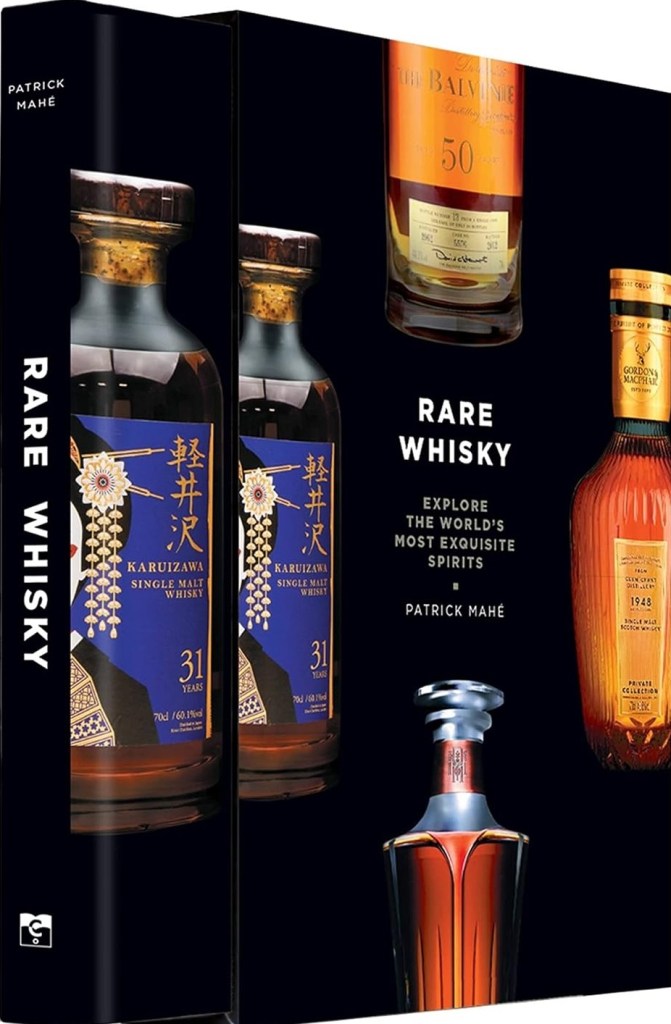
Patrick Mahé’s photographic exposé: “Rare Whisky” is an eye pleasing gallery of friendships deferred. Each exquisitely crafted bottle of distilled spirits awaits patiently to tell a story of ambition, craftsmanship, triumph, and, in many cases, disappearance. Distilleries close, owners pass away, fashions change, and entire eras fade from living memory. Yet these bottles remain.
For most of us, their contents lie forever beyond reach. The market has transformed many of these whiskies from drinks into artifacts of renown and legend. Our role as mere mortals, then, is not to possess them but to remember them: to admire the skill that created them and the generations that patiently brought them to maturity.
If fortune smiles, we may one day taste a dram, perhaps even a drop, of one of these celebrated spirits. Such experiences are rare privileges, connecting the present moment to craftsmen and distilleries long vanished. Yet there exists another class of whisky, one that has crossed the boundary from drink to legend. These bottles have become objects of memory rather than consumption, preserved less for their contents than for what they represent. If not, the stories themselves are enough to remind us that the finest, rarest whiskies, like the finest reputations, are decades in the making. Patience is not an inconvenience but a requirement for discovering the extraordinary among the ordinary.
They are traded at Sotheby’s and Christie’s like fine art. To open one no longer satisfies a desire to indulge a whim of fancy and curiosity but to erase a creative fragment of history. Few would undertake such a destructive act lightly. Such bottles are viewed with admiration as works of craftsmanship and endurance, preserved in the same spirit that protects a manuscript, a painting, or a relic of another age.
Many of the distilleries have changed beyond recognition. The men and women who distilled, blended, barreled, and stored these whiskies are gone. Their names have largely disappeared from history. What remains is a bottle of remembrance, a memorial to men and craft; grain and wood; time and patience.
With that in mind, the following is a toast to the legends of the past, whose surviving bottles remain as memorials in glass, preserving the memory of vanished distilleries, forgotten craftsmen, and the quiet alchemy of grain, wood, and time. Much as music enthusiasts treasure books devoted to album art and recording history, whiskey lovers are drawn to the stories behind the bottle. The spirit is only the beginning. What follows are tales of distillers, artists, statesmen, actors, musicians, collectors, and the cultures they helped shape, revealing the extraordinary lives and histories that have gathered around a simple glass of whiskey.
In 1926, at Easter Elchies on the River Spey near Craigellachie, cask 263 was filled with new-make Macallan spirit and left to mature. Sixty years later, in 1986, only forty bottles emerged, the rest surrendered to the Angel’s Share. The whisky, later known as Macallan Valerio Adami 1926, arrived at a Sotheby’s London auction in 2023 and realized a then-record £2,187,500 (about US$2.7 million). A century after the cask was filled, another bottle from that same legendary release changed hands for US$2.81 million, proof that rarity, like whisky, matures with age.
The Valerio Adami label is among the most coveted by collectors, yet the Michael Dillon version occupies an even rarer place. Its label bears a hand-painted image of Easter Elchies House, transforming the bottle itself into a unique work of art and a tribute to its birthplace.
To carry the Macallan name into the realm of pop culture, the 2012 James Bond movie Skyfall, introduced the cinematic universe to the world of the sophisticated Macallan 1962 50 year old Fine & Rare vintage. In a scene with Silva (Javier Bardem) places a shot glass on Sévérine’s (Bérénice Marlohe) head and tells Bond, using an antique pistole, to shoot the glass. Silva says to Bond, “50-year-old Macallan. A particular favorite of yours, I understand…” Bond after extracting himself from this impossible situation picks up a shot glass of the whisky, downs it and quips, “Waste of good Scotch.”
The vintage year 1962 was chosen deliberately because it was the year Dr. No, the first James Bond film, was released. The “50-year-old Macallan” was a nod to the 50th anniversary of the Bond franchise. Current pricing of 1962 ranges from $50-70,000 per bottle. In that sense, the bottle honors two forms of maturation: the aging of exceptional whisky and the enduring legacy of cinema’s most celebrated secret agent.
Moving on, Winston Churchill, an amateur painter, was thoroughly devoted to his favorite scotch: Johnny Walker Black and painted a still life with the Churchillian understated name: “Jug with Bottles” which fetched $1.3 million at a Southeby auction in 2020. Churchill is said to have begun many mornings with Johnnie Walker and soda, fighting a world-changing war with a whisky that would become one of the most recognizable brands on earth. Unlike the rare Macallans that vanish into private collections, Johnnie Walker built its legacy not through scarcity but through ubiquity, becoming a companion to ordinary drinkers, statesmen, and celebrities alike. Those ordinary drinkers, unlike collectors, seldom concern themselves with preserving an investment. Their whisky is poured, shared, diluted with ice, water or, if the mood strikes, mixed with soda. The purpose is enjoyment rather than preservation.
From the realm of legend we move to the realm of living mythology. Jack Daniels Old No. 7 sour mash has made an indelible mark in the various scenes of bad boys in pop music beginning with Frank Sinatra.
Sinatra loved his Jack Daniel’s and began drinking it in the late 1940s and famously referred to it as “the nectar of the gods.” He kept a glass of it on stage during performances, carried it on his private jet, and ultimately, was buried with a bottle. Many historians of the brand credit Sinatra with helping transform Jack Daniel’s from a small regional whiskey into a nationally recognized icon.
Sinatra lit the fuse. What followed was a cultural cascade. Jack Daniel’s crossed from the worlds of Hollywood and nightlife into the mythology of rock and roll. By the 1960s and 1970s, photographs of musicians with a bottle of Jack Daniel’s had become almost a genre unto themselves. The brand became associated with Jimmy Page, Keith Richards, Mick Jagger, Tom Petty, Slash, and countless others. More than a whiskey, Jack Daniel’s became a symbol of rebellion, touring, excess, and authenticity. For a generation of musicians and fans alike, the square black label was as recognizable as many album covers.
The Rat Pack, of which Sinatra was the undisputed leader, transformed drinking into a form of performance. Sinatra’s devotion to Jack Daniel’s became part of his public persona, while Dean Martin’s ever-present martini glass became inseparable from the character he cultivated on stage and screen. Whether the glass contained martinis as often as audiences imagined mattered less than the image itself.
Their playful approach to spirits produced one of their most famous exchanges. Sinatra told Dean, “I want to talk to you about your drinking.” Dean replied, “What happened? Did I miss a round?”
In the hands of entertainers, whiskey ceased to be merely a drink. It became a prop, a symbol, and ultimately a piece of popular culture. Scotland may have perfected the spirit, but America turned it into folklore.
If Scotland gave whisky its traditions, America gave it new legends.
Source: Rare Whisky: Explore the World’s Most Exquisite Spirits by Patrick Mahe. 2021.

