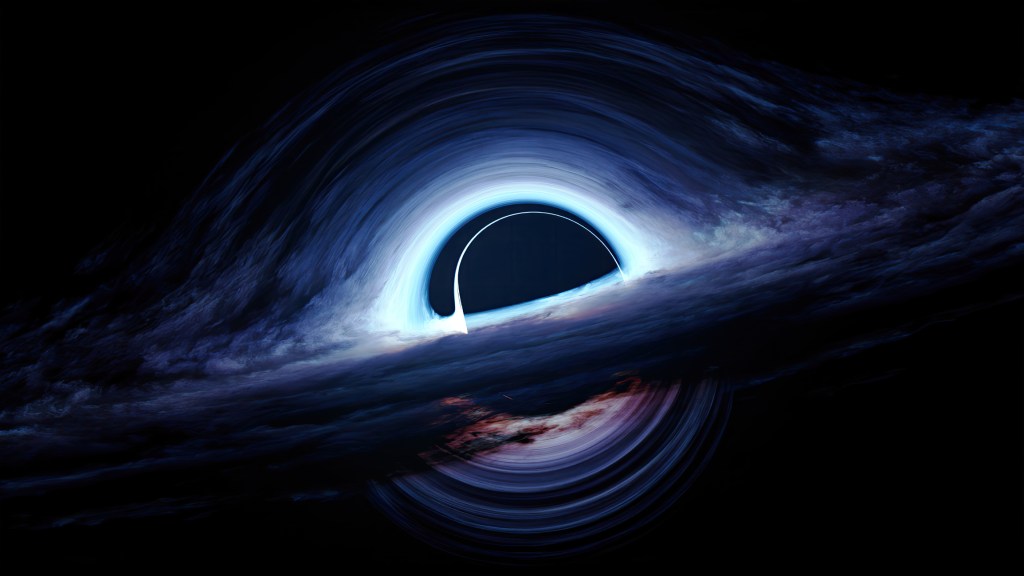
White holes, theoretical counterparts to black holes, might be two sides of a cosmic coin. Black holes devour matter with relentless gravity; white holes expel it, hurling energy, particles, and possibly time into the universe. Both stem from Einstein’s general relativity, which predicts black holes, proven by solid evidence, while white holes remain elusive, perhaps lurking beyond our Earthly senses.
To see their link, rethink black holes’ strangest feature and flaw: the singularity. General relativity paints it as a point where spacetime crushes so tight that physics breaks, a bug, not a feature. Exotic matter, with odd traits like negative energy, was once the fix. But the University of Barcelona’s Pablo Bueno and team ditched it, tweaking gravity with higher-curvature corrections to erase singularities. This needs extra dimensions beyond our four, turning black holes from traps into dynamic zones.
The University of Sheffield adds a twist: the event horizon isn’t sharp. Quantum gravity blurs it into a fuzzy gateway where spacetime bends, not breaks. In 4D, black holes are sinkholes, matter vanishes. In higher dimensions, it slips through, heading elsewhere. Sheffield’s take ties this to dark energy, the universe’s expansion driver. Here, it’s the power plant: quantum fluctuations, fueled by dark energy, replace the singularity with a bounce, flipping spacetime to a white hole.
Enter white holes, Janus-like transitions, Roman god of gates and duality. Black holes vacuum everything; white holes, linked via higher dimensions, spit it out, maybe far off. Picture Sagittarius A*, the Milky Way’s core black hole, channeling matter 25,000 light-years to the Orion Nebula’s arm. Unseen, white holes might hide in dimensions we can’t touch.
This hints at a cosmic cycle, like Earth’s water cycle: evaporate, rain, repeat. Black holes swallow, dark energy and quantum gravity bounce it through higher dimensions, and white holes release it back. Barcelona and Sheffield suggest no endpoints, just a recycling of cosmic raw materials across realms we’re barely capable of understanding.
Source: Black Hole Singularity, Gielen and Menendez-Pidal, University of Sheffield, 2025. Regular Black Holes…by Bueno, P. et al, Physics Letter B, February 2025. Graphic: Black Hole Rendering.
 elsToday