“Life is never made unbearable by circumstances, but only by lack of meaning and purpose.” — Viktor Frankl, Holocaust survivor and psychiatrist
For centuries, we’ve assumed consciousness resides in the brain. Yet, despite decades of slicing, mapping, and probing, its precise location remains elusive. Dr. Wilder Penfield, a neurosurgeon who charted the brain’s sensory and motor regions in the mid-20th century, wrestled with what we might call “self and memory.” While he pinpointed areas tied to movement and sensation, he couldn’t locate the “seat” of consciousness. By the 1960s, this led him to a bold hypothesis: the mind might not be fully reducible to brain activity. In his view, brain and mind could be distinct, with the mind perhaps holding a non-physical dimension—a whisper of something beyond neurons and synapses.
Fast forward to today, and researchers like Michael Levin at Tufts University are pushing this question further, though differently. Levin doesn’t dismiss the brain’s role in consciousness but argues cognition isn’t confined there. He proposes that intelligence and goal-directed behavior arise across the body’s cells and tissues. The brain, in this model, acts as a hub for processing and storing information—not the sole architect of the mind. Levin’s team explores how systems beyond the brain—from cellular networks to synthetic constructs—display mind-like traits: agency, problem-solving, and the pursuit of goals.
At the heart of Levin’s work is bioelectricity, the electrical signaling that guides cells from the zygote’s first spark to a fully formed organism. He sees it as a blueprint, directing how cells collaborate toward a larger purpose, much like ants hauling food to their colony. Each contributes to a collective intelligence, shaped by bioelectric cues that drive development and behavior. Levin stays rooted in empirical science, mapping the “how” without chasing the “why”—hinting at a distributed mind but avoiding a single source or controller.
Could memory bridge consciousness to the self, and perhaps beyond? For Penfield, electrical jolts to the brain summoned vivid past moments—smells, voices—yet the “I” reliving them remained elusive, suggesting a unity beyond the physical. Levin offers a twist: if memory isn’t just locked in the brain but woven into the body’s bioelectric web, consciousness and self might emerge together, shared across every cell. Each recalls its role, its history, to pursue a shared aim—like ants rebuilding their hill. Memory, then, isn’t merely a record but the thread weaving awareness into identity, maybe even purpose. Yet, does bioelectricity simply reflect life’s mechanics, a benign dance of physics and biology? Or does it hint at a deeper force—a directionality we’ve long named “lifeforce” or “soul”? Levin’s inductive lens echoes Descartes’ “I think, therefore I am”—proving existence through awareness but leaving purpose a shadow on the horizon. Science maps the signals; their origin remains unanswered.
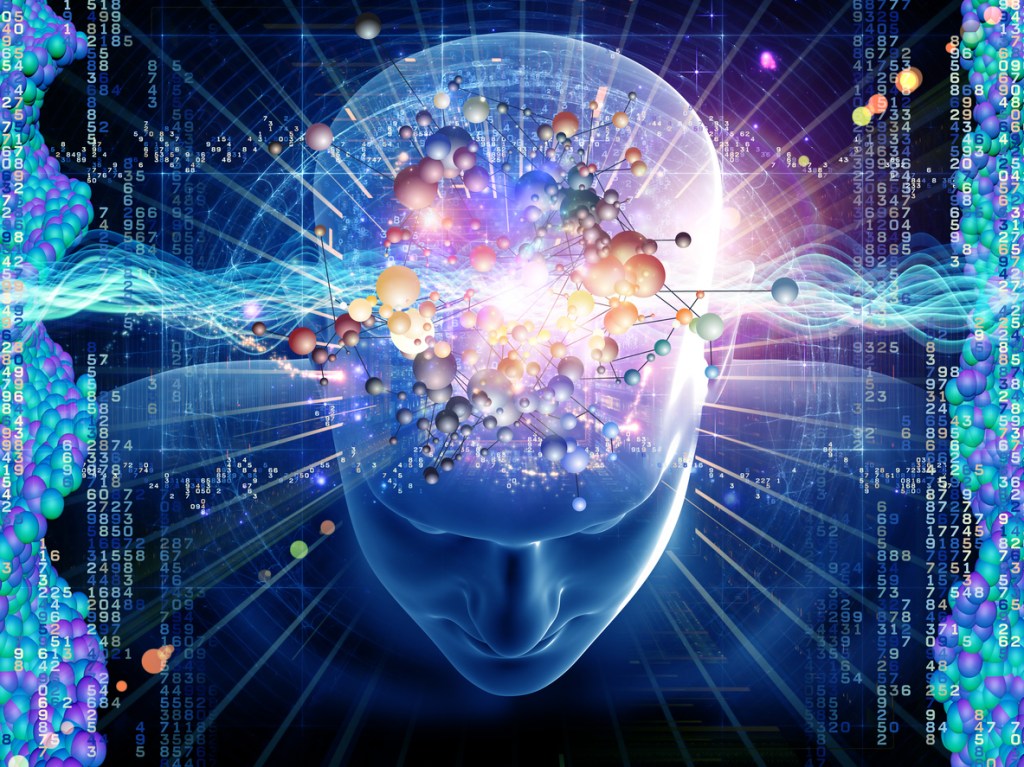
Sources: Technological Approach to Mind Everywhere… by Levin and Resnik, 2025, OSF Preprints; Ingressing Minds… by Michael Levin, 2025, PsyArXiv Preprints. Graphic: Molecular Thoughts by Agsandrew, iStock, Licensed.
 elsToday