Ultra-high-energy cosmic rays (UHECRs) are the universe’s most energetic particles, with energies exceeding 100 quintillion electronvolts (100 EeV)—far beyond anything we can replicate on Earth. First observed over 60 years ago, these particles have puzzled scientists with their immense power and a curious pattern: their energy correlates closely with their electric charge. But where do they come from?
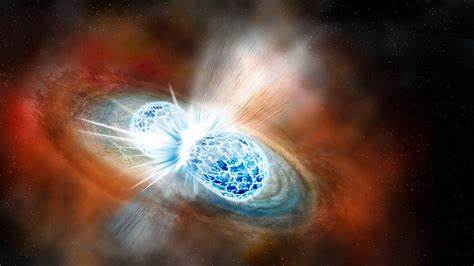
A new theory by physicist Glennys Farrar from New York University offers an answer. She proposes that UHECRs originate in binary neutron star (BNS) mergers—explosive collisions that form a black hole. These events unleash powerful jets of material, acting as cosmic particle accelerators that boost particles to unimaginable energies. The idea links UHECRs’ narrow energy range and charge correlation to a range of combined neutron star mass sufficient to form a black hole.
The theory suggests that the highest-energy UHECRs—those above 100 EeV—could be heavy elements like gold, platinum, or uranium, forged in extreme cosmic events such as supernovae or neutron star collapses (stars can only create elements up to iron through fusion). By tying UHECRs to BNS mergers, Farrar’s work could reveal how precious elements form and deepen our understanding of cosmic cataclysms.
Source: Binary Neutron Star Mergers… by Glennys R. Farrar, Physical Review Letters, 28 February 2025. Graphic: Two Neutron Stars Merging by Universe Today.
 elsToday
Wonderful post 🌅🌅
LikeLike