The Divine Comedy:

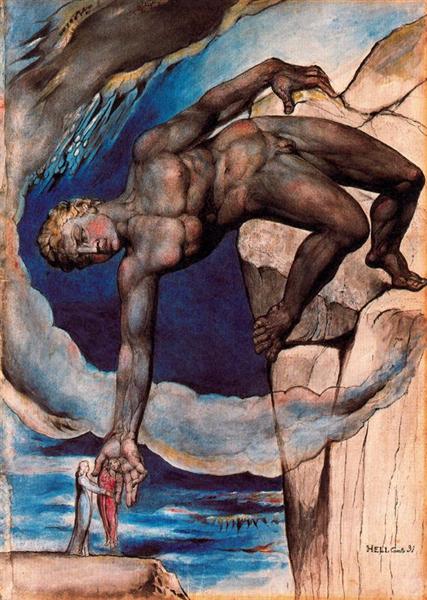
William Blake (1757-1827), in the final years of his life created 102 watercolors and 7 copper plates, most unfinished, for Dante’s ‘The Divine Comedy’. One of the more profound and captivating of these paintings is ‘Antaeus Setting Virgil and Dante into the Ninth Circle of Hell’.

The giant Antaeus, son of Neptune and Gaia, was invincible as long as he remained attached to his mother. Hercules, for his 11th task, had to defeat Antaeus but couldn’t if he touched the Earth, so he lifted him off the ground and strangled him to death.

The Ninth Circle is reserved for the treacherous and is subdivided into 4 rings. The first part is reserved for familial traitors and is named Caina as in Cain and Abel. The second ring, Antenora for Antenora of Troy is for national traitors. Ptolomaea for Ptolemy is the third ring for those who betray their guests. Finally, the inner ring is called Judecca for Judas Iscariot betrayer of Christ and is for the worst traitors: those who turn on their masters. At the center of the Ninth Circle resides Satan.

Finally, as an aside, Dante’s ‘The Divine Comedy’ shouldn’t be interpreted as The Divine Humor, but as The Divine Outcome. The author meant that comedy was the opposite of tragedy. Tragedies begin well and end badly, but Dante’s Comedy begins badly, in Hell, and ends well with Dante reaching his desired destination: Heaven.

Source: Will Blake, The Divine Comedy by David Bindman, 2000. The Divine Comedy by Dante Alighieri, circa 1321. Bulfinch’s Mythology, 1867. Graphic: Antaeus Setting Down Dante and Virgil in the Last Circle of Hell, Blake, 1827, Public Domain.

Journalism – Tom Kummer

Swiss journalist Tom Kummer published fabricated interviews from the rich and famous from 1995-1999. The subjects of the interviews included the personalities Tom Hanks, Bruce Willis, Ivana Trump, and many others; none of which he had actually met much less interviewed. All the interviews were conversations with himself in the privacy of his own apartment. He labeled his style as borderline journalism which some call by the oxymoronic phrase: interpretative journalism.

Mandy De Waal in a story about Kummer for the Daily Maverick states, ‘Kummer’s face-to-face interviews with mega-stars like Sharon Stone, Sean Penn, Kim Basinger and Christina Ricci were revelatory to the point of being almost too good to be true. When Tyson told Kummer he had eaten cockroaches in prison as a source of protein it was beyond sensational – it was unbelievable. That was because Kummer had made that all up… Kummer’s celebrity interviews were nothing more than the product of his imagination and he was nothing more than a lying fake who had never even met any of those celebrities.’

Source:  Tom Kummer by Mandy De Waal 2011, Daily Maverick. Graphic: Photo of Tom Kummer by Christian Werner, 2021.

A Riddle

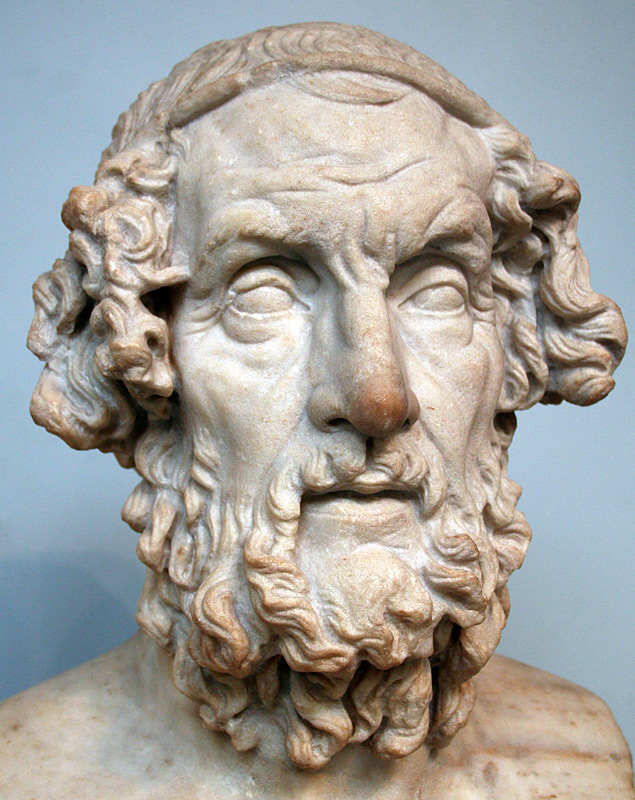
Homer is said to have died of grief or maybe shame when he was unable to solve the riddle posed below by some small children:

‘What do you leave behind if you know you have it and what do you take with you if don’t know you have it?’

Lice.

Almost nothing is known about Homer, including his existance, making everything said about him to be either myth, allegorical, or just made up out of whole cloth.

Source: Bulfinch’s Mythology, 1991 – 1st published 1855. Graphic: Bust of Homer, British Museum, Public Domain

Vengeance

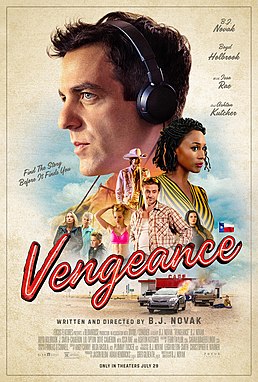
A New York writer’s hookup girlfriend dies, possibly murdered, and he is emotionally coerced into attending her funeral in the sticks of Texas, followed up by a less than enthusiastic investigation of her death.

A film that clicks on all cylinders, screenplay, acting, directing, and social commentary of all things—too bad it died at the box office. It really is a great movie to watch if for no other reason than to see and hear the philosophy of Ashton Kutcher.Theaters: 29 July 2022

Streaming: 16 September 2022

Runtime: 107 minutes

Genre:  Comedy — Crime – Mystery — Thriller

ElsBob:  7.0/10

IMDB:  6.8/10

Rotten Tomatoes Critics:  82/100

Rotten Tomatoes Audience:  86/100

Metacritic Metascore:  65/100

Metacritic User Score:  6.4/10

Directed by: B.J. Novak

Screenplay by: B.J. Novak

Music by:  Finneas O’Connell

Cast: B.J. Novak, Boyd Holbrook, J. Smith-Cameron, Ashton Kutcher

Film Locations:  New Mexico

Budget: $22 million

Box Office: $4.4 million

Source: IMDb. Rotten Tomatoes. Metacritic. Graphic: Vengeance Movie Poster 2022, Focus Features copyright.

Taylor Fladgate 2017

Port from Douro, Portugal

Purchase Price: $109.99

Robert Parker 98-100, James Suckling 99, Wine Spectator 97, Wine Enthusiast 97, Wine & Spirits 96, ElsBob 98

ABV 20%

A very complex purple late-bottled vintage port with aromas of black fruits, earth, and chocolate. A full body wine with a medium sweetness perfect for dessert cakes, chocolates, or mild cheeses.

A classic port that will keep for decades. It probably would have been best if I had waited until 2027-2035 before opening…oh well.

Slash

Slash’s 2nd solo studio album, Orgy of the Damned, a rockin’ blues compilation released in May of 2024, is his best effort since GNR’s 1987 release ‘Appetite for Destruction’.

Following closely in the concept album footsteps of Carlos Santana’s ‘Supernatural and Shaman’, the album contains 11 standards and covers written by a who’s who list of American bluesmen including Robert Johnson (‘Crossroads’), Aaron Walker (‘Stormy Monday’), and Chester Burnett (‘Killing Floor’) plus a new instrumental, ‘Metal Chestnut’ written by Slash.

Slash assembled some of rock’s great guitarists and vocalists to accompany him on the album including Billy Gibbons (ZZ Top), Brian Johnson (AC/DC), Steven Tyler (Aerosmith), Chris Robinson (Black Crowes), and blues vocalist Beth Hart.

Slash, with little memorable musical output since GNR, may have finally found his solo groove sans Axl.

Source: ALLMUSIC.com Graphic: Slash: ‘Orgy of the Damned’ albumcover, 2024, copyright: Gibson.

No Free Lunch

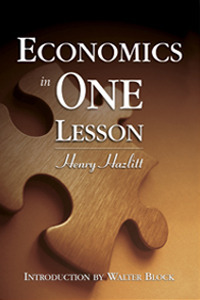
Henry Hazlitt in 1946 published one of the greatest books on economics ever written: ‘Economics in One Lesson’. It’s concise, lucid, factual, and in respect to deductive reasoning on par with Fredrich Hayek’s ‘The Road to Serfdom’ and Adam Smith’s ‘The Wealth of Nations’.

Hazlitt, like Hayek, was a student of the Austrian school of economics which advocated for minimal government intervention, was against central planning, and believed in gold-standard like currencies.

Hazlitt sums up his short book in one sentence, ‘The art of economics consists in looking not merely at the immediate but at the longer effects of any act or policy; it consists in tracing the consequences of that policy not merely for one group but for all groups.’ What’s good for the gander is likely not good for the goose.

He expands this thought by showing that economics is about tradeoffs and choices or to simplify it further, when it comes to government spending there is no free lunch. Spending money on guns means less money spent on butter. When President Johnson, in the 1960s after the book was written, tried to spend money on both guns and butter we received inflation. When our current politicians spent unlimited amounts of money on everything imaginable, we received inflation.

History may not repeat itself, but it rhymes.

Source: Economics in One Lesson by Henry Hazlitt, 1946. Graphic: Economics in One Lesson, Hardcover, 2008 Edition, public domain.

Journalism – Scott Thomas Beauchamp

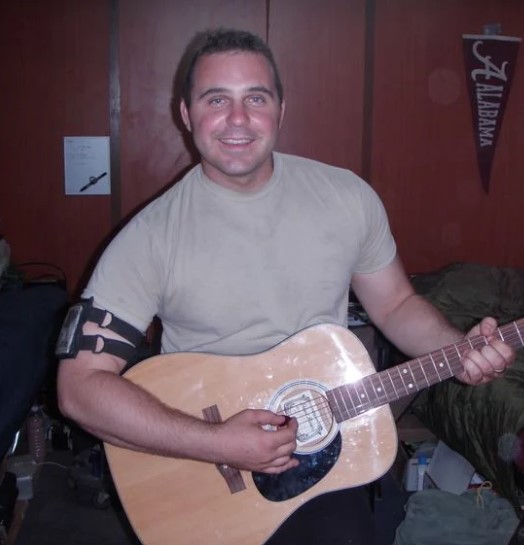
In 2007 The New Republic published three articles by an American Army private, Scott Thomas Beauchamp serving in Iraq titled “Shock Troops”, detailing misdeeds and possible war crimes occurring in and near his forward operating base, Falcon, in Bagdad. The articles were, in part, fact checked by The New Republic Fact-Checker Elspeth Reeve who was also Private Beauchamp’s wife.

Beauchamp claimed that army personnel found mass graves that contained children, and targeted wild dogs for fun, and Beauchamp horribly insulted a woman disfigured by an IED.

The US Army and other news outlets could find no collaboration or substantiation for the events described by Beauchamp. In late 2007 The New Republic stated that they could no longer stand by Beauchamp’s stories.

Reeve is currently a correspondent for CNN. There is no information on the current activities or whereabouts of Beauchamp.

Source:  Fog of War, The New Republic.  Alchetron, 2024. Graphic: Beauchamp by Alchetron, copyright unknown.

Mesopotamian Life After Death

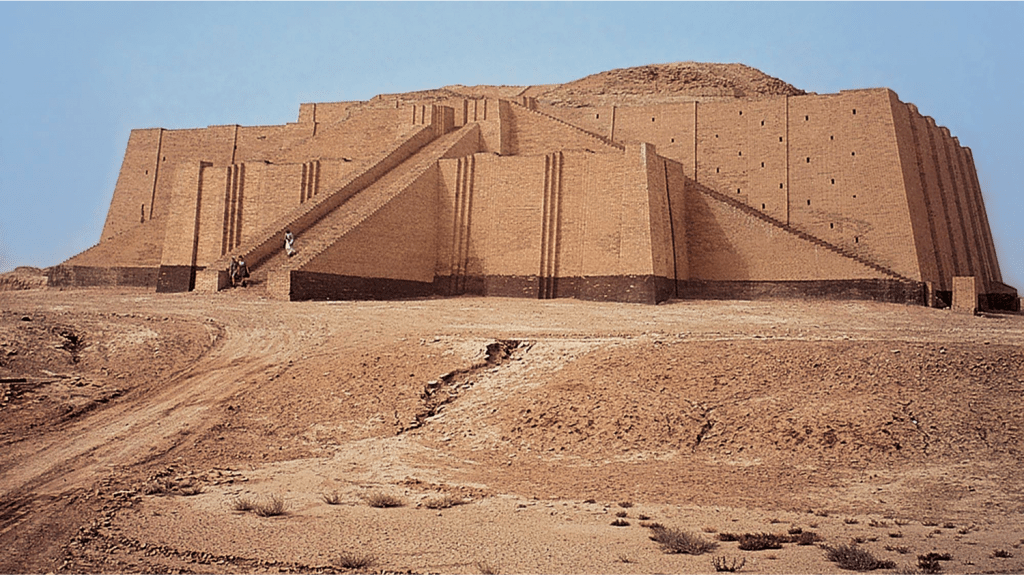
Five thousand years ago, Sumerians and Akkadians, occupying what is now southern and central Iraq, respectively, believed souls or spirits after death occupied a subterranean world called Kur or Irkalla.

All those who entered this underworld could not leave but it was not hell or heaven but more of a place to exist after death; as a ghost of your past.

There is no record that Mesopotamians in 3000 BC believed in reincarnation, resurrection, or any form or transmigration of the soul.

With many exceptions, the spirit or ghost that existed in the netherworld maintained the social status that they had when alive. Thus, kings were still kings, slaves were still slaves.

In the Epic of Gilgamesh, he and his friend Enkidu ventured into this underworld to retrieve their lost magical objects and to seek immortality. They did not find the magical objects, but they did find the Plant of Immortality but promptly lost it to a serpent, learning one of the earliest lessons for humanity: never entrust your life to a snake.

Source: Epic of Gilgamesh. Mesopotamian Beliefs by Chaksi, 2014, World History. The Afterlife by Enlightenment Journey. Graphic: Ziggurat of Ur, 21st century BC, dedicated to the Moon god Nanna.

A Deadly Political Duel

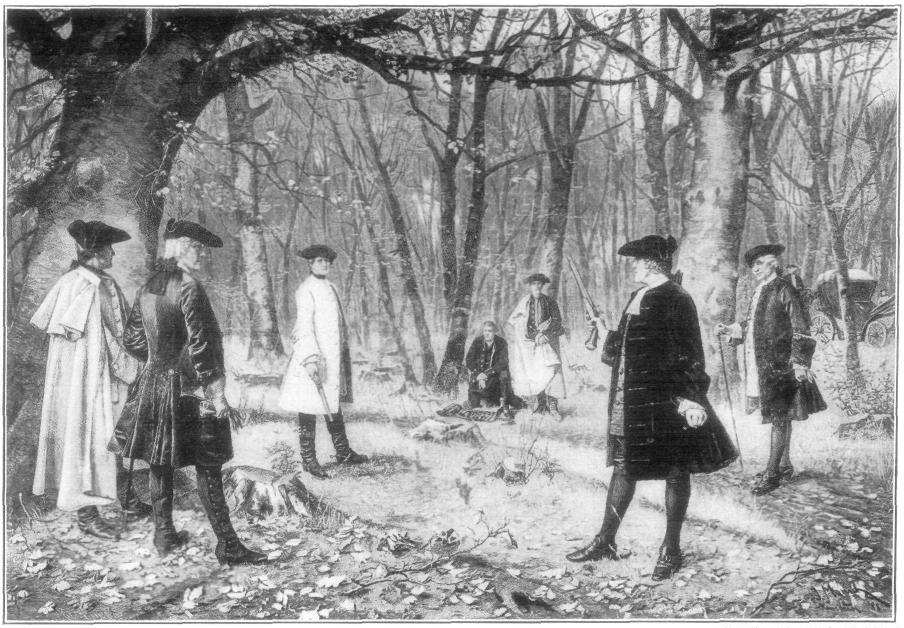
220 years ago on 11 July 1804 Aaron Burr, Vice President of the US challenged and mortally wounded, in a duel, the US Secretary of the Treasury, Alexander Hamilton.

Burr claimed that Hamilton smeared his name by stating that he was a dangerous man and should not be in control of a government. Burr demanded a public apology. Hamilton refused to acknowledge, much less apologize to Burr for the alleged smear, triggering Burr to challenge Hamilton to a duel.

The duel occurred near Weehawken, New Jersey, across the Hudson from Manhattan, and both men fired one round. Hamilton was hit in his side near the hip and died the next day from the wound.

Dueling at the time was illegal but Burr escaped without any charges being brought, although his political career lay in tatters.

Source:  The Hamilton-Burr Duel by Josh Wood, Origins, 2019. Graphic: Hamilton-Burr Duel after a painting by J. Mund, public domain.220