“Happy families are all alike; every unhappy family is unhappy in its own way.” So begins Leo Tolstoy’s epic 19th century Russian novel, Anna Karenina. A beginning line that is not only one of literature’s great openings, but it indubitably stages an existential story that transcends time, culture, and humanity: a diegesis of love and misery.
Love and misery where mental and societal control is lost to emotional need. When Anna’s lover, Vronsky, pleads with her to respect her mother’s needs and his duty, she snaps, “Respect was invented to cover the empty place where love should be. And if you don’t love me anymore, it would be better and more honest to say so.” (chapter 24)
Anna Karenina through time has consistently ranked as one of the greatest novels ever written. Encyclopaedia Britannica lists it as the number one novel of all time.
Sources: Leo Tolstoy, Anna Karenina, serialized in 1875, published in book form in 1878. Plath et al, The 100 Greatest Literary Characters, published in 2019. Enclyclopaedia Britannica, 12 Novels Considered the “Greatest Book Ever Written”, by Jonathan Hogeback.
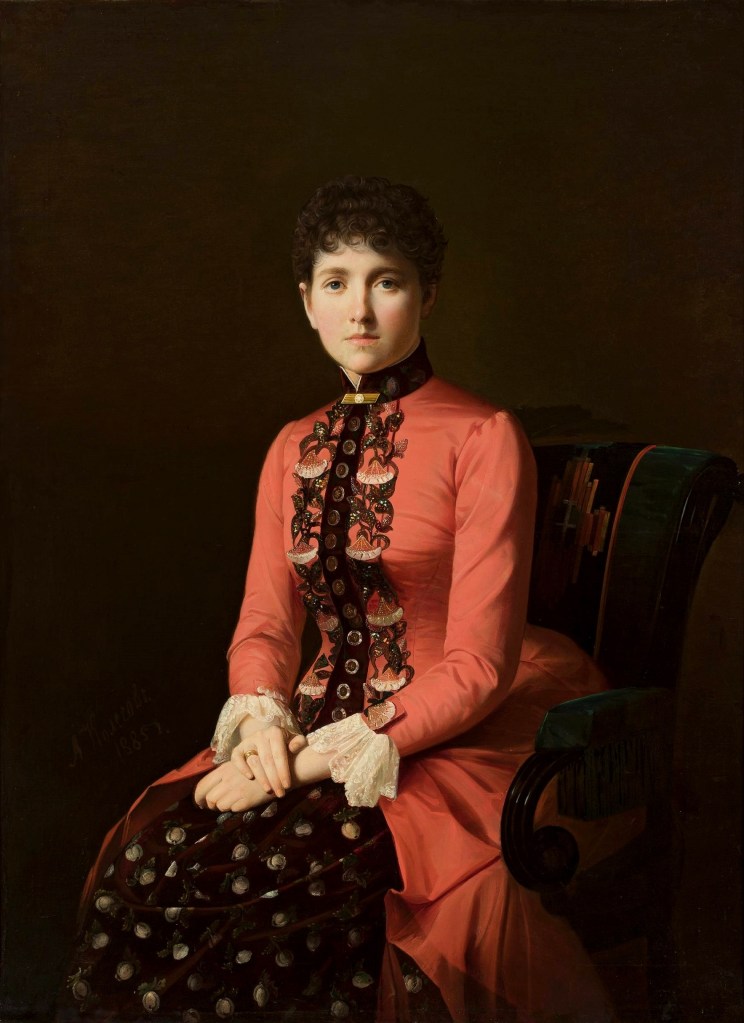
Aleksey Kolesov, “Portrait of a Young Woman” (Anna Karenina), 1885. Public domain, via Wikimedia Commons
 elsToday
“Happy families are all alike; every unhappy family is unhappy in its own way.” – I’m inclined to disagree with this. All of my exes came from abusive families, and the power dynamics were sadly similar. Meanwhile a happy family cultivates their descendants, so they can each bloom in their own way.
LikeLike
Thanks for your comments, it jogged a piece of trivia stuck somewhere in my mind that I didn’t remember when I originally wrote the Anna Karenina post back in March. It was a cloudy memory, so I stumbled around for a while trying to find it until I went with the obvious and did a search on the opening line you mentioned above and out it popped.
The line has taken on a life of its own in the world of statistics, which is where I vaguely remember it from, and is known as the ‘Anna Karenina Principle’. I’ll just cut to the chase and paste a fragment from Wikipedia and go on from there. “The Anna Karenina principle states that a deficiency in any one of a number of factors dooms an endeavor to failure. Consequently, a successful endeavor (subject to this principle) is one for which every possible deficiency has been avoided.”
All happy families are alike because they share a common set of attributes which lead to happiness: Love, Respect, Discipline, et al…with all positive factors possibly present but more importantly there are no negatives present. Each unhappy family is unhappy in its own way or in other words if one negative criteria is present: Violence, Addiction, Incest et al. the family will be unhappy.
From Wiki again: “In statistics, the term Anna Karenina principle is used to describe significance tests: there are any number of ways in which a dataset may violate the null hypothesis and only one in which all the assumptions are satisfied.” To paraphrase one bad apple rots the whole cart. Happy families have no bad apples. Unhappy families may have one rotten apple or multiple rotten apples.
From Commentary.org Gary Saul Morson writes, “In War and Peace and in a variant of Anna Karenina, Tolstoy quotes a French proverb: “Happy people have no history.” Where there are dramatic events, where there is material for an interesting story, there is unhappiness. The old curse—“May you live in interesting times!”—suggests that the more narratable a life is, the worse it is.”
I appreciate your comment. It caused me to think deeper on this than I originally did. I think I’ll rearrange this post a bit and use it for my Sunday book review. Thanks again. Cheers
LikeLiked by 1 person
“Happy people have no history.” Then there are no happy people. I think this proverb holds “happiness” to an unsustainable standard. There have been years when I’ve been unhappy, years when I’ve been happy. If I happen to be happy at the moment, that doesn’t mean my history never happened; I’m probably just not thinking about it.
LikeLike
Thanks. I appreciate your thoughtful comments.
LikeLike