Claret is an English term for Bordeaux wines that traces its origins back to 16th century. The name derives from the French word “clairet,” which described a lighter, more rosé-like style from the Bordeaux region.
Originally, the grapes used to make this wine were Cabernet Sauvignon, Merlot, and Cabernet Franc, similar to today’s right-bank Bordeaux. The left bank added Malbec, Petit Verdot, and Carménère to the mix.
By the 17th and 18th centuries, clarets evolved, through better maceration, aging, and blending techniques, into a darker, full-bodied wine we would recognize today as a Bordeaux. It became a major export to England and the world.
Trivia: Charles Dickens in ‘Martin Chuzzlewit’, ‘The Pickwick Papers’, and ‘Great Expectations’; Wilkie Collins in ‘The Moonstone’; Anthony Trollope in ‘The Belton Estate’; William Thackeray in ‘Vanity Fair’; and George Eliot in ‘Middlemarch’ all mention the drinking of claret, usually at their dinners.
In these novels the claret was diluted with water to reduce the alcohol content, making it more palatable and easier to drink over long meals or gatherings and to stretch the supply.
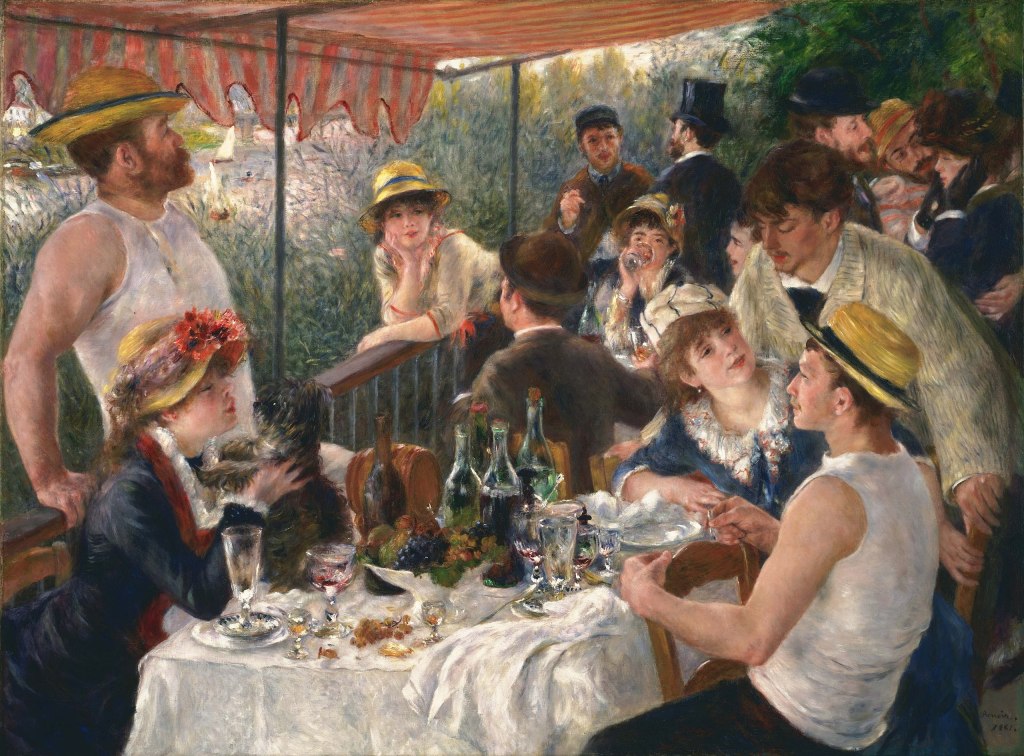
Source: Wine Spectator. Decanter. Graphic: Luncheon of the Boating Party by Pierre-Auguste Renoir, 1881. Public Domain.
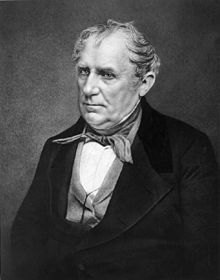
James Fenimore Cooper died in 1851 at the age of 61 in Cooperstown, New York, a small town founded by his father, William Cooper in 1785. The city is located on the southern edge of Otsego Lake which means ‘Place of the Rock’ in the Mohawk language and Glimmerglass in his novel ‘The Deerslayer‘.
Cooper, the eleventh of twelve children, after his first birthday spent his pre-teen years in Cooperstown. He was enrolled at Yale University when he was thirteen and expelled for dangerous mischief at 16 without obtaining a degree. He crewed a merchant ship at the age of seventeen and sailed across the Atlantic to London and down along the Spanish coast into the Mediterranean. In 1808 he joined the U.S. Navy and spent the next two years serving aboard inland lake gunboats and preforming recruiting duties. He resigned his commission in the navy in 1810 for the lack of excitement. (In life where timing is everything, the British naval blockade of American trade during the war of 1812 may have provided Cooper with some needed excitement.) In 1811 he married a wealthy heiress, Susan Augusta de Lancey and settled down to life of leisure for the next decade.
In 1820, after ten years of dabbling in various occupations, more as hobbies rather than employment, he decided to take up writing, producing his first novel, a poor imitation of Jane Austin novels, ‘Precaution’ in the same year. His second novel ‘The Spy‘ was more successful and gave him a measure of fame and wealth, enough to encourage him to continue his pursuit as a novelist and writer.
His first ‘Leatherstocking’ novel. ‘The Pioneers‘ appeared in 1823 followed by the second ‘Leatherstocking’ novel, ‘The Last of the Mohicans‘ in 1826. ‘The Last of the Mohicans‘ is considered his greatest triumph as an author from the time it was written to the present day and has been adapted to film many times over the last one hundred years.
As a testament to his success as a writer, after two centuries almost all his fictional novels are still in print.
The Deerslayer:
‘The Deerslayer‘, first published in 1841, was the fifth and final volume of the ‘Leatherstocking‘ historical romantic novels by Cooper. In ‘The Deerslayer‘ the author brings the protagonist of the ‘Leatherstocking‘ series, Natty Bumppo, back from the future as a prequel to the first four novels. Running in the background to the story is the French and Indian Wars, setting the stage and providing context for the action and dialogue occurring on and around Otsego Lake known as Glimmerglass in the novel.
Natty, referred to by his nicknames Deerslayer and Hawkeye, is a young 17th century moralistic American frontiersman living and traveling among the Iroquoian Mohawks, in what is now known as central upstate New York. Deerslayer has a strong innate sense of right and wrong from a civilized Christian perspective which he continually attempts to square and bridge with the less polished cultural tenets of his Indian brothers. To avoid moral conflicts with his adopted tribal brothers he focuses on the good in the red and, with a nod to cultural sensitivity, he internally closets any interpretive bad in the red as inconsequential. Deerslayer though, takes a less compromising position with his white brethren; admonishing them for traits and behaviors that diverge from his Christian grounding in what is right.
Cooper reinforces the inherent conflicts between good and bad by creating good Indians, Mohawks, and bad Indians, Mingos. The noble, liberated savage versus the evil, fearsome savage. In the end the white and red dissipate and all that is left is the perpetual struggle between good and evil.
Layered on top of Deerslayer’s sententious inclinations is a romance played out between Natty and the beautiful daughter of his traveling companion’s friend: Judith. Judith is slowly drawn to Deerslayer’s inherent goodness while Natty remains committed to his frontiersman bachelor ways. Another gap for the Deerslayer to bridge but in this instance, fails.
Literary Criticism:
‘The Deerslayer‘ received much critical praise from the time of publication onward into the 20th century. Author D.H. Lawrence found the book “one of most beautiful and perfect books…” Critic Carl Van Doren called novel “as a whole absorbing.” Wilkie Collins, author, said “Cooper is the greatest artist in the domain of romantic fiction yet produced in America.” Critic Lounsbury proclaimed that ‘The Pathfinder‘ and ‘The Deerslayer‘ “were pure works of art.”
Not all criticism was positive. Mark Twain supposedly found it dreadful and wrote ten pages explaining his thesis in the aptly titled: ‘Fenimore Cooper’s Literary Offenses‘. As is his want and style, Twain’s account of Cooper’s offenses was exceptionally funny though I’m less than sure if he was serious in his criticisms or if he just saw an opening to throw a few well-constructed barbs to help pay the bills and meet contractual obligations. An excerpt from the opening to ‘Fenimore Cooper’s Literary Offenses‘:
“Cooper’s art has some defects. In one place in ‘Deerslayer‘, and in the restricted space of two-thirds of a page, Cooper has scored 114 offences against literary art out of a possible 115. It breaks a record.
There are nineteen rules governing literary art in the domain of romantic fiction–some say twenty-two. In ‘Deerslayer‘ Cooper violated eighteen of them….”

 elsToday