Black Water

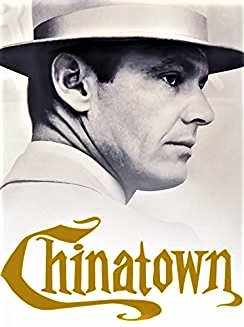
ChinatownM Chinatown 1974

Theaters:  June 1974

Streaming:  November 1999

Rated:  R

Runtime:  130 minutes

Genre:  Crime – Drama – Film Noir – Mystery – Suspense – Thriller

els:  8.5/10

IMDB:  8.2/10

Amazon:  4.6/5 stars

Rotten Tomatoes Critics:  9.3/10

Rotten Tomatoes Audience:  4.2/5

Metacritic Metascore:  86/100

Metacritic User Score:  8.9/10

Awards: 1 Academy Award and 4 Golden Globes

Directed by:  Roman Polanski

Written by:  Robert Towne

Music by:  Jerry Goldsmith

Cast:  Jack Nicholson, Faye Dunaway, John Huston

Film Locations:  California, US

Budget:  $6,000,000

Worldwide Box Office:  $29,200,000

J.J. “Jake” Gittes (Nicholson), a former L.A. cop, spends his days and occasional nights as a private investigator, hired mainly to catch cheating spouses in the act of, well, cheating. An elderly woman hires Jake to find the women her adulterous husband, Hollis Mulwray the chief engineer for L.A. Water and Power, is fooling around with.  Jake photographs Mulwray in the embrace of a young woman and the next day the pictures are on the front page of the newspaper. Mulwray is found dead by drowning in a city reservoir the same day. The wife of Mulwray (Dunaway), who it turns out, is not the women who hired Jake the day before, sues him for publishing the pictures. Jake realizes soon enough that he was set up and Mulwray was murdered. He is determined to find out why.

The movie’s story, set in 1937, is a mixed-up, mashed-up telling of the L.A. water wars in the early 1900s. By the end of the 19th century L.A.’s growth was outstripping its water supply and the city fathers, politicians, started looking for alternate sources that would quench the city’s ever-growing thirst.  They found it 250 miles northeast of L.A. in Owens Valley, a high valley nestled between the Sierras to the west and the beginnings of the Basin and Range region to the east, containing a very nice, thirst quenching river.  The voters in L.A. approved 2 bond measures in 1905 and 1907, totaling $26 million dollars, to build a 233 mile long aqueduct from the Owen River to the L.A.’s Lower San Fernando Reservoir,  which was later renamed the Lower Van Normans Reservoir.  The city along with numerous investors negotiated the water rights from the farmers in the valley, some say swindled, and the aqueduct was built by L.A. Power and Water between 1908 and 1913. The project was supervised by William Mulholland (Hollis Mulwray in the movie), who along with the mayor, Fred Eaton, acquired the water rights to the valley by purchasing the land for a fraction they paid to other land owners outside of Owens Valley.  They told the owners that they only wanted a small part of the rights but by 1928 the city owed 90% of the water. The water diversion to L.A. effectively destroyed farming in Owens Valley and by 1924 Owens Lake, which was fed by the river, dried up to a throat-choking plain of dust. That same year farmers in the valley dynamited some of the diversion gates, allowing the water to return to its natural course, at least for a short while. It was an ineffective revolt and by 1927 the farmers were mostly bankrupt and defeated.

Robert Towne wrote the script for Chinatown, winning an Oscar for Best Original Screenplay and a Golden Globe for Best Screenplay, using the L.A. water wars and Raymond Chandler as inspiration.  He originally envisioned the story to be a trilogy, all starring Jack Nicholson.  The second part, The Two Jakes, involving shady oil deals within the city, was directed by and starred Nicholson. The movie did poorly causing everyone to lose interest in the third movie. Roman Polanski had an uncredited part in the Chinatown screenplay, shortening it and changing the ending.

Roman Polanski, celebrated director and rapist, directed Chinatown, winning a Golden Globe for Best Director by creating a beautiful film noir that elevates the genre to heights not seen since the 1941 The Maltese Falcon or the 1958 Touch of Evil.  His homage to the genre even includes 1940 style rolling credits; a charming touch. While his Rosemary’s Baby was horror within your mind, Chinatown was in your face with political cynicism and sexual debauchery.

Jack Nicholson, winner of two Academy awards for Best Actor and nominated for 10 others including Chinatown, provides the glue that takes this picture from good to great. His role of an aggressively suave, former gum-shoe, propelled him to the heights of a true legend in Hollywood. A couple of pointless points: Nicholson was in a serious, sometimes, relationship with John Huston’s daughter, Angelica, during the filming of this movie and he also lived on Mulholland Drive, see above, in Beverly Hills.

This is another movie that should be on your “Must See in My Lifetime” list.  A true masterpiece of writing, directing, music, and acting.

Bullets from the Past

22 Bullets  (L’immortel, original title — French Audio, English Subtitles)M 22 Bullets 2010

Rated:  NR

Runtime:  115-117 minutes

Genre:  Action  – Crime – Drama – International – Mystery – Suspense – Thriller

Theaters:  Europe – March 2010

Streaming:  US – February 2014

els:  5.5/10

IMDB:  6.7/10

Amazon:  4.1/5 stars

Rotten Tomatoes Critics:  5.1/10

Rotten Tomatoes Audience:  3.3/5

Metacritic Metascore:  NA/100

Metacritic User Score:  NA/10

Awards: NA

Directed by:  Richard Berry

Written by:  Eric Assous and Richard Berry (screenplay), Franz-Olivier Giesbert (book)

Music by:  Klaus Badelt

Cast:  Jean Reno, Kad Merad, Jean-Pierre Darroussin

Film Locations:  Avignon, Marseille, Paris, France

Budget: $20,000,000

Worldwide Take: $21,300,000

Charlie Mattei (Jean Reno) after a career as a gangster wants to retire and spend the rest of his life peacefully with his family; a wife and 2 children.  Well, if wishes were politicians, thieves would rule — oh wait.  Mattei leaves his gangster business to his old criminal friend, Tony Zacchia (Kad Merad), and for 3 years he actually enjoys some peace until someone has 8 mobsters pump Charlie full of chemically accelerated lead. Charlie miraculously survives and recovers from the damage of 22 bullets and sets out to find those responsible; first without bloodshed then when that doesn’t work, firmer measures are employed.

The movie is loosely based on the real life Marseille mobster, Jacques “Jacky Le Mat” Imbert, who in the 1950s specialized in burglaries, hold-ups, and general thuggery.  By 1960s he added extortion, kidnapping and murder to his resume and was, and still is, considered the “Last Godfather” within French crime circles. In the late 1970 Imbert was gunned down by several mobsters associated with his old crime boss, Tony Zampa.  Doctors removed 22 pieces of metal from his body including 7 bullets.  He survived but his right hand was paralyzed.  Later 11 mobsters working for Zampa were gunned down in apparent retaliation for the failed hit. Police suspected and arrested Imbert but released him after 6 months for lack of evidence in the murders.  He reportedly retired when released but continued to associate with gangsters in Paris including the angelic, drug kingpin Francis “The Belgian” Vanverberghe of  The French Connection infamy.

Richard Berry, director, screenwriter and actor, known mainly for his work in French cinema, puts together a glossy gangster movie with great acting talent and replete with all the essential scenes of murder and car chases but little in the way of pizzazz or a hold-onto-your-seat intensity.  The movie at first has visions of Francis Ford Coppola’s The Godfather but quickly degenerates into a story too-many-times told with an uneven delivery of what, in the end, is another pedestrian revenge flick.  The movie keeps your interest but the character development is spotty for the secondary actors, leaving the viewer occasionally lost in the gun-smoke of plot development.  Berry could have also left out the morality lectures from gangsters; way too out-of-place for this genera. Honor among thieves is one thing but mobsters as altar boys is a step too far.

Jean Reno plays Charlie Mattei with his usual aplomb and sophistication which always makes him one of the more, if not the most interesting person in a movie.  Think Leon in The Professional or the inspector Captain Bezu Fache  in Da Vinci Code.

This is an average revenge movie with some interesting and creative scenes of the bad guys delivering justice to the bad guys but it never gets past the formulaic, and thus, predictable plot.  The movie could have been much more with less mobster morality, more with less graphic in your face violence, more with less regularity; a few real plot twists would have taken this movie to another, more interesting level.

Dying Young

The Curious Case of Benjamin Button (Theaters – December 2008; Streaming – May 2009) M Button 2008Rated: PG  —  Runtime: 166 minutes

Genre: Drama – Fantasy – Mystery – Romance – Suspense

els – 7.5/10

IMDB – 7.8/10

Amazon – 4.6/5 stars

Rotten Tomatoes Critics – 7.1/10

Rotten Tomatoes Audience – 3.7/5

Metacritic Metascore – 70/100

Metacritic User Score – 7.3/10

Awards:  3 Academy Awards – Nominated for 13

Director:  David Fincher

Written by:  Eric Roth (story and screenplay), Robin Swicord (story), F. Scott Fitzgerald (story)

Music by:  Alexandre Desplat

Cast:  Brad Pitt, Cate Blanchett, Julia Ormond

Film Locations:  Cambodia; Montreal, Canada; India; Burbank, Los Angeles, California – Donaldsonville, Laplace, Mandeville, Morgan City, New Orleans, Louisiana, US; St. Thomas, US Virgin Island

Budget:  $167,000,000

Worldwide Take:  $379,000,000

Mr. Gateau, the best clockmaker in all of the southern US, is commissioned to build a clock for a new train station set to open in 1918. When the clock is unveiled, it is running backwards. Mr. Gateau, who lost a son to the recent war, affirms that it is running as designed; to  grant those lost to the war a way back to life and the living.  On 11 November 1918, Armistice Day, Benjamin Button (Brad Pitt) is born, wrinkled and worn, losing his mother to his birth and his father, abandoning him on the porch of an orphanage. Benjamin is a consistent contradiction, experiencing life in a counter-clockwise direction.

The Curious Case of Benjamin Button took 20 years, 7 potential directors prior to Fincher, 3 lead actors before Pitt, 3 different possible producers, and 2 production companies to finally deliver a product for the viewing public to consume. David Fincher brings his visual effect expertise to the forefront, as he usually does, with this enchanted story of love and time. He balances the CGI with a spellbinding collage of romance and courage that moves beyond the flesh. The visual effects are absolutely stunning, keeping this fantasy real and believable.  Fincher was likely the only director that could make this movie and keep the audience interested.

Brad Pitt contributes a somewhat predictable performance, detached but lovable, low-key and restrained, letting his body language provide the message, more so than his dialogue. It works and adds to the mystic of the film but it’s Cate Blanchett’s Daisy that draws you into this movie.  Daisy is a very complex character and Blanchett handles it with grace, charm, and a natural style that holds you in a delightful, enamored state of wonder throughout the film. Sad that she wasn’t even nominated for her more than deserving efforts by the Academy or the Golden Globes.

Benjamin Button is beautifully made, telling a story of true love that outstrips the concepts of time.


Boiler Maker Redemption

Small Town Crime (Theaters-NA; Streaming-January 2018) Rated: R  —  Runtime: 91-92 M Small Town 2018minutes

Genre: Crime-Drama-Mystery-Suspense-Thriller

els – 7.0/10

IMDB – 6.6/10

Amazon – 4.0/5 stars

Rotten Tomatoes Critics – 7.0/10

Rotten Tomatoes Audience – 3.9/5

Metacritic Metascore – 68/100

Metacritic User Score – NA/10

Awards: None

Directed by: Eshom Nelms, Ian Nelms

Written by: Eshom Nelms, Ian Nelms

Music by: Chris Westlake

Cast: John Hawkes, Octavia Spencer, Robert Forster, Anthony Anderson

Film Locations:  Utah

Budget: $NA

Worldwide Box Office: $NA

Mike Kendall (John Hawkes) is a big-time drunk and a small-town ex-cop.  A small-town ex-cop because he is a big-time drunk. Riding shotgun, too drunk to drive, with his uniformed partner; occurring immediately before he becomes an ex-cop, in the wee hours of night, they pull over a car and the driver shoots and kills Mike’s partner.  Mike, because he was drunk, is thrown off the force and he sinks further into the bottle but truly believing the police will forgive, forget and hire him back.

Coming around from his nightly bender, Mike finds a badly bloodied girl by the side of the road. He rushes her to the hospital but she soon dies and the death is ruled a homicide.  Seeking redemption, Mike sets out to solve the murder, dragging his family, bartenders, hookers, pimps, grandfathers, and assorted none-too friendly cops along for his burlesque, but borderline professional investigation, into multiple gruesome murders.

The Nelms brothers have woven a fateful crime story worthy of the Cohen brothers’ The Big Lebowski or Fargo. Less comedic than Lebowski and less dramatic than Fargo but all three display the same irreverent contempt for criminals and their slapdash, albeit, serious and consequential, escapades.  The Nelms’ writing and directing are reminiscent of Dragnet’s Friday, just the facts — ma’am.  Watching the movie you wish they would develop some of the more interesting sub-plot lines but in the end the movie does just fine without the added knowledge or clutter.

The acting is superb.  John Hawks is masterful in delivery but he really pulls you in and along with his bumbling style and looks.  His appearance and his face are one with a character that has been on a multi-year drunk.  Gaunt and not too pretty he somehow succeeds in getting you to cheer for him no matter how much his bum nature comes into full gnarly view.

A fun movie, not too serious but captivating just the same.  A worthy addition to pulp fiction and film noir. Escapism with a style all its own.

Alone

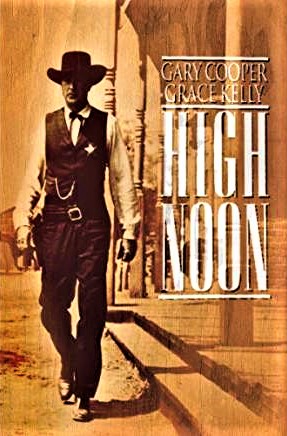
High Noon (Theaters-1952; DVD-May 2004) Rated: TV-PG  —  Runtime: 84-85 minutesM High Noon 1952

Genre: Action-Drama-Suspense-Thriller-Western

els – 8.5/10

IMDb – 8.0/10

Amazon – 4.7/5 stars

Rotten Tomatoes Critics – 8.8/10

Rotten Tomatoes Audience – 4.0/5

Metacritic Metascore – 89/100

Metacritic User Score – 8.4/10

Awards: 4 Academy, 4 Golden Globes

Directed by:  Fred Zinnemann

Written by:  Carl Foreman

Music by: Dimitri Tiomkin

Cast: Gary Cooper, Lloyd Bridges, Grace Kelly

Film Locations:  Burbank, Columbia State Historic Park, Iverson Movie Ranch, Jamestown, Tuolumme, Wanerville; all in California, US

Budget: $730,000

Worldwide Box Office: $8,000,000-18,000,000

Will Kane (Gary Cooper), a soon to be retired lawman from a small, quite, town of dusty streets in old west New Mexico, is getting married and taking his new Quaker wife (Grace Kelly) away for a fresh beginning in another town; to raise a family and run a store.  Moments before they are to leave they learn that Frank Miller, a convicted murderer that Kane and a local judge captured, convicted, and sent to prison has received a pardon from the governor. Miller is coming in on the noon train to settle the score. Waiting at the train station for Miller is his younger brother and two other shifty varmints, eagerly providing guns and muscle to back him up in his all-consuming quest for revenge.  Kane attempts to round-up a pose to face Miller and his gang, but all the town folk decline and insist, instead, that he leave town, a suggestion heartily supported by his pretty young wife.  Knowing that if he ran Miller would follow, Kane stays to make his stand now rather than later: alone.

A truly classic western filmed in black and white under Foreman’s spartan script and directed by Zinnemann in real-time at a parsimonious and fast pace.  The stark cinematography provides the tension inherent in the plot, always pushing the viewer onward to the next scene, straight ahead or around the corner.  The acting was absolutely first-rate.  Gary Cooper won a best actor Oscar for his efforts and had a supporting cast that included some of the greatest names in Hollywood; Lloyd Bridges, Grace Kelly, Otto Kruger, Eve McVeagh, Thomas Mitchell, Henry Morgan, and Lon Chaney Jr.  What a lineup.  Finally the movie included the legendary theme song Do Not Forsake Me, Oh My Darlin’ aka The Ballad of High Noon written by Dimitri Tiomkin and preformed by Tex Ritter; a hardy but forlorn synopsis of the movie’s plot.

The film, when previewed for the press was greeted with derision.  Due to the critics proclaiming the movie a failure the producers decided not to release the movie.  Tiomkin then bought the rights to the theme song and released it with Frankie Laine singing the lyrics, becoming an immediate worldwide hit.  Because of the public’s  positive reaction to the song, the movie was released a few months later, eventually garnering Tiomkin 2 Oscars for movie’s theme song and score.

The movie, released in 1952, played in theaters during Korean War and McCarthy’s Red Scare: the hunt for communists in US government and private institutions, especially Hollywood.  The movie was, and still is, believed to be an allegorical expression of the downtrodden, the just David standing tall against the unjust and unproven allegations. Standing up to the Goliath known as Joseph McCarthy.  During this time being branded, with or without proof, by the scarlet, hot iron C of communism was the end of many careers in the US.  The movie tried to push back and with all things Hollywood, feigned righteous innocence.

Without, or maybe even with, the knowledge of the Red Scare, the movie today is seen more as good versus bad without the partisan grey over-prints.   The right and the small meeting the wrong and the mighty.  Fighting the good fight whatever the odds. Being small doesn’t make you weak.  Being alone doesn’t make you wrong.


All Chan, All Good

The Foreigner (Theaters-September 2017; Streaming-January 2018) Rated: R  Runtime: M Foreigner 2017113-114 minutes

Genre: Action-Crime-Drama-Mystery-Suspense-Thriller

els – 7.0/10

IMDb – 7.1/10

Amazon – 4.6/5 stars

Rotten Tomatoes Critics – 5.9/10

Rotten Tomatoes Audience – 3.8/5

Metacritic Metascore – 55/100

Metacritic User Score – 7.1/10

Directed by: Martin Campbell

Written by: David Marconi (screenplay), Stephan Leather (novel)

Music by: Cliff Martinez

Cast: Jackie Chan, Pierce Brosnan

Film Locations:  London, England; Larne, Northern Ireland

Budget: $35,000,000

Worldwide Box Office: $140,793,485

Quan (Chan), a widower, lives a quiet London life, looking after his only daughter and his restaurant, his only major concerns are the boys chasing after his beloved teenaged girl.  Then a new IRA faction blows up a bank, killing his little girl, who was shopping at a dress shop adjacent to the bank, and Quan’s life and priorities change. He wants to know who killed his daughter, who was responsible.  He wants justice.  When the officials are unable to give him any names or promise any arrests, soon, he organizes his vigilante squad of one and slowly narrows down the possibilities; Jackie Chan style, but without malice for dogs or the innocent.

Jackie Chan steps past his normal fun side, giving the audience a taste of his drama and emotional acting abilities, and proves that his serious character portrayals are real, believable and effective.  Not since his role as a morose handyman in the 2010 Karate Kid have I seen him in such a convincing dramatic role, but this time the screenplay (Marconi) and supporting actors are not relegating him to a least common denominator of mediocrity and cheesiness.  The screenplay flows well, it’s coherent, and has enough twists to keep you guessing, but it does have a flaw, and unfortunately its a big one. Brosnan’s Liam Hennessy role is muddled, his level of involvement and guilt in the IRA bombing is never completely resolved. Maybe it’s intentional but it adds clutter to the plot and its conclusion. That aside, this is a typical Martin Campbell film, full of action, intrigue and entertainment, always spot on and fun; ok, maybe the Green Hornet was a dud, but usually his films are a must see, as is this one.

This was a fun action-drama to watch.  Jackie Chan displays what made him famous, his martial arts moves, but in the film he also displays his serious side and lets us know that, yes, he can play that part.

Chillin’ Back to the Future

Baby Driver (Theaters-2017; Streaming-2017)  Rated: R  Runtime: 112 minutesM Baby 2017

Genre:  Action-Crime-Music-Suspense-Thriller

els – 8.5/10

IMDb – 7.0/10

Amazon – 3.9/5 stars

Rotten Tomatoes Critics – 8.0/10

Rotten Tomatoes Audience – 4.2/5

Metacritic Metascore – 86/100

Metacritic User Score – 7.7/10

Directed by:  Edgar Wright

Written by:  Edgar Wright

Music by:  Stephen Price

Cast:   Ansel Elgort, Jamie Foxx, Kevin Spacey, Jon Hamm, Lily James

Film Locations:   Atlanta, Dunwoody and Gainesville, Georgia, New Orleans, Louisiana, US

Budget:   $34,000,000

Worldwide Box Office:  $228,311,809

Baby (Elgort) is a getaway driver, choreographing his high RPM street racing to the music pumping through his ear buds, playing catch me if you can with a no sweat demeanor that has you cheering for him non-stop.  Baby works for Doc (Spacey), a criminal mastermind that plans all his heists in chalk-board detail, never using the same group of robbers twice, except for Baby.  Baby is exceptional. Spacey catches Baby, how that happens is somewhat implausible since no one every catches Baby, trying to rob him and forces him to drive his den of thieves away from their crime scenes as retribution.

I’m late to this movie so I will give my due respect to the principles and then move on to what makes this movie so special: script and score–together.  Edgar Wright has put together a story that doesn’t come along too often, a story that has is all, action, comedy, crime, love, suspense–it has everything that you and I watch movies for. He brings it all together with a coherent and convincing screenplay, tight directing, precision choreographed cinematography (Bill Pope), and acting that is just perfect. Of course it doesn’t hurt to have Elgort, Foxx, Hamm, and Spacey providing believable and real characters along with the very pretty James. Throw in some subtle paeans to the past, such as Back to the Future, and you have a simply stunning movie, a true masterpiece; the bits and pieces adding up to a fulfillment of a lost cinematic ideal: pure, unadulterated entertainment.

Then Wright brings forth the melody.  A melody that matches and honors the lyrics: the screenplay. Lyrical poetry, accordant with the harmonic notes performing a dance of rockin’, rollin’, tango action.  Not since the 1983 Big Chill has Hollywood scored music so perfectly with the movie.

The Big Chill brought together children of the 1960s, audience and actors alike, in a comedic drama about trying to find meaning in a modern world after their fling with anarchy and drugs.  They found no meaning.  The point of the 60s was that there was no point.  But the 60’s music was sublime and transcendent. The music in The Big Chill, complimented the story as if they were fraternal twins, different veins but the same beat. Bringing together the rockin’ soul of the era with the burn-it-down pathos of its youth.  Marvin Gaye, Aretha Franklin, Smokey Robinson, black soul groovin’ the white bourgeoisie who thought they were the proletariat.  A movie, and an era, of no meaning, expressing itself with music that meant everything, and the two together brought soothing cover and entertainment.

Baby Driver just brings entertainment, no-guilt-pleasure, meshing the visual with the phonic.  It brings in The Big Chill‘s soul sound with the likes of Carla Thomas, Sam and Dave, and Barry White; and then branches out to include the  old-time rockers of Queen, T. Rex (Marc Bolan’s son sued the movie for using Debora without permission), and Golden Earring; progressing up the time scale with blues-rocker Jon Spencer Blues Explosion, and alternate-stuff Beck; capping it off with the synth-pop of Sky Ferreira. A great collection of musicians that compliments the movies action, creating a greater artistic experience than the two alone could achieve. Jon Spencer’s Bellbottoms in the opening car chase scene sets the throbbing standard for the movie that doesn’t abate until the ending credits roll, accompanied by the Simon and Garfunkel song: Baby Driver.

Sony and Edgar Wright have agreed to a sequel, hopefully in 2019.  May the magic strike twice.

Art Imitates Life

American Made (Theaters-2017; Streaming-2018)  Rated: R  Runtime: 115 minutesM American Made 2017

Genre:  Action-Adventure-Biography-Comedy-Crime-Drama-Mystery-Suspense-Thriller

els – 6.5/10

IMDb – 7.2/10

Amazon – 3.5/5 stars

Rotten Tomatoes Critics – 7.0/10

Rotten Tomatoes Audience – 3.8/5

Metacritic Metascore – 65/100

Metacritic User Score – 6.8/10

Directed by:  Doug Liman

Written by:   Gary Spinelli

Music by:  Christophe Beck

Cast:   Tom Cruise, Domhnall Gleeson, Sarah Wright

Film Locations:   Atlanta, Ball Ground and Madison, Georgia, US; New Orleans, US; Araracuara, Caqueta and Medellin, Columbia

Budget:   $50,000,000

Worldwide Box Office:  $135,581,390

Barry Seal (Cruise) is a hustler, a con, a drug smuggling, gun running, money laundering, CIA operative; a Medellin Cartel useful stooge, and all around terrific husband and father who will not let anything get between him and an illicit mountain of cash. Seal is a TWA pilot who can’t make ends meet or fulfill his adrenaline needs, so he turns to flying drugs from South American to supplement his legitimate wages and feed his risk cravings.  He soon attracts the attention of the CIA who need a gofer to conduct business between the agency and Panama’s Noriega. This leads to running CIA supplied guns to Panama and the Cartel in Columbia.  Return flights are loaded with Columbian cocaine netting Seal $2000 per kilogram smuggled.  The amount of drugs involved eventually causes Seal to run out of banks and closet space for his green abundance. The entire story is told with more humor than drama, concentrating on Seal’s/Cruise’s smile and devil be damned style. You know Seal is man without a conscience but he is so darn likable and fun.

American Made is aptly directed by Doug Liman who keeps the focus of the movie light and airy, bordering on silly, against a background of drugs and the ensuing trail of death and ruin; and somehow it all works. Liman last worked with Cruise in the fantastic and critical acclaimed 2014 sci-fi flick: Live Die Repeat: The Edge of Tomorrow.  A little known, but talented writer, Gary Spinelli wrote the screenplay for this movie and auctioned it off to Universal for a cool million back in 2014. At that time Ron Howard was pegged to direct the movie. Filming started around May 2015 and continued off and on until January 2017.

This film is blithely marketed as a true story, a biography. As with all things Hollywood, that statement stretches reality to the breaking point. Barry Seal was a pilot for TWA and he was a drug smuggler; that part is true, after which the rest of the story gets the Hollywood treatment where the truth is pitted against fiction; may the highest gross potential wins.  The CIA part of the story may or may not have happened but the official line is it did not or at least not till much later in time.  Seal was busted for drug smuggling and money laundering and was facing serious time in the pen. He cut a deal with the DEA to help bring down the Columbian Cartels in exchanged for a lighter sentence.  At this point it appears the CIA, in conjunction with the DEA, stepped in to also gather information on the Nicaraguan Sandinistas.  Subsequently, Seal, at an airport in Nicaragua, took photos of Pablo Escobar, Ochoa, plus a Sandinista government official, Federico Vaughan, directing the loading of cocaine onto a DEA aircraft.  These pictures leaked out to the general public, after which Escobar placed a bounty on Seal’s life; supposedly $1,000,000 for capture and return to Columbia or $500,000 for his death. In early 1986 Seal was assassinated by Escobar’s hit men in front of a Baton Rouge, Louisiana Salvation Army facility.

Seal’s American Made life is a comedy.  Seal’s real life was a tragedy. Aristotle said in the 4th century BC, that art imitates life, mimesis, whereas Oscar Wilde in 1889 said the life imitates art, anti-mimesis. Here art imitates life, but comedy polled better than tragedy: money wins. Ok, that might be a bit heavy.  It’s a good movie so kick your feet up and pass the popcorn.


With a Little Help from My Mum

Kaleidoscope (Theaters-2017; Streaming-2017)  Rated: NA  Runtime: 99-100 minutes

Genre:  Drama-Mystery-Suspense-ThrillerM Kaleidoscope 2017

els – 7.0/10

IMDb – 6.0/10

Amazon – 3.5/5 stars

Rotten Tomatoes Critics – 6.4/10

Rotten Tomatoes Audience – NA/5

Metacritic Metascore – 52/100

Metacritic User Score – NA/10

Directed by:  Rupert Jones

Written by:   Rupert Jones

Music by:  Mike Prestwood Smith

Cast:   Toby Jones, Anne Reid, Sinead Matthews

Film Locations:   London, England

Budget:   NA–Low Budget Indie Film

Worldwide Box Office:  $6,906 (Limited Release)

Carl (Jones) is a lonely man. Just out of prison, for what is never stated, he attempts a lonely hearts, social network consummated, date for the first time in 15 years. The date appears to be just what Carl needs to jump-start his life and leave his ill-defined past behind; until his mother (Reid) calls.  The call releases his past in waves of psychological, matriarchal malevolence, torturing his mind with fits of murderous rage and metaphysical straight-jackets. His date goes downhill and his mother shows up at his flat to complete the twisted anguish taking place in Carl’s mind.

Kaleidoscope was written and directed by Rupert Jones, a sophomoric directorial effort in the feature film category, blood-tied to a clan of English stage and movie actors; father Freddy Jones, mother Jessie Heslewood, and brothers Toby and Casper Jones. His main efforts prior to this film were in the realm of shorts and music videos, including directing: Most Likely You Will Go Your Way  by Bob Dylan. Jones weaves a captivating psychological thriller that holds you, rivets you, to Carl’s revolving kaleidoscope of shifting past memories and misty glimpses of the present. A surprisingly great movie from one with such an unsuspecting thin cinematic resume.

Toby Jones and Anne Reid play Kaleidoscope precisely as needed: a dysfunctional family, and play it as if it were their reality. Their whole body, visual as well as vocal, creates a truly intricate and color-saturated story that the sparse dialogue only begins to animate into a meaningful coherence. Toby’s silent looks speak volumes while Reid’s wrinkles and loose skin invoke not sympathy, but a cold certainty that she should be tossed from a fast train or a high balcony.

This is a remarkable movie; psychotic portraits vividly drawn on a Kandinsky canvas, divorced from any obvious visual realities. The visuals keep you engaged but the reality is hidden; past is prologue, present is interesting, if not terrifying. A low-budget masterpiece; a great story with great direction and acting.

Liam’s Choice

Radius  (Theaters-2018; Streaming-2017)  Rated: NR  Runtime: 87-93 minutesM Radius 2017

Genre: Fantasy-Mystery-Science Fiction-Suspense-Thriller

els – 6.0/10

IMDb – 6.2/10

Amazon – 3.7/5 stars

Rotten Tomatoes Critics – 7.8/10

Rotten Tomatoes Audience – 3.5/5

Metacritic Metascore – NA/100

Metacritic User Score – NA/10

Directed by:  Caroline Labrèche, Steeve Léonard

Written by:  Caroline Labrèche, Steeve Léonard

Music by:  Benoît Charest

Cast:  Diego Klattenhoff, Charlotte Sullivan

Film Location:  Selkirk, Manitoba, Canada

Budget:  NA

The mystery begins as Liam (Klattenhoff) wakes up in a confused state, lying next to an overturned car.  As he stumbles away from the car and walks down a lonely road, an approaching car slows, possibly to pick him up, but instead, appears to try to run him over in slow motion. Liam sidesteps the car, and it coasts off the road and comes to a stop in the ditch.  In a what-the moment, Liam approaches the car, opens the driver’s door, and finds the occupant dead.  Upon calling 911, or whatever the Canadian equivalent is, the operator asks for Liam’s name; stumped by the question he resorts to looking at his driver’s license for the answer. Liam remembers nothing, who he is, what he is, where he is; his existence started at the point of regaining consciousness at the crash site.  The dead driver scene repeats in various forms; people, birds, any living mammal that approach him, or vice versa, dies.  With the bodies piling up, he ultimately realizes that it isn’t a pathogen killing everyone; its him: get too close to Liam, a radius of a few tens of feet, and you die: instantly. Jane (Sullivan), a passenger in Liam’s car at the time of the crash, but unknown to Liam when he woke up at the crash site, tracks Liam down and they discover that his radius of death is inoperative when she is near. Her yin to his yang.

A set of moral dilemmas are introduced with a semi-transparent brush that are easily resolved, but not very satisfying, at least not from an emotional perspective.  Are you responsible for a past life that you can not remember? Are you responsible for a life that your are fully cognizant of, but unable to control?  Jane answers no to both queries. Liam answers yes, at least to the latter. The movie leaves you to decide his answer to the former.

This is Labreche and Leonard’s second low-budget movie they have directed together. Their first movie they directed, Sans Dessein (Without Design), was filmed in Montreal for $15,000 Canadian, and released in French in 2009. The movie received above average reviews from critics and viewers (IMDb 7.0/10).

In Radius the movie production is very good, for a low-budget film, and has met with similar reviews as Sans Dessein. I suspect their efforts in this movie, as writers and directors, will get them noticed by folks with deeper pockets in the near future.

An original story and script, with mostly good acting, certainly not bad. The directors set a pace that’s a tad slow, resulting in the viewer leaping ahead of the story, which in this case, is not necessarily bad.  An entertaining flick with a unsatisfying, but necessary ending.  Hitchcock may not have approved but he would have understood.