Mamma Mia

Bohemian Rhapsody” was the eleventh track, and the first single released from Queen’s 1975 album, A Night at the Opera. Written by Freddie Mercury, the song has become the band’s signature tune and is hailed as one of the greatest rock songs ever recorded. Initially, critics were unsure what to make of the song, with some labeling it as a novelty, campy, calculated, and a brazen hodgepodge. However, they were all wrong. Rolling Stone ranked it 17th in its list of the 500 greatest songs in 2021, and Time ranked it among the top 100 songs written since 1923.

Mercury started writing the song in the 1960s, and it is a combination of three songs with multiple parts, including a cappella ballad, opera, and hard rock. This six-minute lament appeals to many, but everyone has their own interpretation of the song’s meaning. The band has never fully explained the lyrical meaning of the song, only stating that Freddie was a complicated individual with mercurial personality traits and habits. In the album’s Iranian release, it was mentioned in the liner notes that Freddie Mercury, of Indian and Persian descent, explained that ‘Bohemian Rhapsody‘ is about a young man who accidentally kills someone, makes a Faustian bargain by selling his soul to the devil, and ultimately calls upon God, Bismillah, to reclaim his soul.

Source: …Bohemian Rhapsody by Lily Rothman, Time, 2015. Graphic: Bohemian Rhapsody, Cover and Video by Queen, 2008.
Journalism – Sabrina Erdely 2014

On 19 November 2014, Rolling Stone published “A Rape on Campus” by Sabrina Erdely, an incendiary and malicious expose of gang-rape by U of Virginia fraternity brothers. Erdely’s story centered on UVA student Jackie Coakley, only identified as Jackie in the article, who was allegedly gang-raped at a Phi Kappa Psi party by several members that fraternity in 2012.

Mainstream journalists at Worth, Slate, and the Washington Post immediately began to question the sourcing and methods that went into the story. Rolling Stone, to quell the growing roar of disbelief, commissioned the Columbia School of Journalism to investigate the story and the magazine’s journalistic methods.

Columbia School of Journalism found that the “Rolling Stone’s repudiation of the main narrative in “A Rape on Campus” is a story of journalistic failure that was avoidable. The failure encompassed reporting, editing, editorial supervision and fact-checking.”

Jonathan Taylor of Title IX for All wrote, “Virtually every claim made by “Jackie” and chronicled by Sabrina Rubin Erdely in Rolling Stone has been objectively proven false.”

Multiple lawsuits by university personal and fraternity members were filed against Erdely and Rolling Stone in 2015 and 2017. The UVA lawsuit was settled for $3 million in damages against the magazine and Erdely. The PKP fraternity lawsuit was settled for $1.65 million. A lawsuit by members of Virginia Alpha chapter of PKP was settled though the fraternity members are bound by confidentiality agreement that does not allow comment or disclosure of terms.

Source: #uvahoax – UVA Rape Hoax by Jonathan Taylor Title IX for All, 2015. Rolling Stone’s Investigation by Sheila Coronel et al, CJR, 2015. Graphic: UVA Rape Hoax, Title IX for All copyright.

Cactus: Temple of Blues—Influences & Friends

Carmine Appice, rock drummer extraordinaire, in an unguarded moment of over-exuberance has expanded his Cactus band to proportions that could be considered ‘just right’, producing a re-imagined compilation of previously recorded Cactus songs that may be simply stated as full throttle blues, boogie and rock sensations.

Released on disc and vinyl by Cleopatra Records on 7 June 2024, Cactus’ ‘Temple of Blues: Influences and Friends’ showcases 14 of the band’s greatest songs from their first 3 albums that they recorded in the early 1970s.

Appice brings in a who’s who of past and present marquee rockers, including Joe Bonamassa, Ted Nugent, Billy Sheehan, Dee Snider, Pat Travers, Warren Hayes, and many others to compliment the bands songs along with a few blues standards such as Willie Dixon’s ‘Evil’.

Carmine Appice, ranked the 28th Greatest Drummer of All Time’ by the Rolling Stone in 2016, formed and played not only for Cactus but also was an original member of the 60s psychedelic band: Vanilla Fudge, the power rock trio Beck, Bogert, & Appice and was part of Rod Stewart’s backing band.

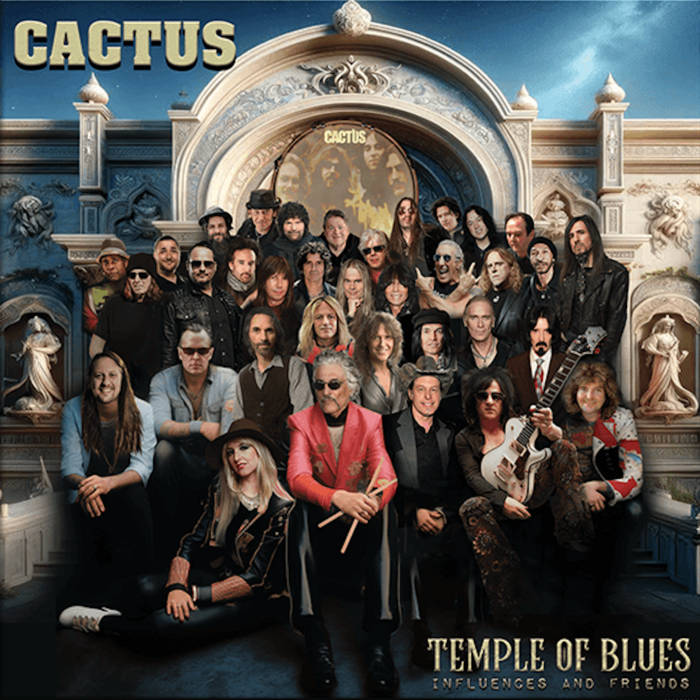
In the trivia department the ‘Temple of Blues’ cover shows a picture of the original Cactus lineup in the background arch of the temple (from left Bogert, Day, McCarty, and Appice) which comes from a trade ad that ran in a 1970 Billboard issue.

Source: Cleopatra Records. Graphic: Cactus Album Cover, Cleopatra Records copyright.

Before the Flood

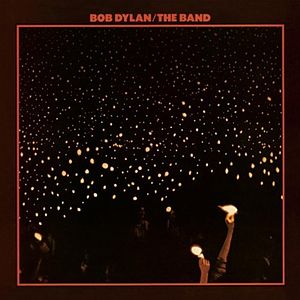
50 years ago, 20 June 1974, Bob Dylan and The Band released their double live album Before the Flood, peaking at number 3 on the U.S. Billboard 200 and going Platinum in the U.S. In addition to being Dylan’s first live album, the music was a compilation of Dylan’s greatest hits.

Stephen Thomas Erlewine of All Music comments “Dylan reworks, rearranges, reinterprets these songs in ways that are still disarming, years after its initial release. He could only have performed interpretations this radical with a group as sympathetic, knowing of his traits as the band, whose own recordings here are respites from the storm. And this is a storm — the sound of a great rocker, surprising his band and audience by tearing through his greatest songs in a manner that might not be comforting, but it guarantees it to be one of the best live albums of its time. Ever, maybe.”

Tom Nolan with Rolling Stone notes that “Throughout Bob Dylan‘s performances on this in-concert album there is evident an effort to match the material — nearly all from much earlier in his career — with a suitable style of delivery, a vocal stance which can express in a later year the brilliant and sometimes malevolent energy contained by these pieces when they were first created.”

The album was high energy, something that Dylan and the Band were not known for, but it brought a side to their music that, up till then, no one had experienced.

Source:  All Music. The Rolling Stone Album Guide. Graphic: Album Cover Before the Flood, copyright Columbia Records.

The House of the Rising Sun

The Animals, an English rock band, released the traditional folk song: The House of the Rising Sun, 60 years ago to great commercial success. It’s a ballad as a cautionary tale about living a life in New Orleans on the wrong side of right. The song possibly goes back to, in one version or another, England in the 1600s.

Alan Price, founding member and keyboardist of The Animals arranged the folk song with a bluesy rock twist. The band recorded the song in May of 1964 and released it as a single the following month.

The song attained the number 1 position on the English and U.S. charts and has been ranked by the Rolling Stone magazine and RIAA as one of the best songs of the 20th century. Along with The Beatles and Peter & Gordon, The Animals were part of the British Invasion of 64 that controlled the top chart positions in the U.S. for that year.

Source: All Music. Song Facts. Wikipedia. Graphic is the MGM cover.