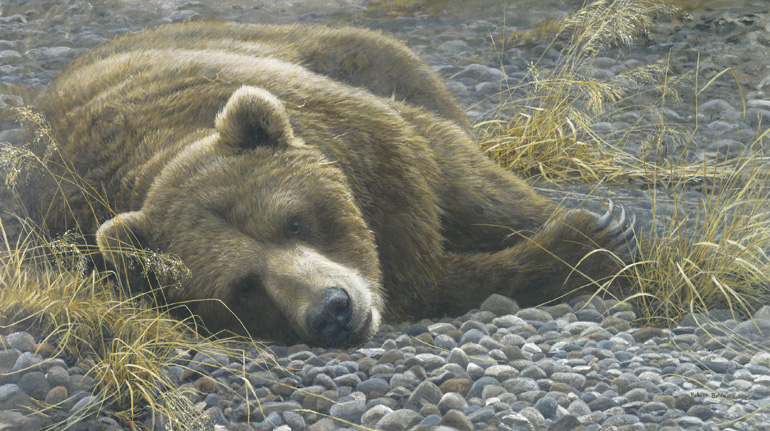
Robert Bateman, a Canadian artist from the school of Realism, paints wildlife with the precision of a photographer, leaving the viewer to ponder reality as it is rather than relying on the interpretation of the man with a brush. Bateman, explaining his motives, says, “I try to portray an animal living its own life independent of man.”
His paintings often place the subject tangentially, guiding the line of sight from the center to an edge where the action occurs. This composition suggests a reality beyond all living things, implying that we are all bit players, regardless of our size.
Bateman’s style is reminiscent of fellow Realist Andrew Wyeth, whom he acknowledges as a significant influence. However, Wyeth never entirely let go of his early impressionistic impulses. Roger Tory Peterson noted that while Wyeth froze his subjects in the moment, Bateman’s “subjects are ready to go somewhere else, to fly away,” allowing the reality of the moment to transition to another point in time, to a different reality.
Edgar Degas, an Impressionist Realist who combined realistic details of life with the softening blur of Impressionism, commented that one of the past masters of Realism, Jean-François Millet, painted so realistically that his work almost destroyed the profession. Wallace Stevens, a 20th-century modernist poet, took a different and somewhat counterintuitive view, stating that Realism is a corruption of reality. He believed that Realism reduced the complexity and beauty of the universe to the literal, leaving no room for the experience of humanity.
Both criticize Realism for its lack of emotion and interpretation, failing to observe that a gift from God is perfect as presented.
Source: The Art of Robert Bateman by Ramsay Derry 1981. Graphic: Grizzly at Rest by Robert Bateman, 2006.
 elsToday