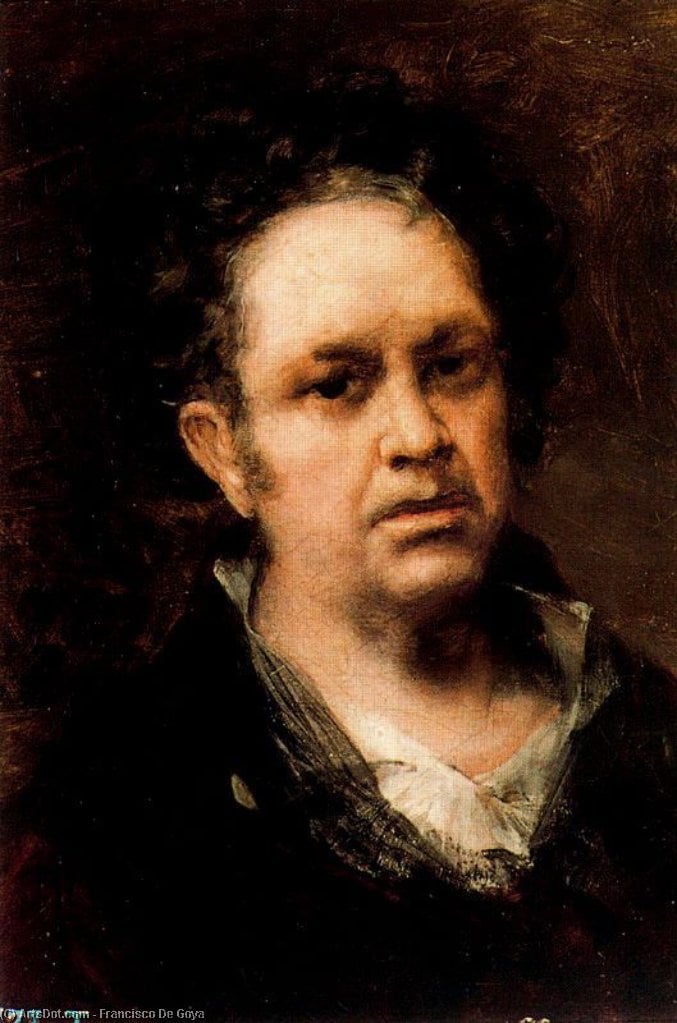
Francisco de Goya, a late 18th to early 19th century Spanish painter of the Romantic school, is a fascinating study in evolving style, a visual descent into deafness, isolation, and existential dread, though more philosophically, his lifelong disillusionment with civilization’s failure to embody the Enlightenment’s promised ideals of reason, justice, and human dignity. His art swung like a pendulum, from crisp detail to loose rendering to the raw emotion of a mind increasingly separated from reason.
As a court painter to the Spanish monarchy, Goya’s portraits became canvases for cynicism, derision, and paradox. He offered scathing critiques hidden beneath formal composition, and the court loved him for it. They mistook his precision for praise, even as he quietly dismantled their poise and splendor.
His colossal canvas Charles IV of Spain and His Family (110 × 132”) does not illustrate majesty or brilliance; it immerses the senses in familial estrangement and tedium. Awkward poses; lifeless gazes; a composition emotionally hollowed, drained of vitality and intent. These are not confident rulers but bored figures waiting for the dinner bell to summon a distraction: ceremonial chatter over fish soup and presentation of chocolates. In the background of the painting, Goya includes himself, brush in hand, an artist caught in the act of witnessing. It was a nod to Velázquez’s Las Meninas; Goya once said he “had only three masters: Nature, Velázquez, and Rembrandt”; but here, reverence turns to scorn. Goya didn’t flatter his subjects; he distorted the real, undermining not his own reverence for form, but theirs. His royal figures do not speak; they stare blankly, confirming that the emperor wears no clothes. He looked beneath the surface in search of beauty and instead found something far less attractive, an insignificant echo of a tired reality.
Goya’s notion of beauty, conventionally understood, remained intact. But in his subjects, he saw hypocrisy, a lie, elegantly draped, concealing the moral disfigurement beneath. This critique finds haunting expression in his etching Nadie se Conoce (“Nobody recognizes himself”), Plate No. 6 of Los Caprichos, where masked carnival patrons drift like phantoms of untruth. On the reverse of the plate, Goya inscribed his chilling reflection: “The world is a mask; the face, the costume, and the voice are all feigned. Everyone wants to appear what they are not, everyone deceives, and no one knows himself.”
Goya painted the existential. His late works: The Disasters of War, The Black Paintings, The Madhouse, Saturn Devouring His Son, reveal more of his suffering psyche than his technical ability. Anthony Cascardi argues in Francisco de Goya and the Art of Critique that Goya’s entire oeuvre is a sustained confrontation with Enlightenment ideals. Reason and beauty dissolve under his brush. Societal decay no longer whispers, it screams.
In style, Goya stands at the edge of the Impressionist movement, decades before its arrival. His gestural freedom, emotional brushwork, and psychological texture prefigure the rawness of Manet and even hint at Bacon’s existential grotesque. Paint becomes not just medium but mood, an extension of perception unraveling. Form overrides detail. But Goya moved to a darker rhythm, his brushwork shades where theirs shimmered. Where Monet dances with light, Goya wrestles with darkness. The Impressionists chose beauty over Goya’s emotional appeal, which ultimately served to mock his subjects’ feigned grace.
Unlike Picasso’s theatrical mockery, Goya’s assessment is surgical. He dispenses with pretense and seeks truth, not a truth easily embraced, but one rooted in the soul’s unpleasant, hidden recesses. Picasso once echoed a similar sentiment in a 1923 interview with The Arts: “Art is a lie that makes us realize truth, at least the truth that is given us to understand.” Art distorts to reveal what reality conceals, truth not always visible, but deeply felt. Superficial beauty without the soul is not art, it is a lie.
In contrast to today’s symbolic excess, where the subject is buried beneath concept and symbols, Goya’s portraits are revealing to the point of brutality. He doesn’t idealize; he removes the layers of deceit. The beast within becomes the subject. His cynicism is constant, his honesty sometimes absurd, but always truthful.
Goya takes a moral stance. His genius lies in the ability to paint the conscious with the unconscious, to render not just what he saw, but what he felt and feared, the form with the spiritual. His style matched his psyche. He painted the perceived rot beneath grandeur, the weariness behind powdered wigs, the absurdity beneath court spectacle.
Goya’s fame was built and balanced on a knife’s edge: he gave the rich what they wanted in form, while seeding beneath it a quiet, damning truth. That duality, beauty as lure, truth as blade, is Goya’s lasting contribution to art.
Graphic: Self-Portrait at 69 Years, by Goya, 1815. Museo del Prado-Madrid.
 elsToday