Trend Following: How to Make a Fortune in Bull, Bear, and Black Swan Markets
Michael W. Covel
Published by Wiley
Copyright: © 2017


(Note: This is the third of 3 reviews detailing the stories and methods of stock market trend followers and traders that collectively became known as ‘Turtles’. The following short bio is a repeat from the second post in this series.)
Biography:
Michael W. Covel, 54, born in Virgina, is an author of 8 books on markets and trading with a specialization in the market technical analysis known as trend following or ‘Turtle’ trading.
He also hosts a podcast, ‘Trend Following Radio‘, which he has, to date, recorded more than 1200 episodes. The podcast follows a format of interviewing leading authorities in economics, trading, and various other topics of interest to the investment world.
Market Players:
People analyzing and trading the markets fall into two distinct groups: fundamental and technical. Those taking a fundamental approach to the markets tend to be long-term investors whereas technical analysts have a short-term focus.
A fundamental analyst of the market keys in on news and financial data to assess the relative strength of a security. These investors tend to adhere to the Efficient Market Hypothesis/Theory (EMH or EMT): that individual securities are fairly valued. Inherent to this theory is that markets are rational. Stock prices reflect all the information available and are not affected by emotional spasms otherwise known as volatility. Ha.
Actually, volatility is a well-defined statistical measure of a stock’s price swings away from its mean. Large price swings equate to high volatility. High volatility stocks are riskier stocks to trade because the price swings are large and unpredictable. There are those on the technical side of trading that believe that volatility and risk are unrelated, but this always seems to be, at its core, a sematic argument. Additionally, higher volatility stocks have a higher price premium built into their option prices.
By sifting through mountains of market news and financial data investors are attempting to identify financially strong securities to hold for the long term. Also, in their quest to understand and know the markets and companies, they hope to uncover the rare, undervalued security which may lead to significant profit. Ironically, undervalued, aka value stocks, belie the premise behind the EMH. Doubly ironic, searching for value stocks is akin to unicorn hunting, neither exists in the real world, so why bother, in my most humble opinion.
The timing of entry to and exit from a market trade is the greatest pitfall for a long-term investor. A trade may take the price elevator south, accumulating significant losses before there is any data, or none, to support its rapid descent.
A technical analyst is only concerned with the security’s price, and its current trend. Is it going up, down, or sideways? There is a belief that technical analysts and traders are attempting to predict the future direction of security’s price, but this is incorrect. Technical traders, using statistical probabilities, attempt to take the path of greatest potential profitability. The greatest downside to technical trading is that all statistical analysis of a security or market is calculated from data derived from the past and the present but never the future so even with the best tools trends reverse themselves with warning.
Technical analysts like to think of themselves as card counters at a blackjack table trying to ascertain when the deck is heavy or light in high cards. A higher ratio of high cards favors the player. Stocks with a strong trend favor the trader. The problem with this analogy is that the US market has close to ten thousand ticker symbols that trade daily or to keep the metaphor intact about two hundred decks of cards for the card counting trader to digest.
Ten thousand securities, all with their own trend or no trend, all in constant state of flux, it is difficult to consistently pick the stocks with the winning trend. Losses are and will be incurred under the best of systems. Successful trend followers exit losing trades when they are down about 20%. Exit your losers and quickly to stay in the game.
Whether a fundamental investor or a technical trader, forecasting price is fraught with danger and losses. In the immortal words of Niels Bohr, father of the mathematical foundations of quantum theory: “It is very hard to predict, especially the future.” (Quote and variations sometimes attributed to others such as: Samuel Goldwyn, Yogi Berra, and Mark Twain)
Trend Following:
Covel’s ‘Trend Following’ deals with the technical analysis of the markets with a not so insignificant dollop of whining condescension directed towards the fundamentalists. The book is divided into three sections. The first two sections, written mainly by Covel, define and explain market technical analysis and trading along with seven in-depth interviews with successful trend traders. The concluding section is a collection of trend following research papers written by experts in the field of technical analysis and trading. Interspersed throughout the book are a plethora of epigraphs, epigrams, and aphorisms, ranging in worth from the profound to the quaint. Most are the equivalent of footnotes, sometimes useful and instructive, but mostly time-consuming and distracting.
The first edition in 2004 was a manageable 256 pages. The second edition in 2005 increased in size by 65% and totaled 420 pages. The 2009 third edition was even fatter with 464 pages. The fourth edition I can find neither hide nor hair of, but it likely experienced similar inflationary page count pressures. The 5th edition of this book comes in at an eye watering 688 pages: 578 pages of trending stuff and 109 pages of footnote/index stuff. Stuff is the correct word, mostly.
This book is beginning to resemble the 3-semester text for college calculus where every possible type of integral insists on its 15 minutes of fame. Teaching and learning take a back seat to the authors’ need to impress their peers. For the sake of future readers interested in trading on the price trend let us hope that Covel may stop adding material and start addressing the always interesting topic of concision.
Trend following, trend trading, momentum investing, ‘Turtle’ trading all refers to the same basic method of analyzing the market: probabilistic analysis of the current price and the trend of its price history. The concept of price and its trend is too simple of a concept for a good chunk of Wall Street traders to accept but we all follow trends without thinking. We follow the herd when deciding where to shop, what schools to send the kids to, what books to read. Why are stock price trends anathema to a good chunk of the investor class? Who knows? Ed Seykota, one the world’s most successful trend traders’ comments, “All profitable systems trade trends.” Trading at a profit or loss implies a trend.
To evaluate the results of trading on the trend requires a focus on absolute return. All that means is that one makes the most profit possible. Making the most requires that the trader be on the right side of the market at the right time. Being on the right side of the market starts with not fighting the trend, going with the flow. When the markets or security are on an upswing do not try to convince yourself that a downturn is imminent, even though trend reversals are common, betting on reversals is the road to bankruptcy. The trend is your friend. Stay friendly. Stay profitable.
Michael W. Covel Media:
- Trend Following: How Great Traders Make Millions in Up or Down Markets. Financial Times Management. 2004
- Trend Following: How Great Traders Make Millions in Up or Down Markets, New Expanded Edition. Financial Times. 2005
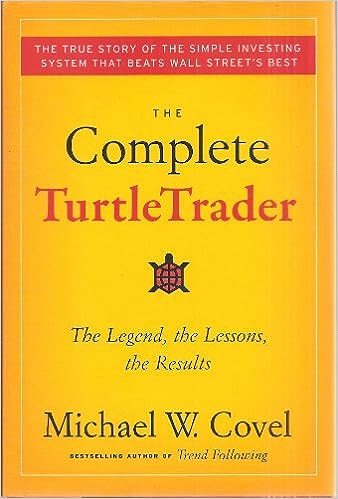
- The Complete TurtleTrader: The Legend, the Lessons, the Results. Collins. 2007
- Trend Following: Learn to Make Millions in Up or Down Markets, Updated Edition. Financial Times. 2009
- The Complete TurtleTrader: How 23 Novice Investors Became Overnight Millionaires: Paperback. Harper Business. 2009
- Trend Commandments: Trading for Exceptional Returns. Financial Times. 2011
- The Little Book of Trading: Trend Following Strategy for Big Winnings. Wiley. 2011
- Trend Following Analytics: Performance Proof for the World’s Most Controversial and Successful Black Swan Trading Strategy. Pearson Education. 2012
- Trend Following: How to Make a Fortune in Bull, Bear and Black Swan Markets, 5th Edition. Wiley. 2017
- Trend Following Mindset: The Genius of Legendary Trader Tom Basso. Harriman House. 2021
- Trend Following Masters – Volume 1: Trading Conversations. Harriman House. 2023
- Trend Following Masters – Volume 2: Trading Psychology Conversations. Harriman House. 2023
- Broke: The New American Dream. Film. 2011
- Michael Covel’s Trend Following. Podcast. 2012-2023
References and Readings:
- The Original Turtle Trading Rules. No personal attribution. Original Turtles.org. 2003
- Market Wizards: Interviews with Top Traders. By Jack D. Schwager. Wiley. 2006
- Who Were the Turtle Traders? No personal attribution. Managed Futures Trading. 2014
- Would the Turtle Trading System Work Now? By Ella Vincent. Trading SIM. 2020
- Turtle Trading: A Market Legend. By Michael Carr (Original Turtle). Investopedia. 2021
- Turtle Trading Tutorial. By Richard Cox. AskTraders. 2022
- Fundamental vs. Technical Analysis: What’s the Difference? By Christina Majaski. Investopedia. 2022
- Turtle Trading Rules: Does It Still Work Today? Rayner Teo. Trading with Rayner. 2022
- Efficient Market Hypothesis (EMH): Definition and Critique. Lucas Downey. Investopedia. 2023
- Volatility: Meaning In Finance and How it Works with Stocks. Adam Hayes. Investopedia. 2023
- Fundamental vs Technical Analysis. Hugh Kimura, Trading Heros. 2023
- Turtle Trading: History, Strategy & Complete Rules. By Leo Smigel. Analyzing Alpha. 2023
- Turtle Trading Strategy: Richard Dennis Rules, Statistics, and Backtests – Does It Still Work? No personal attribution. Quantified Strategies. 2023
- Original Turtle Trading Rules & Philosophy. By Michael W. Covel. Turtle Trader. No date
- Turtle Trading: What Is It and What Are the Rules? No personal attribution. IG Markets Limited. No date
- Rules to Use Turtle Trading Strategy. No personal attribution. MTrading. No date


 elsToday