Great art is the interpretation of great beauty. Art without aesthetic is something rawer, more fleeting, an attempt to conjure emotions that challenge the intellect but not necessarily feed the soul. Picasso and Pollock jolted the mind, often with a visceral, nihilistic force. Alfred Sisley, though, honored the soul, developing and refining an impressionistic palette of light and color on landscapes that captured nature’s beauty and humanity’s place in it throughout his career.
Alfred Sisley was born in Paris in 1839 to a prosperous English expatriate family. At 20, in 1859, he left for London to study business, prepping to succeed his aging father, then 58. But over four years there, he skipped lectures, haunting museums instead, captivated by art. Back in Paris by 1862, his parents relented, letting him trade commerce for canvas. Soon after, he met Monet, Renoir, and Bazille, and together they took to painting ‘en plein air’, in the open air, chasing light, color, and atmosphere over precision. From these outings, Impressionism took root.
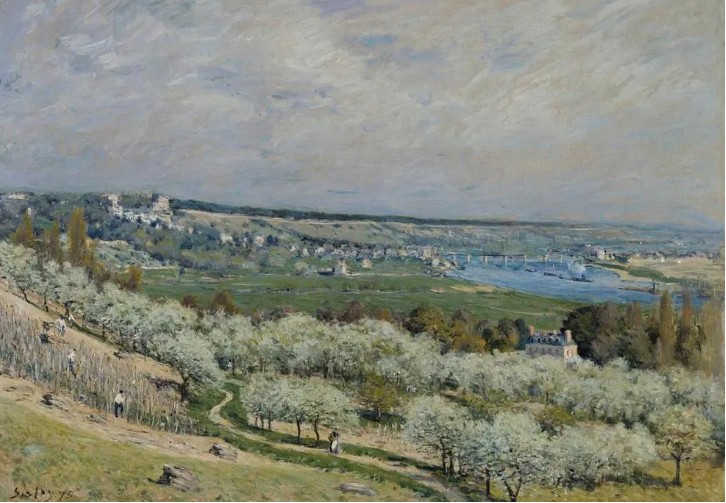
Sisley found inspiration and tranquility in the rural Seine Valley, just tens of miles from Paris, where he painted some of his most enduring landscapes. In The Terrace at Saint-Germain, Spring (1875), near his home, he bathes the valley in a tender, radiant light, blending nature and humanity into a soul-soothing vista. His works, unwavering in their beauty, stand as a testament to art’s power to nourish the spirit, a tribute to life’s grace.
Source: Sisley by Cogniat, translated by Sachs, 1979. Graphic: The Terrace at Saint-Germain, Spring by Sisley, 1875. Walters Art Museum, Baltimore.
 elsToday