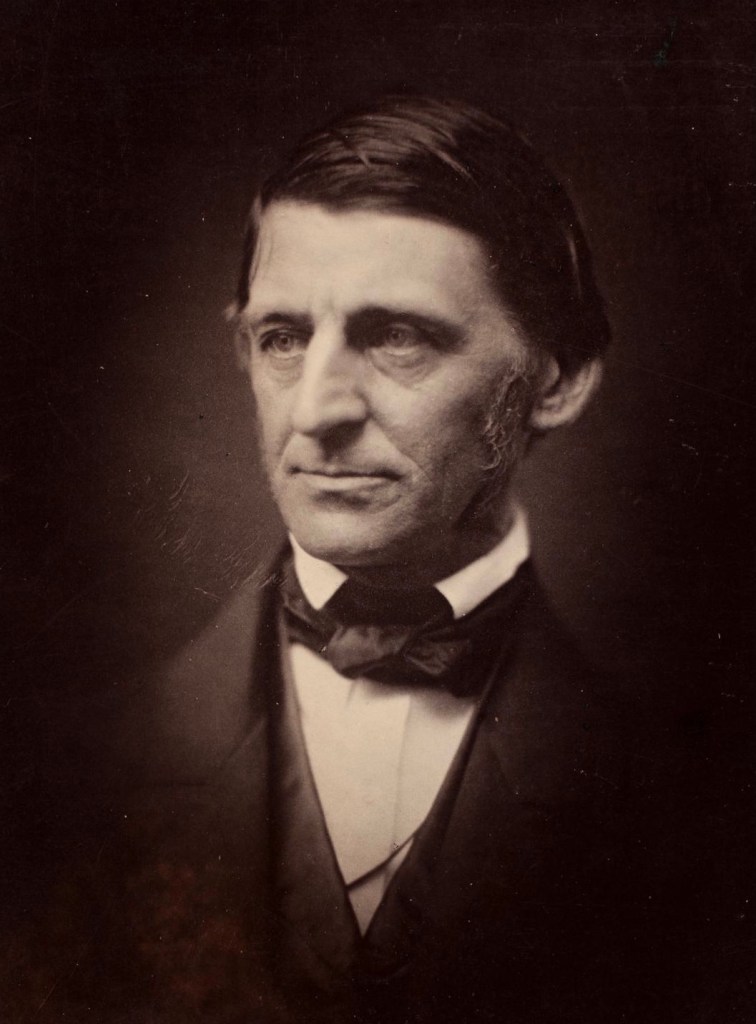
Ralph Waldo Emerson, author of the transcendental essay, “Self-Reliance” is often credited with saying, “When you strike at a king, you must kill him.” The exact setting and time for the quote is unknown but Ann Althouse believes it was said during a conversation with Oliver Wendell Holmes Jr., one of the most widely cited Supreme Court justices, after Holmes attacked Plato. Emerson’s parried with the quote above, meaning that if you strike at the philosopher king you must be thorough.
Niccolò Machiavelli, in his book “The Prince”, didn’t specifically mention the need to “kill the king” however, he did say, “If an injury has to be done to a man it should be so severe that his vengeance need not be feared,” and he also added “People should either be caressed or crushed. If you need to injure someone, do it in such a way that you do not have to fear their vengeance.”
Source: The Prince, Machiavelli. Emerson, Althouse Blog, 2019. Graphic: Emerson by Hawes, 1857, Public Domain.
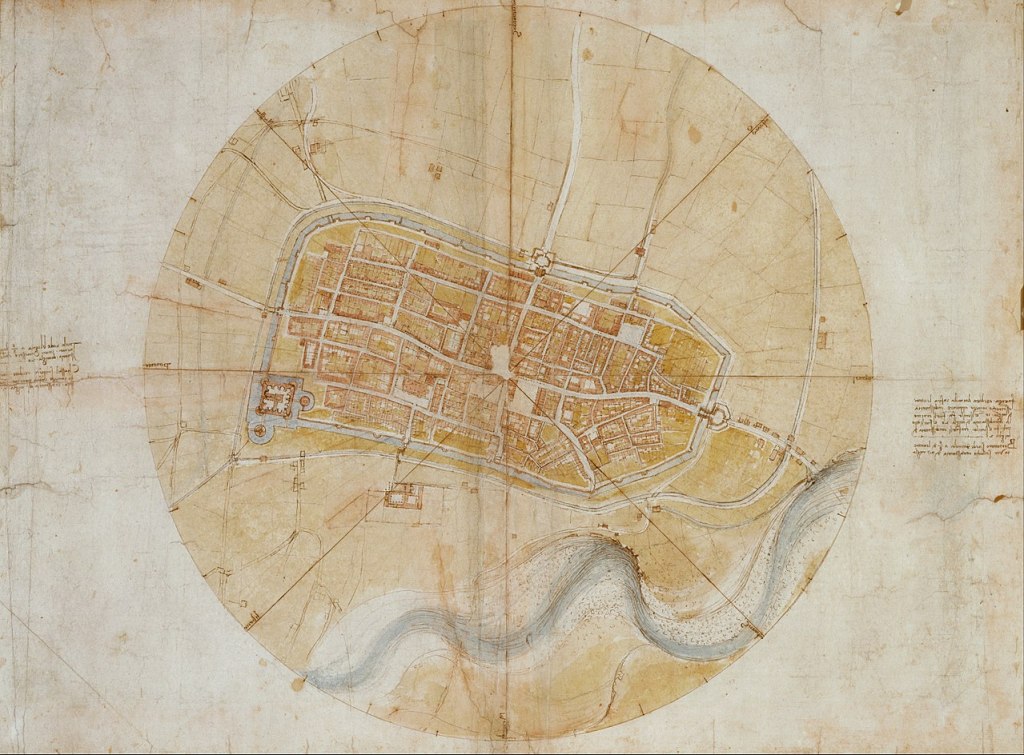
Leonardo, dreamer, artist, and scientist; Cesare Borgia, Cardinal, murderer, duplicitous tyrant; and likely subject of Niccolo Machiavelli’s book: The Prince, were holed up together for three months during the Renaissance winter of 1502-1503 in the five blocks by eight blocks Italian walled garrison town of Imola.
According to Walter Isaacson in his 2017 “Leonardo da Vinci” biography he states that, “While he was in Imola with Machiavelli and Borgia, Leonardo made what may be his greatest contribution to the art of war. It is a map of Imola… It is a work of beauty, innovative style, and military utility…Drawn in ink with colored washes and black chalk… The aerial view is from directly overhead, unlike most maps of the time. On the edges he specified the distances to nearby towns, useful information for military campaigns…”
Cesare Borgia (1475-1507), backed by his father Pope Alexander VI, was on a military campaign to carve out his own personal princedom, by hook, crook or force. He had moved his court to Imola to further plans for his conquest of the area. Leonardo da Vinci (1452-1519) was there because he had signed on as Borgia’s chief military engineer. Leonardo’s task was to reinforce castles and defenses in the region and construct new military machines based on his notebook designs such as his rapid-fire projectile weapon, armored car, helicopter, and giant crossbows; none of which were ever built in his lifetime. Niccolo Machiavelli (1469-1527), was dispatched by the Florentine authorities as a diplomat to discern Borgia’s intentions towards the city and dissuade him, if possible, from attacking Florence.
As an aside, Friedrich Nietzsche (1844-1900), German philosopher and critic, introduced the concept of Ubermensch: an idealized individual who transcends conventional morality and societal norms. Nietzsche elevated Borgia to this lofty status. Borgia’s daring, ruthlessness, and strategic cunning seemed to align with the philosopher’s ideals of a powerful individual who creates his own fate. Many have split hairs with Nietzsche’s concept of Ubermensch but when one creates his own morality it is hard to distinguish the end result from that of a psychopath.
Shown above is Leonardo’s map of Imola drawn in 1502-03. Public domain.
Shown above right is a Friedrich Nietzsche, circa 1975. Photo by Friedrich Hartmann. Public domain.

 elsToday