MIT researchers found that Large Language Models (LLMs), although able to output impressive results without internal understanding of the data they manipulate, were unable to cope with small modifications to their data sets.
The researchers discovered that an LLM could provide correct driving directions in New York City while lacking an accurate internal map of the city. When they took a detailed look under the LLM’s hood, they saw a map of NYC that included many nonexistent streets superimposed on the real grid. Despite this poor understanding of actual streets, the model could still provide perfect directions for navigating the city—a fascinating “generativegarbage within, Michelangelo out” concept.
In a further twist, when the researchers closed off a few actual streets, the LLM’s performance degraded rapidly because it was still relying on the nonexistent streets and was unable to adapt to the changes.
Source: MIT. “Despite Its Impressive Output, Generative AI Doesn’t Have a Coherent Understanding of the World.” ScienceDaily, 2024. Graphic: AI istock.
The United States Air Force commissioned the Massachusetts Institute of Technology’s Lincoln Laboratory to design and build a series of satellites, known as Lincoln Experimental Satellite (LES), that would test both devices and techniques for satellite communication. The stated goal was to increase the downlink transmission capabilities of small satellites. The development phase of the program ran from 1965 to 1976 but the last satellite developed, LES-9, continued to transmit data for 44 years until it was decommissioned in the year 2020.
FootnoteA
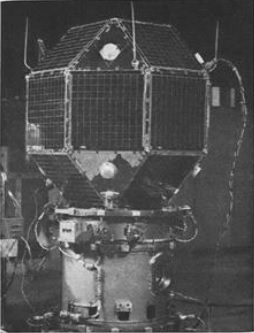
The first satellite the Lincoln Laboratory developed was the LES-1. It was designed to test a solid-state X-band transmitter while in orbit above the Earth. A ground-based mobile receiver was also part of the test package.
The LES-1 was a 26-sided polyhedron, with eighteen square faces and eight triangular faces. Also known as a rhombicuboctahedron, a small rhombicuboctahedron, or an Archimedean solid, if you really must know. It had a diameter of 61 cm (24 inches) and a mass of 31 kg (68 lbs.). The square faces were covered with 2,376 solar cells generating a minimum of 26 W in sunlight. The eight triangular faces held Earth and Sun sensors and eight semi-directional horn antennas.
FootNoteB
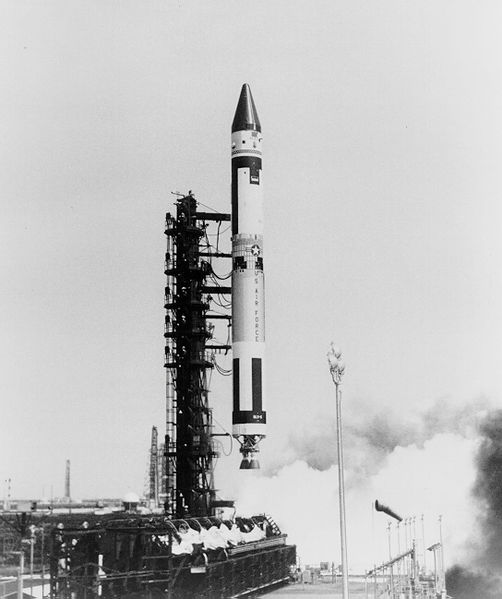
The satellite was launched on a Titan 3A rocket which was a modified two-stage Titan 2 ICBM with a third stage added. The rocket lifted off from Kennedy Space Center on 11 February 1965 and the first two stages performed their mission successfully. The third stage after its first burn placed the satellite into its planned 185-kilometer (115 mile) orbit. The second burn of the third stage moved the satellite into a 2,777 by 2806 kilometer (1726 by 1744 miles) slightly elliptical orbit. At this point, the satellite was deployed with a destination of 18,500-kilometer (11495 mile) apogee orbit. Because of a malfunction the smaller attached satellite rocket didn’t fire, and the satellite remained in its 2,777-kilometer orbit. Despite this failure, the project was still able to collect some useful data, but the satellite was spinning out of control making continued operations difficult. The LES 1 was shut down in 1967.
On 18 December 2012, the satellite woke up after 46 years of silence. A signal from LES 1 was detected in North Cornwall, England by an amateur radio operator. It is believed that a short developed in the satellite which allowed its power system to reach the transmitter directly. The signal being transmitted is believed to be a test tone but because the satellite is tumbling it sounds ghostly and garbled.
As of 2022 the satellite is still transmitting. It is now referred to as a zombie satellite.

 elsToday