Bloomberg’s Mark Gongloff postulates that the market’s next Black Swan event will be related to climate change like the Amazon rainforest’s dieback or the permafrost melts and releases all its stored methane and CO2. These events or any catastrophic climate-related event could cause the stock market to lose 40-50% of its valuation. Since we are at it, so could nuclear winter, a 6-mile-diameter asteroid hitting Wall Street or a super volcano blowing Wyoming to the Moon.
By definition, black swan events are not predictable. Some may seem inevitable in hindsight but predicting is difficult especially the future:)
To put a 40-50% climate induced market drops in context, during the great depression the market dropped 83%, 1937-38 just prior to WWII it was 84%, 1973-74 48%, dot.com bubble 49%, mortgage bubble 56.7%, and during covid 34-37%. So, been there, done that, lived through it.
This prediction is based on a study by EDHEC-Risk Climate Impact Institute in London. Gongloff fails to explain how the study reached its market conclusions or what the probability is of the climate events even happening. He just says that the sky is falling.
Gongloff states that a key finding of the study is that climate change damage isn’t priced into the market yet. Gads, this revelation comes from someone working for Bloomberg. The market can’t even price in tomorrow’s JOLTS report much less a possible 2 degree rise in temps by 2100.
‘What if’ scenarios are academically interesting, occasionally, but usually not informative, educational, or worth the resources that produced the study. If a business school could correctly predict Fed interest rate movement for this year rather than forecasting the end of the world in 50 years, I may sit up and listen. Until then–meh.
Source: ‘The Market’s Next Black Swan is Climate Change’ by Mark Gongloff, Bloomberg, 19 July 2024. Understanding Market Corrections by Wes Moss, 2018. Graphic: Black Swan, AI generated, 2024.
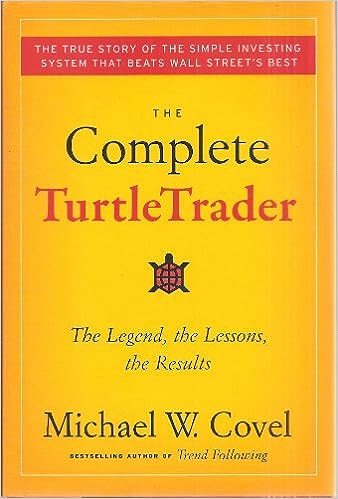
(Note: This is the second of 3 reviews detailing the stories and methods of stock market trend followers and traders that collectively became known as ‘Turtles’.)
Michael W. Covel, 54, born in Virgina, is an author of 8 books on markets and trading with a specialization in the market technical analysis known as trend following or ‘Turtle’ trading.
He also hosts a podcast, ‘Trend Following Radio‘, which to date has recorded more than 1200 episodes. The podcast follows a format of interviewing leading authorities in economics, trading, and various other topics of interest to the investment world.
The previous post, ‘Turtle of the First’ was from the perspective of Curtis Faith who, in 1984, began his trading career in the first class of Richard Dennis’ ‘Turtles’. Michael Covel’s book is from the perspective of an outsider looking in. Before moving onto Covel’s story a quick recap from the previous post.
In 1983 Richard J. Dennis and his partner at C&D Commodities, their Chicago trading firm, budgeted $15,000 to run a recruitment ad in the Wall Street Journal, Barrons, and the International Herald Tribune seeking recruits to train in futures trading:
…Mr. Dennis and his associates will train a small group of applicants in his proprietary trading concepts. Successful candidates will then trade solely for Mr. Dennis: they will not be allowed to trade futures for themselves or others. Traders will be paid a percentage of their trading profits, and will be allowed a small draw. Prior experience in trading will be considered, but is not necessary. Applicants should send a brief resume with one sentence giving their reasons for applying…
From Richard J. Dennis et al ad in the above-mentioned newspapers and magazine.
From the replies to his ad Dennis chose 23 inductees into the ‘Turtle’ program that included college graduates with degrees in accounting, business, economics, geology, linguistics, marketing, music, and the US Naval Academy. Those from the paycheck world he picked a security guard, salesperson, broker, phone clerk, bartender, board game designer, and someone who listed himself as unemployed. An eclectic bunch for a very structured task indeed.
Dennis was looking for high IQ types willing to break from the herd and take risks. Intelligently calculated risks to be precise.
Dennis and his partner William Eckhardt taught the students in a conference room, not the trading pits, all they needed to trade in two weeks. Each student received $1 million to trade and was allowed to keep 15% of the profits.
They had one objective. Make as much money trading, on their terms, as humanly possible. It was definitely high risk, but the rewards were commiserate. The persistent need to win was mandatory if they were to survive as a ‘Turtle’.
Dennis insisted that to win, his students must always question conventional wisdom. He knew from experience in the trading pits that the majority opinion was wrong a majority of the time along with information coming from the news sources.
‘Turtles’ were discouraged from following the news, reading economic reports, or collecting stock tips because the markets move faster than information can be assimilated into the market. Or in other words information didn’t move the markets; people trading, often irrationally, did.
Conventional wisdom on Wall Street was to buy low and sell high. ‘Turtles’ tossed the conventional wisdom, bought high, and sold higher or shorted new lows.
Dennis and Eckhardt taught the ‘Turtles’ to follow the trend. They waited for the market to move then they followed it. Capturing most of the trend, up or down, was the goal.
They determined when to buy high, or to short stocks going lower, by observing breakouts in the markets or securities. If a stock made a new 20 or 55 day high, they bought the stock. If it made a new 20 or 55 day low, they shorted the stock. If the trend continued in the desired direction, they bought, or shorted, more of the stock. When the trend ended they sold.
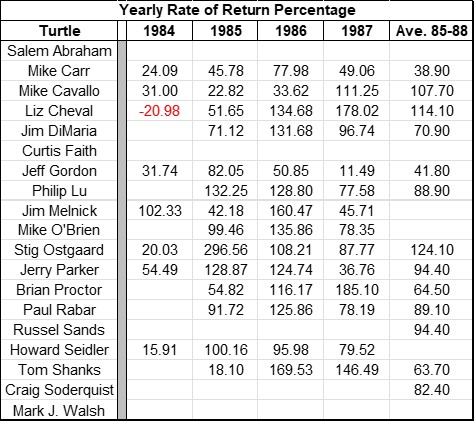
It was a simple system and it worked exceptionally well for the ‘Turtles’ who collectively made profits of $175,000,000 over the 5 years they worked for Dennis’s firm. The spreadsheet to the right shows the individual ‘Turtle’ results while they were working for Dennis (source: Covel and the Wall Street Journal – not all ‘Turtles’ listed)
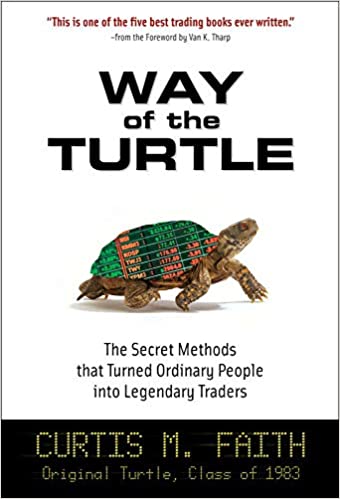
(Note: This is the first of 3 reviews detailing the stories and methods of stock market trend followers and traders that collectively became known as ‘Turtles’. Curtis Faith was a turtle and a trader. The two reviews following this one concern publications by Michael Covel a market writer and trading coach who has lectured and written extensively on trend trading and Turtles.)
In 1983 Richard J. Dennis and his partner at C&D Commodities, their Chicago trading firm, budgeted $15,000 to run a recruitment ad in the Wall Street Journal, Barrons, and the International Herald Tribune seeking recruits to train in futures trading:
…Mr. Dennis and his associates will train a small group of applicants in his proprietary trading concepts. Successful candidates will then trade solely for Mr. Dennis: they will not be allowed to trade futures for themselves or others. Traders will be paid a percentage of their trading profits, and will be allowed a small draw. Prior experience in trading will be considered, but is not necessary. Applicants should send a brief resume with one sentence giving their reasons for applying…
From Richard J. Dennis et al ad in the above-mentioned newspapers and magazine.
The ad was the opening volley to proving a nature versus nurture disagreement between Dennis and his partner William Eckhardt. Dennis believed successful trading could be taught. Eckhardt, a mathematician by training turned trader, believed trading was innate, natural, inborn. You either had it or you didn’t, and no amount of teaching could change that.
To settle the debate Dennis agreed to teach his trading style and rules to a select group, letting them learn the craft using his money. From the firm’s ad and a follow-up true and false questionnaire they cobbled together a group of candidates, 23 in two tranches of 14 and 9 that were taught the firm’s trading rules. The traders came to be known as ‘Turtles’ because Dennis had seen a turtle farm, of all things, in Singapore and he believed he could raise traders as efficiently as Singaporeans raised turtles.
Over the next 5 years the ‘Turtles’ as a whole earned, made is probably a better word, $175,000,000. Dennis won the bet, but he worried that no amount of instruction could ultimately overcome human nature. Not sure if the following quote is a contradiction or just plain old irony but he worried his ‘Turtles’ couldn’t remain true to their training, stating “I always say that you could publish my trading rules in the newspaper, and no one would follow them. The key is consistency and discipline. Almost anybody can make up a set of rules that are 80% as good as what we taught our people. What they couldn’t do is give them the confidence to stick to those rules even when things are going bad” (from Market Wizards, by Jack Schwager).
Curtis Faith was a ‘Turtle’ selected in the first group and began trading under Dennis and Eckhardt’s tutelage in 1984. He was C&D Commodities’ most successful student, reportedly earning $31.5 million for the firm by the end of the experiment. To put that into context the 23 ‘Turtles’ as a whole averaged a little over $7.5 million each. Some twenty plus years later Faith published a book detailing his experience and methods living in ‘Turtle Time’ during the 1980s (apologies to Danny Flowers and Don Williams).
Faith was a risk taker, and he was probably the greatest risk taker of all the ‘Turtles’, even greater than Richard Dennis. Taking and managing risk is what traders do. They buy and sell risk. And you need nerves of steel or as Dennis states above: discipline. When managing risk, one needs a plan to get into a security and a plan to get out. In the immortal words in Don Schlitz’s 1976 song ‘The Gambler‘ made famous by Kenny Rogers: “You got to know when to hold them, know when to fold them…”
Traders buy and sell liquidity and price risk. Market Makers trade liquidity–making money off the spread between buy and sell prices. Speculators trade price risk. Buying low and selling high. Or with ‘Turtles’ buying high and selling higher or vice versa.
Speculators are not long-term investors. Speculators are short-term traders who have no desire or need to find the intrinsic or fundamental value of any security. Their only concern is price and which way is it moving; up, down, or sideways. The statistical analysis of price momentum and sometimes volume are the tools of the trade for the short-term speculators. This is usually referred to as technical analysis and technical trading.
Turtles are speculators, technical traders, playing trends in price that may not have a fundamental basis. Price trends without a fundamental basis are almost by definition irrational.
Adam Smith in his ‘Wealth of Nations’ postulated the first form of the Rational Choice Theory, that an individual’s actions are mostly selfish, which he dubbed the ‘Invisible Hand’. The theory suggests that individuals act in their own best interest and that their behavior is rational. At the beginning of the 20th century the hypothesis that the markets are efficient and rational began to take hold among traders and economists. This led to the Efficient-Market Hypothesis (EMH) or Theory that maintains that valuations or prices for assets such as stocks and bonds reflect all available information and are fairly valued. Only added information will then affect the price of an asset. This implies that it is impossible to beat the market. Just invest in DIAs, IWMs, SPYs, and QQQs and forget about them until you retire.
Faith and the Turtles say bunk to all that market rationality and index investing. Technical trading and trading like a turtle works because market movements are driven by the irrational collective behavior of the market participants or so they believed.
Turtles were trend followers attempting to take advantage of large price increases or decreases over a period of several months. Significant profitable trends happen infrequently with a high percentage of promising trend trades turning south soon after placing them. They experienced significantly more losers than winners but exited their losses quickly, usually around 20% below entry price.
Following trends is geared towards the present and what the market is currently doing. It is never about trying to predict the future. They entered trades when the calculated probabilities, through technical analysis, were in their favor.
The Turtle method was simple and easy to understand. The strategy could be summed up in one sentence. Trade with an edge, manage risk, be consistent, and keep it simple.
Trade with an edge. Have a plan and stick to it. Through experience or preferably back testing find a trading strategy that will have positive returns over the long run.
Manage your risk. Control your risk or in other words don’t bet the bank on a single trade and don’t hang onto your losers hoping for a turnaround.
Be consistent in executing your strategy. Do not jump into trades that look interesting but fail the tactical elements of your plan.
Keep it simple and follow your plan. Most of your trades may be losers but the winners will make up for the shortfall or drawdown. Think in terms of the long game and don’t fixate on the individual losing trades.
The Turtles tactics used in implementing their strategy were also simple.
Turtles traded liquid futures such as commodities, currencies, metals, energy, and bonds.
The Turtle’s most complicated tactic was position sizing the trades. Generally, the more liquid the market the fewer the contracts they traded.
The Turtles identified trends using two similar systems employing price breakouts at 20 and 55 days. They tried to enter as many of these breakouts as possible so as not to miss out on the rare but very profitable, large price movements.
All trades had stop losses.
Trade exits were set as a 10-day low for long positions and a 20-day high for shorts. They never exited a trade at maximum profitability but only when the end of the trend was evident.
Simple stuff and they made $175,000,000 with it. Dennis reportedly made $200,000,000 trading his own account.



 elsToday