The Fable of the Turkey

Drum, a plump turkey, trusted his caring master, Strum, who fed him daily and cooed, “You’re the finest bird here.” Drum, a data geek, tracked his weight, 18 pounds on day 300, projecting 24 by day 400. On day 364, a Wednesday, he lost his head and some weight. By Thursday, day 365, Strumpf found him tasty, and his weight hit zero. Blind trust in trends can carve you up.

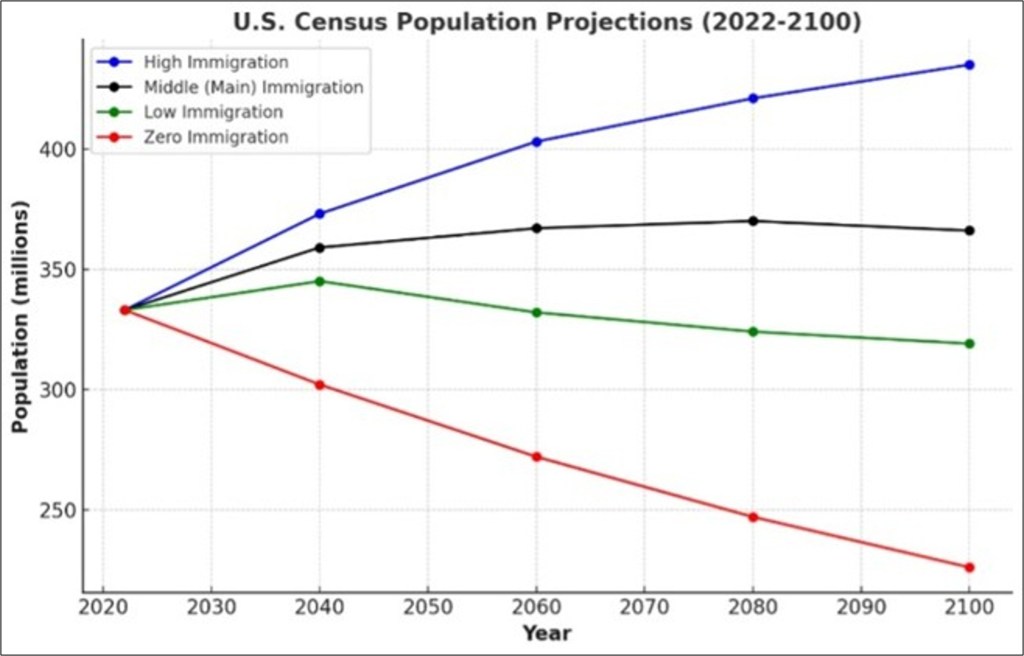
The Census Bureau’s 2023 Population Projections for the U.S. to 2100 play the same game. This “projection, not prediction” uses births (Total Fertility Rate, TFR, at 1.6), deaths, and net migration, spinning four population scenarios: Zero Immigration (333 million today drops to 226 million, down 32%), Low (down to 317 million), Main (up to 369 million), and High Immigration (435 million with 1–1.5 million newcomers yearly). Only immigration increases the population; births and deaths stay flat. It’s 78 years built on 2–3 years of data; no risks, no “what ifs,” no alternatives.

This is a house of cards sold as insight. Projections might hold up in the short term, but 78 years? Please. The Census Bureau, I assume, pitches this study for policy, budgets, districts, but it’s a narrative push: immigration or bust. Zero immigration craters us to 226 million; 1.5 million new bodies annually swells the population to 435 million. Yes, immigration boosts numbers, but why’s it the only solution? No probe into low births, no fixes beyond “import more bodies.” It’s not analysis, just bait for Congress and the public.

A growing or declining population has consequences. A 30% drop could tank GDP and programs such as Social Security. Or yield cheaper homes and a leaner U.S., like Japan (96 million by 2050, still thriving). Growth has costs too, more support for Social Security but more sprawl, maybe more crime, resource strains but the Census skips over those trade-offs. And a low TFR isn’t fate. The WWII generation raised four kids on $60,000 (adjusted) when homes were $12,700. Now we have $420,000 homes, $65,000 wages, and $10,000-per-kid childcare, maxing out affordable families at two. Inflation (2%+ since ‘71) and $36 trillion in debt, increasing by a trillion every 3 months, destroyed the dollar and concomitantly the Federal Reserve and government killed big families.

Increasing family size is a choice. Possible solutions to reverse the trend are tax credits at $5,000 per kid, or even an expanding credit for each additional child above 2, could lift TFR from 1.6 to 2.1 by 2035. That’s 700,000–1 million extra births annually within a decade, millions more Americans by 2050, no immigration spike needed. Cut housing costs by slashing senseless regs, open land to building, drop mortgage rates to 1%) and one income might work again. A declining family size is a choice, not a given.

The Census Bureau releases raw numbers, no “why,” no debate. Immigration’s one fix but not the only one. The government broke the system; it can unbreak it. Next time, Mr. Census Bureau, ask some questions, beyond just slinging spurious stats to support a preferred narrative.

Source: Census Bureau, The Black Swan, Fable of the Bees.  Graphic: Population Projections by the Census Bureau.
14th Amendment

The 14th Amendment, introduced during the Reconstruction era, was crafted to address legal and constitutional deficiencies exposed after the U.S. Civil War. Its first sentence; “All persons born or naturalized in the United States, and subject to the jurisdiction thereof, are citizens of the United States and of the State wherein they reside“, has become a focal point for competing interpretations. Much like the Second Amendment, its wording has sparked legal and grammatical debates, particularly surrounding the clause “and subject to the jurisdiction thereof.”

The Second Amendment faced similar scrutiny for over 200 years, particularly its prefatory clause, “A well-regulated Militia.” This ambiguity was finally addressed in District of Columbia v. Heller (2008), where the Supreme Court clarified that the historical record and documents like the Federalist Papers supported the right of private citizens to own firearms. The Court also ruled that the prefatory clause did not limit or expand the operative clause, “the right of the people to keep and bear Arms, shall not be infringed.

Likewise, the 14th Amendment’s clause “and subject to the jurisdiction thereof” remains unsettled, awaiting similar historical and grammatical scrutiny to solidify its interpretation. Initially aimed at protecting freed slaves and securing their citizenship, this provision has since invited broader interpretations in response to modern challenges like immigration.

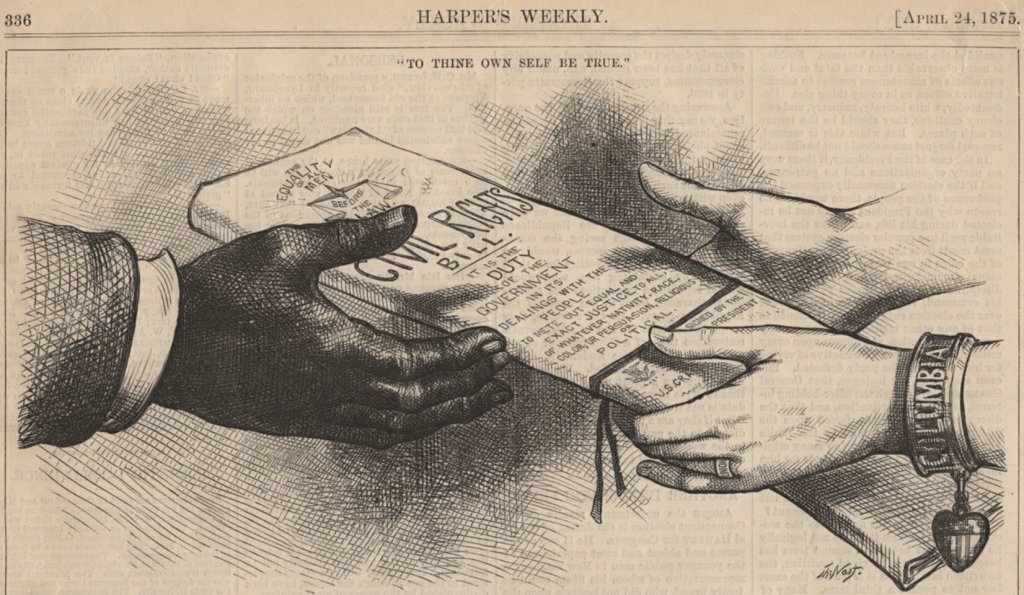
The framers’ intent during Reconstruction was to ensure equality and citizenship for freed slaves and their descendants, shielding them from exclusionary laws. At the time, the inclusive principle of jus soli (birthright citizenship) aligned with the nation’s need to address the injustices of slavery and foster unity among the country’s existing population. However, changing migration patterns and modern cultural dynamics have shifted the debate. The ambiguity of “subject to the jurisdiction thereof” now raises questions about its application, such as how jurisdiction applies to illegal immigrants or children of foreign diplomats, in a globalized world.

Legal precedents such as United States v. Wong Kim Ark (1898) affirmed that nearly all individuals born on U.S. soil are citizens, regardless of whether their parents’ immigration status is legal or illegal. While this aligns with the practical interpretation of jurisdiction, it has spurred debates about the fairness and implications of modern birthright citizenship practices.

Immigration today involves a broader spectrum of cultures and traditions than during earlier waves, when newcomers often shared cultural similarities with the existing population. Assimilation, once relatively seamless, now faces greater challenges. Nations like Britain and Germany have recently revised their jus soli policies to prioritize the preservation of societal norms. The unresolved question of how to address declining populations further complicates the debate; a debate with the citizens that has not occurred much less resolved.

While originally crafted to address the systemic exclusion of freed slaves, the 14th Amendment’s principle of birthright citizenship continues to evolve in its application.

Graphic: 14th Amendment Harper’s Weekly.