Fed Independence or Not

For more than a century, the independence of the Federal Reserve has been treated as the holy grail of policy dogma. Economists defend it as the firewall shielding monetary policy from the passions of electoral politics and politicians. Journalists speak of it with the same reverence they reserve for constitutional rights. Yet beneath this vow of righteousness and infallibility lies an implicit assumption. That fiat money is a stable, coherent, self‑sustaining system. Once this assumption begins to decay, the entire debate over Fed independence reveals itself as no more than a side-show distraction; a nonsensical argument about who gets to captain a grounded ship.

To understand why, one must begin with the nature of fiat itself. Fiat money is often described as being “backed by the full faith and credit of the government,” and faith is the key word. Fiat is a belief system. Not belief in metaphysical truths or moral principles, but belief in a story. A narrative about competence, stability, continuity, and trust. Fiat works when people believe that the institutions issuing it are capable stewards of their money and future. It works when inflation is low enough to ignore, debt stays at acceptable levels, political institutions appear stable, and the public assumes that tomorrow will be much like today. And, a really big and, above all, the Fed must appear to know what it’s doing. “Forever QE” and transitory inflation are not words of assurance, but policy choices to mask underlying problems.

Belief is the core mechanism to fiat. It is the glue that holds the system together. And it is very, very fragile. Fiat has no basis in physical reality. It is not tied to energy, or production, or land, or gold, or work, or any measurable capacity of the world. It exists entirely on expectations. And the expectations are inherently psychological and political. When the story is coherent and the holders feel safe, fiat, like Plato shadows on the wall remain acceptable and real. When the story becomes visibly illogical with inflation and high debt coming into sharp focus, belief drifts from acceptance to catastrophic loss. Gradually at first, and then suddenly, as Hemingway described bankruptcy. Bankruptcy of everyone all at once.

The Federal Reserve’s role is to maintain the story of competence and solvency. Its tools: interest rates, liquidity operations, forward guidance, balance‑sheet adjustments, do not directly control the real economy. They shape expectations. The Fed is, in a very real sense, the narrator of the monetary story. Its independence is meant to signal that the narrator is trustworthy, competent, that the story is objective, that the governing institution stands above politics. Cutting the federal funds rate on the eve of an election can shatter that trust and illusion of independence in an instant. And when the story itself begins to lose coherence, the independence of the narrator becomes irrelevant. The problem is not who tells the story. The problem is that the story no longer matches people’s experience. At that point, belief collides with reality, and reality wins: holders of paper lose.

Over the past several decades, the narrative foundation of fiat has weakened precipitously. Inflation, once subdued after the Fed Chairman Volcker era, has returned in unpredictable waves. Sovereign debt has grown to levels that strain the imagination. Political polarization has eroded institutional trust and effectiveness. Global supply chains have been revealed as suppressors of the middle-class and gross vulnerabilities to national resilience. Geopolitical tensions have dissipated the assumption of a unified global monetary order. And digital alternatives, however imperfect, have demonstrated that fiat’s monopoly is not certain. Crypto’s rise is not evidence of crypto’s strength; it is evidence of fiat’s weakness. Gold’s relentless upward march mirrors fiat’s decline. Gold is a search for monetary stability: an anchor to stop loss of value in a monetary system. BRICS nations are attempting to offer an alternative narrative, but their proposals remain variations on the same theme. The world is searching for a different narrative, a new anchor, something beyond blind faith.

Both the United States and BRICS are trapped in the same deception: that the future will be won by whoever controls the existing fiat narrative. Each is fighting to preserve a version of monetary primacy that no longer commands the world’s confidence. The deeper problem is not mismanagement but design: fiat systems decay because their value depends on political restraint, institutional credibility, and collective belief. All these factors erode over time. Fiat invites the very forces it claims to contain: short‑termism, opportunism, fiscal excess, and the slow erosion of incentives. Whether issued by Washington or by BRICS, a fiat regime remains vulnerable to the same pressures of politics, greed, and narrative manipulation. The real challenge is not choosing the next steward of fiat but recognizing that the architecture itself guarantees monetary decline and eventual failure.

Gold once provided stability but lacked liquidity; it could not expand fast enough to support a growing credit economy. Fiat solved the liquidity problem but forfeited stability, allowing credit to expand faster than real output. The mechanism changed, but the boom‑and‑bust cycles did not. A century of data shows that recessions occur with almost the same frequency as before. The tools of modern central banking: interest‑rate adjustments, balance‑sheet expansion, crisis intervention, can shape expectations temporarily, but they cannot alter the deeper forces that drive credit economies.

This is why the debate over Federal Reserve independence is the wrong question. Independence gives the Fed room to act, but it does not give it the power to cure the system’s structural instability. Modern monetary policy resembles a doctor endlessly adjusting a patient’s blood‑pressure medication: the dosage changes constantly, the treatment never ends, and the underlying condition remains untouched. When inflation rises, the Fed tightens; when markets wobble, it loosens. These actions contradict each other because they target symptoms, not causes. The Fed cannot control the human impulses that generate leverage, speculation, fear, political pressure, and herd behavior. It can only dampen the consequences, usually at the cost of accelerating fiat’s long‑term decline.

The persistence of recessions before and after the Fed reveals the deeper reality: the problem is not the monetary mechanism but the nature of a credit‑based economy itself. Gold failed because it was too rigid; fiat struggles because it is too flexible; Bitcoin, more commodity than money, will fail for the same reasons gold failed, its supply is perfectly inelastic and its price too volatile. And Stablecoins add nothing new; they are simply fiat in a crypto wrapper. Every architecture confronts the same contradiction: money must be stable enough to be trusted yet elastic enough to support lending, investment, and crisis response. No system has ever resolved this conflict because the real driver of instability is not gold, fiat, or Bitcoin. It is the cycle of human behavior interacting with credit. Until that changes, the mechanism will change its shape, but the outcomes will remain the same.

If fiat is losing its narrative monopoly, what replaces it? Crypto attempted to answer this question with mathematics and a limited supply. Gold answered it with geology and limited supply. Commodity baskets answered it with diversification around hard assets. But none of these fully solve the problem. Crypto is digital gold. Gold is rigid and insufficient for a modern credit economy. Commodities are volatile and become incoherent during panics. Attempting to replace human need with symbols fails every single time.

A deeper insight emerges when you step back and view civilization as a physical system rather than a financial abstraction. The true foundation of economic value is not mathematics, geology, or diversification. It is the capacity to perform work. Work is force or energy moving mass.

Civilization runs on energy generation, energy storage, energy transmission, industrial capacity, logistics networks, and computational infrastructure: organic or silicon. These are the engines of real productivity. They are scarce, measurable, auditable, and grounded in physics. They cannot be printed, inflated, or conjured by policy. They are the physical substrate of economic life. Without energy, life reverts to the stone age before fire. And energy is the force that moves economies. In the financial world, economic work is an incentive force (wages, etc.) producing goods and services.

Money is not merely a measuring stick; it is an incentive field. People work because they receive something in return. Money is barter with flexibility, a universal IOU that aligns human behavior with the physical work civilization requires to survive. Any monetary system that ignores incentives collapses (socialism), because incentives are the bridge between physics and behavior (selfishness). They determine whether capacity is created, maintained, or abandoned.

A monetary system fastened to work‑capacity. The ability of a civilization to perform work in the future. It solves the core problem fiat cannot: it ties money to something the world cannot fake. You can fake a balance sheet. You can fake a narrative. You can fake a token. You cannot fake a gigawatt. That is a first principle: neither arbitrary nor rigid, but physically independent of human interpretation. It scales with civilizational growth. It reflects real productivity. It resists political manipulation. And fraud becomes easy to detect. But only if there is the will to detect it. Most importantly, it aligns incentives with reality: you earn money by increasing the world’s capacity to perform work, not by manipulating symbols.

But a work‑anchored system adopted by even one sovereign does not remain a domestic experiment. It immediately creates pressure elsewhere. A currency tied to audited work‑capacity becomes harder, more credible, and more stable than fiat, and capital begins to migrate toward it. Exchange rates shift. Trade balances distort. Governments that rely on narrative management find their monetary sovereignty constrained by physics. They cannot negotiate with a watt. The result is geopolitical conflict, not because the system is coercive, but because it exposes the gap between a nation’s stories and its real productive base.

In such a system, money becomes a claim on future work. A power plant, a data center, a steel mill, a logistics network, each can issue claims proportional to its audited capacity to perform work. These claims circulate as money. They settle against actual output. Fraud becomes self‑defeating because it cannot survive contact with physics. A plant that over‑issues claims cannot deliver the promised work. A grid that misreports capacity is exposed by its own output. A ledger that attempts to rewrite history is contradicted by the physical world it purports to represent. In this architecture, cheating is not impossible, but it is unprofitable.

The transition from fiat to a work‑anchored system is evolutionary, not revolutionary. It occurs through parallel adoption. A second monetary base emerges alongside fiat. Institutions adopt it for long‑term contracts. Governments recognize it for infrastructure financing. Savings and credit migrate. Fiat becomes a convenience layer, not the foundation. This is not Bitcoin’s adoption curve. It is slower, quieter, and more stable because it is tied to real infrastructure, not speculative enthusiasm. Governments do not adopt it because they want to. They adopt it because the old system stops working for them. They do not lose control. They lose the illusion of control. And that is the real political friction.

Once money is anchored in work‑capacity, the Fed’s role changes fundamentally. It no longer manages inflation, steers the business cycle, manipulates expectations, or performs narrative maintenance. It becomes a clearinghouse, a standards body, a referee, an auditor. Its job shrinks from managing the economy to ensuring the measuring stick is honest. In that world, the debate about Fed independence becomes meaningless. One does not argue about the independence of the Bureau of Weights and Measures. One does not politicize the definition of a kilogram. One does not campaign on the governance of the volt. When money is anchored in physics, not narrative, the central bank becomes a notary, not a priesthood. And the question of its independence becomes as irrelevant as arguing about who should steer the boat when the rudder is missing.

The pointlessness of Fed independence is not a critique of the Fed. It is a recognition that the architecture it manages is reaching the end of its narrative life. Fiat’s fragility is not a failure of policy. It is a failure in its foundation. A work‑anchored monetary system, grounded in the ability of civilization to perform work, offers a path out of the cave of shadows. It replaces narrative with physics, belief with capacity, and discretion with measurement. And once money is anchored in reality, the independence of the storyteller becomes irrelevant. Because the story no longer holds the system together. Reality does.

In the end, every monetary architecture is a story about how a civilization chooses to coordinate work. Fiat coordinates through narrative. Gold coordinates through rigidity. Crypto coordinates through code. A work‑anchored system coordinates through physics and incentives. It does not promise perfection; it promises honesty. It does not eliminate politics; it limits the damage politics can do. And it does not replace human behavior; it aligns it with the real constraints of the world. When money measures capacity instead of belief, the system no longer depends on the storyteller. It depends on the civilization itself.

Fiat creates symbols. Work creates reality.

Postscript: In a work‑anchored system, generators of capacity become profit centers, users become cost centers, and currency becomes a digital ledger of claims and redemptions tied to the physical delivery of work. Taxes take the form of a pure consumption tax or a drawdown of civilization’s work‑capacity. The only form of taxation that aligns incentives, physics, and public finance.

Gold in the Middle Kingdom

In November 2024, China’s state media announced the discovery of a “supergiant” gold deposit in the Wangu Gold Field, Hunan Province. Initial exploration and delineation drilling confirmed approximately 300 metric tons (9,645,225 troy ounces) in place. Subsequent geologic modeling suggests that the total resource may exceed 1000 metric tons (32,150,750 troy ounces), potentially making it the largest known deposit in the world.

At the current October 2025 gold price of $4,267.30 per ounce that equates to about $137.3 billion in gross value assuming an unrealistic 100% recovery.

But is all this gold recoverable without sinking vast capital only to lose more in the process? Public data remains limited, yet a ballpark estimate is possible.

Incorporating global subsurface mining economics, the project, assuming a capital expenditure of $12.5 billion and operating costs of $2100 per ounce, would be profitable. Its projected return of 17% is respectable but far from spectacular (more on this below). Not the proverbial gold mine, but a respectable sovereign nest egg, nonetheless.

However, when factoring in a 40% chance of technical success, the projects’ risk-adjusted return drops below 7%, falling short of industry’s typical 10% threshold. In economic terms, the project fails; at least under current conditions and postulated costs.

The deposit is hosted in Neoproterozoic, between 1 billion to 538 million years ago, sandy and silty slates within the Jiangnan orogenic belt. It comprises over 40 quartz-sulfide veins, located from 2000-3000 meters (6500-9850 feet), and associated with north-west trending faults.

The main ore body, V2, averages 1.76 meters in thickness with the other veins ranging from 0.5 to 5 meters with a maximum of 14 meters collectively spanning several square kilometers (exact areal extent remains unpublished). Published average gold grade is stated at 6-8 grams of gold per ton with exceptionally rich veins reaching a world class 138 grams per ton.

At depths of 2,000-3,000 meters, Wangu enters the realm of ultra-deep mining. Compounding that depth challenge is a blistering geothermal gradient, placing the gold-bearing rock in a roasting 110-200 degrees Celsius (230-392 degrees Fahrenheit), temperatures far beyond human endurance without extreme and prohibitively expensive cooling. Robotic retrieval of the resource becomes essential.

To reduce human risk in high-temperature zones, autonomous mining systems will be the default standard. These will include robotic cutters and remote rock loaders, guided by AI software to navigate the narrow veins. Engineering challenges abound: thermal degradation of electronics, lubricant breakdown, sensor failures, and a multitude of other factors. Even in a robotic environment cooling infrastructure, such as ice slurry plants and high-capacity ventilation, will likely be required, adding significantly to the overall operating costs.

At these depths in a highly faulted regime, rock plasticity and instability add to the risk and costs of recovery.

Wangu’s extreme technical demands evoke parallels with deepwater oil exploration and spaceflight, domains where success has come only through phased engineering, initial high costs, and extensive testing. The project may draw on space-grade alloys and ceramics, deepwater telemetry and control, thermal shielding from reentry vehicles, and autonomous navigation from off-Earth rovers.

China’s mining expertise and Hunan’s infrastructure; power grids, skilled labor, automated systems, may mitigate some of these challenges. Still, the scale and depth of the deposit suggest a complex, phased engineering operation. Development will likely proceed vein-by-vein, shallow to deep, prioritizing high-grade zones to maximize early returns and to refine the learning curve.

Estimating a timeline for this project involves multiple phases: feasibility studies, including geotechnical, thermal, and remote sensing analysis, possibly running from 2028 till 2030. With state support, permitting and financing may be expedited, taking only 1 or 2 years. Construction of shafts, cooling systems, and robotic infrastructure may take another 5-8 years. Commissioning, de-bottlenecking, and problem-solving would add another 1-2 years before peak capacity is reached.

If all proceeds smoothly, first gold may be achieved in 12-15 years. However, given the extreme technical challenges, a more realistic horizon is 15-20 years. In a perfect world first gold may be expected between 2040-2045.

Achieving first gold will likely require $10-15 billion in capital expenditure, with operating costs estimated at $1800-2400 per ounce over a 20-year life of mine and 90% resource recovery. Assuming a starting gold price of $4270 per ounce and a 5% annual growth, the project yields an initial IRR of about 17%. But when factoring in the 40% chance of technical success, across geotechnical, thermal, and robotic domains, the risk-adjusted IRR drops below 7%, rendering the project uneconomic under current conditions. Expect years of recycling before this project is formally sanctioned.

Still in a world increasingly skeptical of fiat currencies, Wangu is more than a source of gold, it is a sovereign hedge, a deep Chinese vault of wealth to anchor a post-fiat strategy.

By way of comparison, Fort Knox reportedly holds 147.3 million troy ounces of gold. Additional U.S. government holdings in Denver, New York, West Point, and other sites brings the total to 261.5 million troy ounces; worth roughly $1.1 trillion at today’s prices. The Chinese government officially holds about 74 million troy ounces worth about $315.6 billion. Wangu could theoretically increase China’s gold holdings by 43%.

Graphic: Gold veins in a host rock.

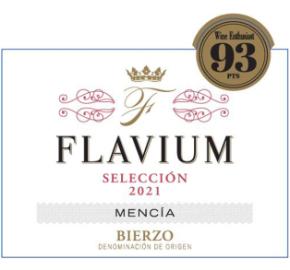
Vinos de Arganza Flavium Seleccion Mencia 2021

Mencia from Bierzo, Spain

Purchase Price: $14.97

Wine Enthusiast 93, Wilfred Wong 91, ElsBob 92

ABV 13%

A concentrated dark ruby color. Aromas of black and blue fruit coupled with a hint of spice, sporting a very smooth red fruit taste and a beautiful lasting finish.

An excellent table wine at a fantastic price. Current price ranges from $10-18.

Trivia: Just southwest of Vinos de Arganza lay the largest open-pit gold mine in the Roman Empire. Known as Las Médulas, it was worked by a method called ruina montium: “wrecking of the mountains”, a form of hydraulic mining that would later see service in the gold rush days of California. As Pliny the Elder described in 77 AD, Roman engineers diverted water from the Cantabrian and La Cabrera mountains into vast reservoirs, then released it in violent surges to erode entire hillsides and expose gold-bearing sediment.

Centuries later, the same principle of hydraulic head would be artistically employed for music and water sculpture: the Fountain of the Organ at Tivoli, north of Rome, used gravity-fed water to power its jets and to also force air through the pipes of a Renaissance organ.

Pliny estimated an annual yield of 20,000 Roman pounds of gold (1 Roman pound ≈ 0.72 English pounds). Over the mine’s 250-year lifespan, from the 1st through the 3rd century AD, approximately 58 million ounces of gold were extracted. At today’s prices, that would be worth over $225 billion, a fortune that once flowed through imperial treasuries, legion payrolls, and massive Roman infrastructure projects.

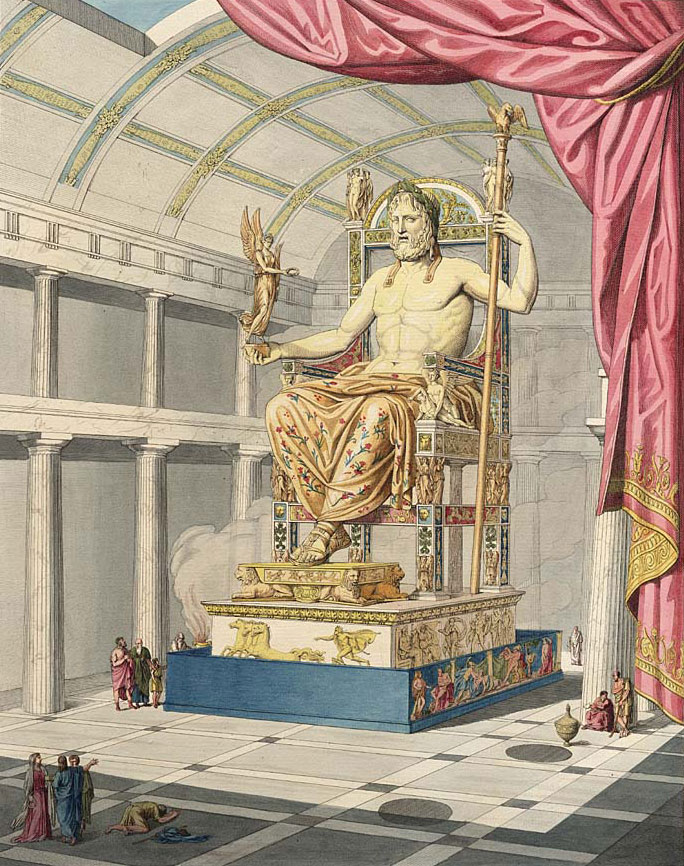
The Statue of Zeus at Olympia

The 40’ tall statue, considered one of the seven wonders of the ancient world, was constructed by the Greek sculptor Phidias around 435 BC during the Golden Age of Athens and the time of Pericles.

The statue was composed of what the ancients called ‘chryselephantine’ or ivory, depicting flesh, and gold, which defined Zeus’ robes and ornaments. The ornaments included his scepter in his left hand and in his right hand he held a statue of Nike, Greek goddess of victory (Bulfinch reverses the hand order in his book on Greek mythology). He is seated on a throne of cedar encrusted with gold and precious stones.

Detailed descriptions of the statue come from the Greek geographer Pausanias and from numerous Greek and Roman coins and engraved gems.

The statue was housed in the Temple of Zeus at Olympia near the western coast of the Peloponnese peninsula and hasn’t been seen since the 5th or 6th century AD. It is believed to have been destroyed by an earthquake and or fire at Temple of Zeus or it was transported to Constantinople and destroyed by a fire there in 474 AD.

Source: Bulfinch’s Mythology edited by Richard Martin, 1991. Statue of Zeus by Britannica, 2024. Graphic: Olympian Zeus Statue as drawn by de Quincy, 1815, Public Domain.

A Modern Golden Fleece

The question has been making its rounds on social media asking if the U.S. should sell off 20% of the U.S. gold reserves to pay off the debt?

The answer is no.

If I did the math correctly, selling 20% of U.S. gold stocks, 1476 tonnes, at the current price of $2345/oz equals about $462 billion.  A tonne is 2202 pounds. If you are referring to the U.S. debt of $34 trillion then money from the gold sale would only amount to a little more 1% of the total debt.

On a different note, the U.S. used to have more than 18,144 tonnes of gold or $1.5 trillion in today’s dollars. Due to the consequences of 1944 Brenton Woods agreement and the failure of the Kennedy/Johnson/Nixon administrations to stop the ability of foreigners to change dollars into gold, the gold supply was reduced to 7379 tonnes.

Changing the subject again, the Chinese have been on a gold buying spree since 2023. The People’s Bank of China bought 735 tonnes of gold in 2023 and their private sector bought an additional 1411 tonnes. In January of this year alone China has purchased 228 tonnes. All this buying has helped to drive up the price of gold by about 27% since January of 2023.

A better question to explore is why are the Chinese buying so much gold?

Gold to End Dollars

The Good, The Bad, and The UglyM Good 1967

Theaters:  December 1966

Streaming:  November 1997

Rated:  R

Runtime:  177 minutes

Genre:  Action – Adventure – Western

els:  9.0/10

IMDB:  8.9/10

Amazon:  4.7/5 stars

Rotten Tomatoes Critics:  8.8/10

Rotten Tomatoes Audience:  4.0/5

Metacritic Metascore:  90/100

Metacritic User Score:  9.1/10

Awards:

Directed by:  Sergio Leone

Written by:  Agenore Incrocci and Furio Scarpelli (screenplay), Luciano Vincenzoni and Sergio Leone (story and screenplay)

Music by:  Ennio Morricone

Cast:  Clint Eastwood, Lee Van Cleef, Eli Wallach

Film Locations:  Spain and Italy

Budget:  $1,200,000

Worldwide Box Office:  $25,100,000

In 1862, 3 gunfighters, prowling the New Mexico Territory for easy money; the Good (Eastwood), the Bad (Van Cleef), and the Ugly (Wallach) hear tales of Confederate gold buried in a Civil War cemetery. Pairing up when convenient, going alone when it wasn’t, they set out for the golden grave at Sad Hill Cemetery but only the “Man with No Name” knows which grave. Their travels and adventures to the final resting place of Blue and Grey casualties leave a trail littered with the excesses of betrayal, brutality, deception, extortion, and death.  Honor and friendship are vices that will get you killed, according few serviceable distinctions between the good, bad, and ugly.

The movie ties its tale around the events of the Confederate Army’s Civil War New Mexico Campaign in 1862. Confederate General Henry Sibley convinced the president of the southern slave states, Jefferson Davis, to invade the western states and territories from the east side of the Rockies and continue on to California.  The goal was to capture the gold mines of the Colorado Territory, a major source of revenue for the Union’s war efforts, and the California ports.  The ports would provide additional resupply bases for the Confederates or at a minimum require the Union Navy to divert scarce resources in attempting to blockade them.  Sibley’s initial thrust, beginning in early 1862, came from Texas and continued up into New Mexico towards Santa Fe and Fort Union. The Confederates, initially successful, were eventually forced to retreat back into Texas, because Sibley’s already thin supply lines were destroyed.  Skirmishes continued for another year but the South’s New Mexico campaign lasted less than 6 months and General Sibley was demoted to logistic details, ironically the major drawback of his southwest strategic, invasion planning.

Sergio Leone may not have invented Spaghetti Westerns but he certainly raised the genre to a high and profitable art form. As a director his credits are few, just 11 movies, but his 2 trilogies, Dollars and Once Upon a Time, were critical and financial successes. Leone, additionally, has  screenplay credits for most of the movies he directed along with a second unit director credit for the 11 Oscar award-winning, 1959 film: Ben Hur. His trademark long view shots of uninviting background coupled with intense close-ups of emotion filled eyes gave his westerns a barefaced, grainy look of realism in a land of little opportunity except for those who created their own.

Ennio Morricone made his name and fortune composing the scores for Sergio Leone’s Dollars trilogy. Creating an iconic sound of wolves howling, punctuated with Indian drum beats portending events to come.  None of the Dollars movies had a large budget to work with causing Morricone to creatively improvise, using ricocheting bullets, whips, and trumpets to fill in for the missing orchestra.  His film scores eventually earned him an honorary Academy Award in 2007 and the Best Original Score Academy Award for the 2016 movie: The Hateful Eight.

Then there was Clint Eastwood. Initially reluctant to do the final movie in The Man with No Name trilogy, he agreed to it after Leone met his hefty financial demands, $250,000 plus 10% of the profits.  In the mid-1960s these were demands that stars made, not the unknown Eastwood, who previously had just played bit parts in forgettable movies.  Leone must have seen something in him though because A Fistful of Dollars, For a Few Dollars More, and The Good, The Bad, and The Ugly made Eastwood an international star.  In these westerns Eastwood plays the part that he would reprise many more times throughout his career. That of a loner, willing to push morality and law to the limits and beyond, but showing compassion and tolerance when needed.

This movie should be on your “Must See in My Lifetime” list. If you have seen it, watch it again. A true masterpiece of writing, directing, cinematography, music and acting.