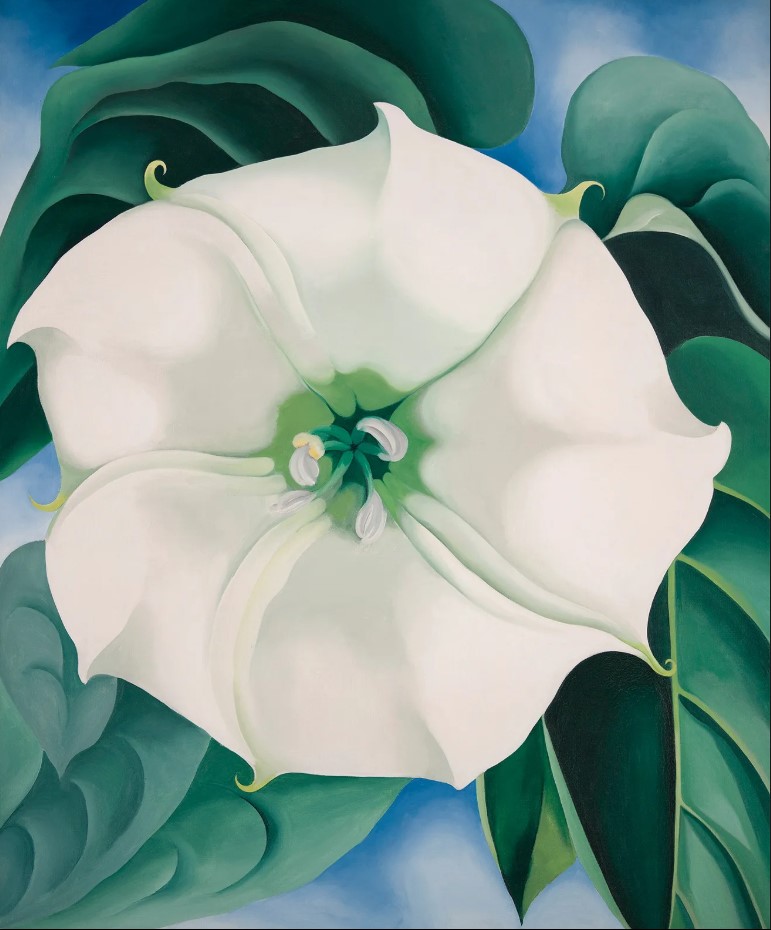
Georgia O’Keeffe, a major influence and definer of early 20th-century American Modernism, was an exemplar of the natural world, painting flowers, desert landscapes, and skyscrapers with precision, coated with a veneer of the sublime and a touch of the surreal.
Her flowers were her gifts and instructions to the world. In the May 16, 1946, issue of the New York Post, she articulated her artistic purpose: “When you take a flower in your hand and really look at it, it’s your world for the moment. I want to give that world to someone else. Most people in the city rush around so, they have no time to look at a flower. I want them to see it whether they want to or not.”
The American Modernism movement is difficult to define, though O’Keeffe seems to have taken the movement a step back from the light and color of French Impressionism to a more classical form, incorporating precision of shape with the synthesis of modern abstraction.
When she abandoned precision for immersion in total abstraction, she sometimes found herself lost in amateurish erotica or unending interpretive babbling, enigmatically and essentially labeling these works as meaning whatever she wanted them to mean.
Source: Georgia O’Keeffe Edited by Barson, 2016. Graphic: Jimson Weed/White Flower No. 1, oil on canvas by Georgia O’Keeffe, 1932; in the Crystal Bridges Museum of American Art, Arkansas. 121.9 × 101.6 cm. Edward C. Robison III/ © 2016 Georgia O’Keeffe Museum/DACS
 elsToday