On Thanksgiving Day in 1976, Bill Graham’s legendary Winterland Ballroom in San Francisco played host to an unparalleled musical spectacular: The Last Waltz. Orchestrated by the visionary filmmaker Martin Scorsese and the iconic concert promoter Bill Graham, this five-hour marathon has earned its place in history as the greatest rock documentary ever made.
A star-studded fantasy night where rock, roots rock, blues, and folk giants converged. The Band taking center stage, were joined by a stellar lineup including Bob Dylan, Dr. John, Van Morrison, Joni Mitchell, Ringo Starr, Eric Clapton, and many more. Each performance was a masterpiece, weaving together years of musical brilliance into a single, unforgettable tapestry.
Michael Wilmington of the Chicago Tribune and Rolling Stone have rightfully hailed this epic concert as a monumental achievement, a time capsule of musical greatness that continues to inspire and captivate audiences nearly 50 years later.
The Last Waltz wasn’t just a concert; it was a celebration of artistic vision, camaraderie, and the timeless power of music.
Graphic: The Last Waltz Official Trailer #2, 1978, Copyright Last Waltz Productions.
Emmylou Harris’ voice is as soothing as light summer rain dancing softly off the lilies in a Monet Pond. Peace and grace personified.
Most prefer her mostly country 1975 album ‘Pieces of the Sky’, but I find that her 1977 album, ‘Luxury Liner‘, is a more complete representation of her genius as an interpreter of songs across the genres of country, rock, pop, and her masterful blending of all three.
Source: Apple Music. Graphic: Luxury Liner album cover, copyright Reprise Records. Audio: Luxury Liner title track from her 1977 eponymous album.
In subsequent posts I will attempt to examine the relationship between wine ratings and price. To get there I thought it may be useful to quickly rehash the reasoning and methodology of ratings, which has been done many times by many others, before I compare them with wine prices.
The Need for Wine Ratings:
After many years of spending considerable time, money, and effort buying and drinking poor quality wines, I was ready to throw in the grapes and stick with whiskey: Irish whiskey, Scotch whisky, Canadian whisky, but not American burbon whiskey, too rough around the edges for my tastes. But this is not about whiskey. This is about choosing a decent wine at an affordable price–choosing a wine that doesn’t provoke tongue burn and esophageal spasms. Finding a wine without pouring over countless wine reviews in search of something within my budget and of acceptable quality. Unless you were a fervent oenophile steeped in the language and nuance of the vine you could get through about as many reviews as there were licks in a Tootsie Pop – 3 – before giving up and picking a wine at random at the local liquor store. An all-around Herculean and, as a rule, unrewarding task. An alternate method was to collect tips from fellow wine travelers. Experience taught me that wine tips were the blood brothers to stock and racehorse tips. Hang onto your wallet when receiving them and expect nothing good to come from them.
Considering the abysmal state of pre-1970s wine analytics, the ability to sort wine by quality and price, it’s a wonder anyone drank the stuff. Before ratings, the sellers of wine usually wrote glowing reviews of their product leading most buyers, through experience, to question their objectivity. Producer and seller reviews continue to the present with caveat emptor remaining germane and necessary to the buyer.
Then along came Robert Parker in the 1970s with a 100-point impartial wine rating/ranking system, a 50-point system in reality, which revolutionized how wine was bought and sold. His approach was to evaluate wines independently of the producers and sellers, communicating his results directly to the consumer.
Parker’s system wasn’t meant to replace wine reviews and tasting notes but to supplement them. The ratings were meant to provide a comparison between the seemingly infinite number of wines that were all labeled good and worthy of your time and money, but impossible to narrow down to something manageable, affordable, and drinkable. The ratings gave the consumer one number, along with price, helping to winnow the field of immense possibilities to single bottle or two for the evening’s festivities.
Wine rankings have their detractors mainly because they are subjective, but all rankings are subjective whatever they may be–books, clothes, cars, phones, whatever. Name a subject and you will be able to find a ranked list and it will have a subjective component. As a species we describe objects by comparing them with other objects and then rank them in a list. Consumer Reports have been doing this since 1936 and as much as they try to be objective there is always a subjective piece in their evaluations. Ranker.com, going live in 2009, has collected a billion votes from millions of users on hundreds of thousands of items and lists, all with subjective content.
When looking for a movie to stream on Friday night you may check out the written reviews which are likely to range from love it to hate it for any given flick, but the first thing that catches your eye are the consensus scores. A movie that scores 30 out of 100 you will give a pass, unless campy movies are your thing, but the ones rated 85 out of 100 prods your interest. You may even go on and read a review or two by critics that you know and trust. This eliminates a bit of the trial and error, taking thousands of movies and finding something we wish to spend our Friday night watching. Not fool-proof but better than written reviews by themselves.
The same process works for wine. That numerical score assigned by a reviewer that you trust narrows the choices of finding an acceptable wine for that Friday night movie, leaving you time to put together a colorful fruit and cheeseboard to complement your well thought out bottle of red… or white.
The Wine Rating Methodology:
Wine ratings are subjective by nature which means the numerical scores will not only change from reviewer to reviewer, but an individual reviewer will likely assign a different score at a different time and place. Moods, physical states, and surroundings affect us all. Smell and taste will not be the same in fresh air as it would in a smokey room. The variables to consistent, or inconsistent, scores are endless, but one must persevere.
To bring some objectivity to ratings the tastings are generally done blind. In blind tastings information about the producer(s) and price is not divulged to the reviewer. In some cases, even the varietal of wine is not communicated before the actual tastings have been completed. The reviewer uses the same scorecard listing the same criteria to analyze all wines. A typical scorecard will contain some or all the following criteria:
Appearance – Color, Viscosity, and Opacity
Consistency or Mouthfeel – Body and Density
Aroma and Bouquet
Taste – Acidity, Flavors, Intensity, Balance, Depth, and Aftertaste
Complexity
Varietal
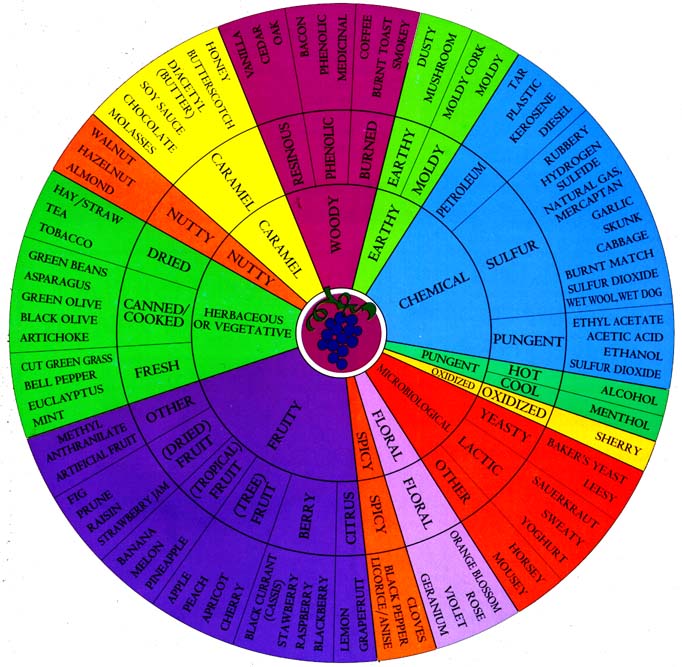
To assist in tasting and evaluating wine the UC Davis wine tasting wheel, divided into three expanding detail circles, was developed, and is shown above right.
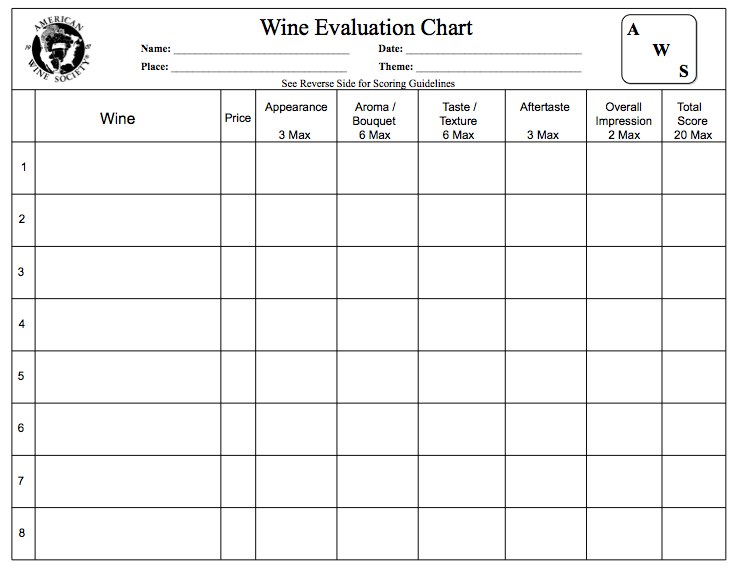
The American Wine Society evaluation sheet shown below is for scoring on the UC Davis 20-point system.
With the above criteria a reviewer will assign a numerical value or star(s) to that vintage bottle of wine. The most common scoring structure is the 100-point system devised by Robert Parker. Others, such as Jancis Robinson use a 20-point system designed at the University of California at Davis in the 1950s. On the simple and basic end of ratings is the ubiquitous 5-star system that ranks wine with very little pretentious hair splitting. Vivino’s use of the 5-star system is strictly constructed and populated from aggregated and averaged individual consumer rankings and correlates very well with the more orthodox expert 100-point ratings. A Vivino 4-star rating equates to a 90-point Parker rating. The four rating scales, plus mine, are listed below.
Ratings in Practice:
On a finale note, those employing the 100-point scale very seldom, either for ranking or subsequent sales promotion, publish any scores below 88 or 89 reducing their scoring system to a 12-point scale that only contains outstanding to extraordinary wines. I have almost no experience with 20-point scales so I cannot speak directly to their posting, or not, of inferior wine scores. Vivino’s 5-Star system publishes all ratings provided by their customers, the good, the bad and the ugly. Vivino’s system subdivides each star into ten parts creating a 40-point system. In the end, whether you are using a 5-, 20-, 40-, 50-, or 100-point system the goal is to add a little quantitative assessment to qualitative reviews.
Robert Parker’s System:
96-100 — An extraordinary wine of profound and complex character displaying all the attributes expected of a classic wine of its variety. Wines of this caliber are worth a special effort to find, purchase and consume.
90-95 — An outstanding wine of exceptional complexity and character. In short, these are terrific wines.
80-89 — A barely above average to very good wine displaying various degrees of finesse and flavor as well as character with no noticeable flaws.
70-79 — An average wine with little distinction except that it is soundly made; in essence, a straightforward, innocuous wine.
50-59 — A wine deemed to be unacceptable.
60-69 — A below average wine containing noticeable deficiencies, such as excessive acidity and/or tannin, an absence of flavor, or possibly dirty aromas or flavors.
University of California at Davis System:
17-20 – Wines of outstanding characteristics having no defects
13-16 – Standard wines with neither outstanding character nor defect
9-12 – Wines of commercial acceptability with noticeable defects
6-8 – Wines below commercial acceptability
1-5 – Completely spoiled wines
American Wine Society Version of UC Davis System:
18 – 20 – Extraordinary
15 – 17 – Excellent
12 – 14 – Good
9 – 11 – Commercially acceptable
6 – 8 – Deficient
0 – 5 – Poor & Objectionable
Vivino et al 5 Star System:
Five Stars – Superlative
Four Stars – Excellent (Robert Parker’s 90-point rating)
Three Stars – Perfect for everyday consumption (Vivino’s average wine is 3.6 stars)
Two Stars – Casual drinking
One Star – Very Ordinary
Els Ranking:
Five Stars – 95-100 points – A most excellent wine
Four Stars – 90-94 points – An outstanding wine (My sweet spot for balancing quality and price)
 elsToday