Kinder Surrealism

I feel the need of attaining the maximum of intensity with the minimum of means. It is this which has led me to give my painting a character of even greater bareness.” Joan Miro.

Joan Miró (zhwahn mee-ROH, 1893–1983), a Catalan artist, began his career exploring Expressionism and Cubism before rejecting the rational world, which he found suffocating possibly depressing. He turned inward, merging an abstract dreamworld with Surrealism, ultimately evolving into a minimalist, conveying deep meaning through sparse, naïve brushstrokes and colors.

Symbolism became his hallmark; for Miró, the image was secondary to the message which was always open to interpretation. Initially inspired by Van Gogh and Cézanne, he later grew enamored with Picasso and Dalí, but it was Sigmund Freud who awakened his subconscious, plunging him into the mysteries of dreams and hallucinations. In pursuit of these visions, Miró intentionally induced states of hunger and exhaustion, risking madness to capture the fleeting essence of his dreamscapes. His dreams produced a primitive, childlike, whimsical innocence, with no explicit instructions for interpretation.

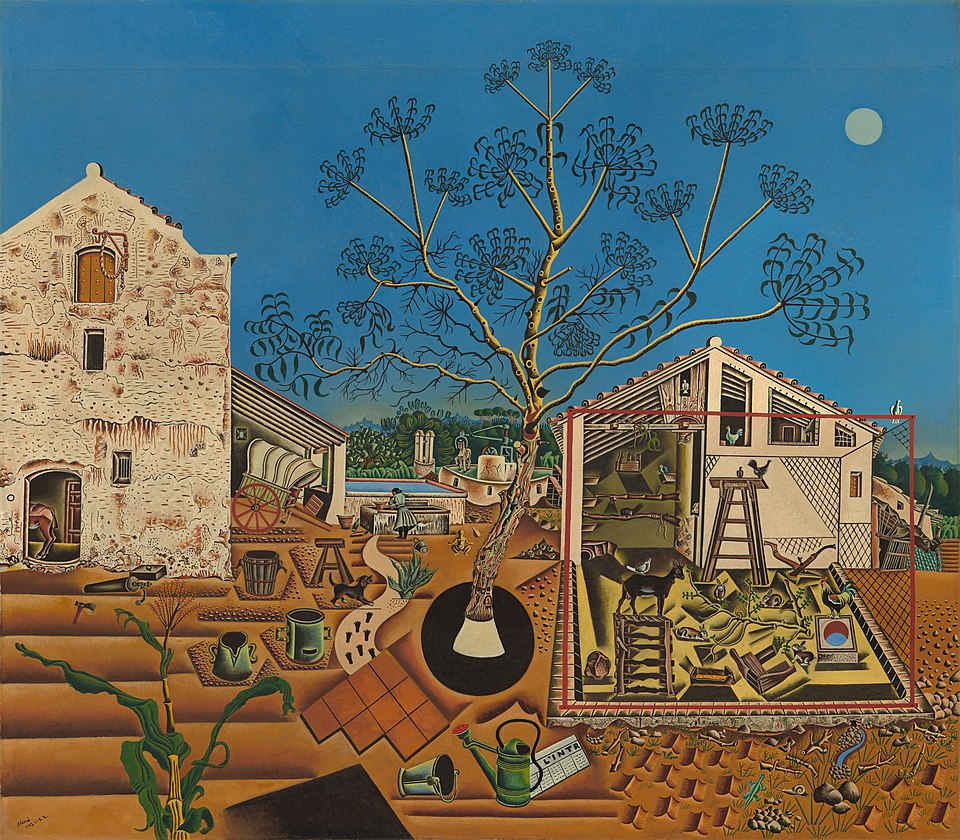
Miró’s early masterpiece, The Farm (1921–22), serves as a biographical snapshot of his life at 29, capturing the essence of his Spanish countryside upbringing and young adult life. This highly detailed precursor to his later Cubist and abstract works was purchased by Ernest Hemingway for 5,000 francs as gift to his wife.

By 2024, Miró’s works continue to command prices that place him among the top 25 most valuable artists worldwide. His Peinture (Étoile Bleue), or Painting (Blue Star), one of his best-known dreamscapes, sold for £23.6 million at a London Sotheby’s auction in 2012, equivalent to $37 million at the time, or approximately $31.5 million in today’s dollars.

Source: Miró by Gaston Diehl, 1979.  Graphic: The Farm (1921–1922), National Gallery of Art, Washington D.C. (Public Domain)
Real Not Real

Have no fear of perfection; you’ll never reach it.” – Dali.

Salvador Dalí was the entertaining, surrealist voice of the masses. His dreamlike spectacle of melting clocks and flamboyant persona captivated popular culture, injecting eccentric brushstrokes into the lives of the disengaged and disinterested. Dalí spoke directly to the public’s fascination with dreams and absurdity, transforming art into a theatrical experience and a giggly poke at the eminent egos on high altars.

Dalí was a 20th-century Spanish artist who drew from influences such as Renaissance art, Impressionism, and Cubism, but by his mid-twenties, he had fully embraced Surrealism. He spent most of his life in Spain, with notable excursions to Paris during the 1920s and 1930s and to the United States during the World War II years. In 1934, he married the love of his life, Gala. Without her, Dalí might never have achieved his fame. She was not just his muse but also his agent and model. A true partner in both his art and life. Together, they rode a rollercoaster of passion and creativity, thrills and dales, until her death in 1982.

Dalí had strong opinions on art, famously critiquing abstract art as “inconsequential.” He once said, “We are all hungry and thirsty for concrete images. Abstract art will have been good for one thing: to restore its exact virginity to figurative art.” He painted images that were real and with context that bordered on the not real, the surreal. For those who believed that modern abstract art had no life, no beauty, no appeal, he provided a bridge back to a coherent emotional foundation with a dreamlike veneer. Incorporating spirituality and innovative perspectives into his dreams and visions of life.

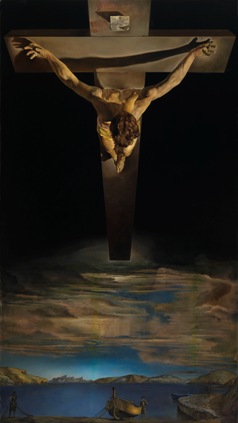
The Persistence of Memory (1931) is Dalí’s most recognizable and famous painting, but his 1951 work Christ of Saint John of the Cross is arguably his most autobiographical and accessible piece. A painting dripping with meaning and perspective, Dalí claimed it came to him in a dream inspired by Saint John of the Cross’s 16th-century sketch of Christ’s crucifixion. The perspective is indirectly informed by Saint John’s vision, while the boat and figures at the bottom reflect influences from La Nain and Velázquez. The triangular shape created by Christ’s body and the cross represents the Holy Trinity, while Christ’s head, a circular nucleus, signifies unity and eternity: “the universe, the Christ!” Dalí ties himself personally to the crucifixion by placing Port Lligat, his home, in the background. He considered this painting a singular and unique piece of existence, one he likely could never reproduce because the part of him that went into the painting was gone forever.That part is shared with his viewers, offering a glimpse into Christ’s pain, Dalí’s anguish, and his compassion: an emotional complexity that transcends mortal comprehension.

Source: Salvador Dali by Robert Descharnes, 1984. Graphic: Christ of Saint John of the Cross, Dali, 1951. Low Res. Copyright Glasgow Corporation.

Chagall and Expressionism

Art critic Raimond Cogniat described Marc Chagall as an artist of opposites, a painter who thrived in the interplay of form and color, color and meaning. Chagall infused his paintings with love and happiness, crafting worlds that felt both fantastical and deeply alive. He shaped reality from his feelings, “making it conform to his inner spiritual logic,” even if, as he once confessed, he wasn’t entirely conscious of his process.

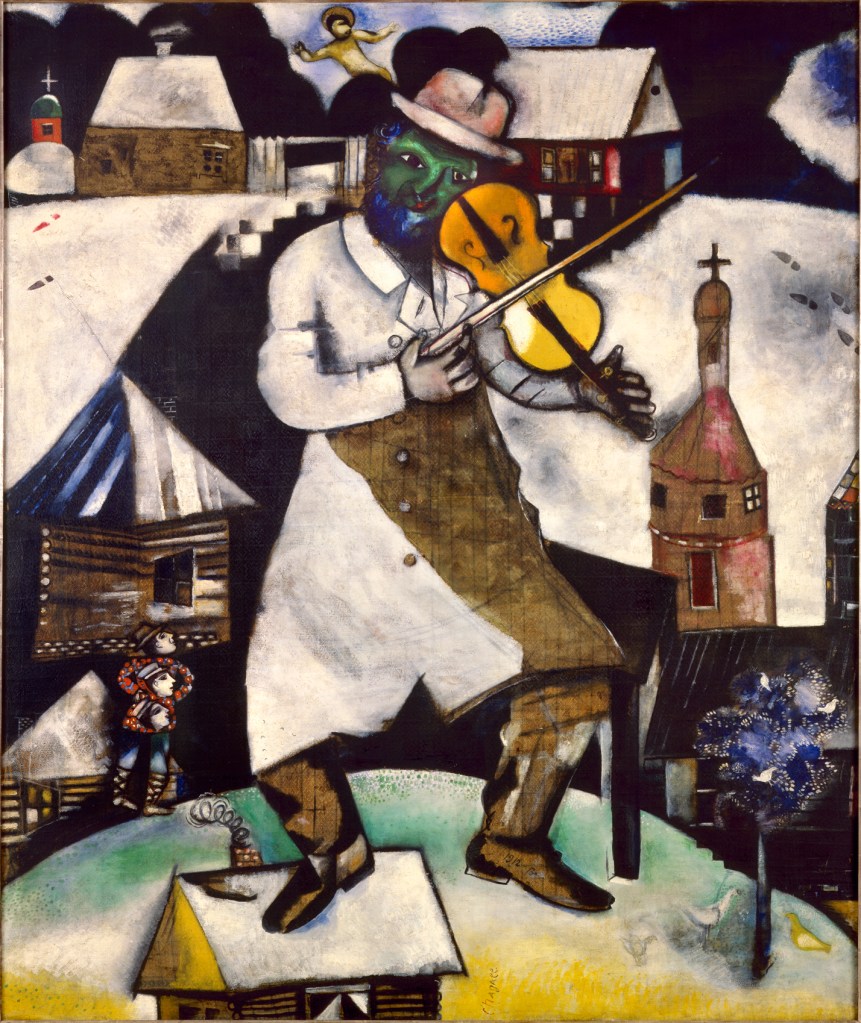
Born Moishe Shagal in 1887 in Vitebsk (now Belarus), Chagall grew up in a Jewish enclave within the Russian Empire. He later embraced France as his adoptive home, blending his Eastern European roots with French artistic flair. Though he briefly explored Cubism during its peak in the early 20th century, he thankfully abandoned that style to carve his own path as an expressionist. Vivid, otherworldly colors, and exaggerated forms defined his style, while his Jewish heritage, evident in depictions of shtetl life, fiddlers, and biblical scenes, remained his anchor. His 1912–1913 painting The Fiddler is said to have inspired the title of the musical Fiddler on the Roof.

In a 1963 speech to an American audience, Chagall reflected on his philosophy: “Any moral crisis is a crisis of color, texture, blood and the elements, of speech, vibration, etc.—the materials with which art, like life, is constructed. Even when mountains of color are piled on a canvas, if one can discern no single object even through great sound and vibration, this will not necessarily give authenticity.” To Chagall, authenticity was more than paint; it demanded the infusion of human experience, blood, and the essence of nature.

Source: Chagall by Raimond Cogniat, translated by Ann Ross, 1977. Graphic: The Fiddler, Chagall, 1912-1913. Public Domain

Bits and Pieces

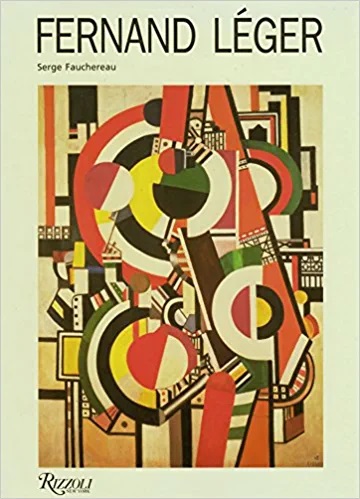
Fernand Leger

By Serge Fauchereau

Translated by David Macey

Published by Rizzoli International Publications

Copyright: © 1994

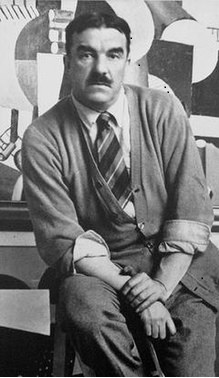
Fernand Leger in 1916

Serge Fauchereau, born on Halloween in 1939 in France, is an art curator; art critic; professor of literature, art history, and writing; and author of artist biographies and art styles. Fauchereau has spent his adult life educating the public on, and extolling, 20th century avant-garde painting and sculpture, specifically the abstract and cubist styles.

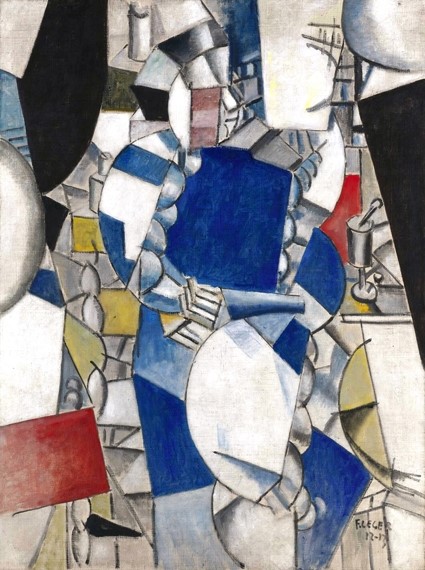
Cubism – The Woman in Blue – Legar 1912

Abstract art attempts to free visual representations of reality from the concrete, expressing form and color spiritually, emotionally, metaphysically without the chains of perspective, fact, or conclusions. Cubism, a mathematical sub-set within the abstract world, takes the whole of reality apart piece by piece, reexamines and reimages the pieces, giving them their own perspective, color, and frame; and then collects the many pieces into something greater than the one. Sometimes this works.

Paul Cézanne, 19th century French post-impressionist painter, is considered the father of Cubism but not actually a Cubist himself. Cezanne stretched the accepted norms of perspective, giving separate objects within his paintings their own reality, their own commentary. Pablo Picasso and Georges Braque, along, to a lesser extent, with Fernand Leger, took their cues from Cezanne, developing a style that became known as Early Cubism in the first 15 years of 20th century.

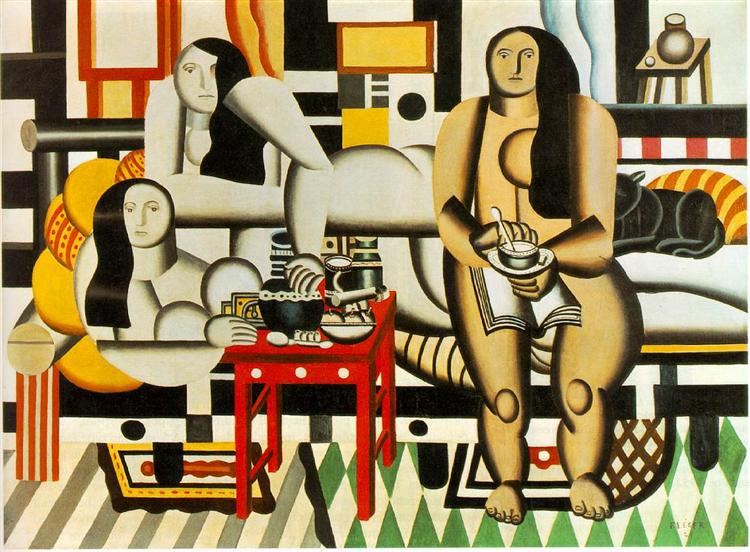
Tubism – Three Women – Legar 1921
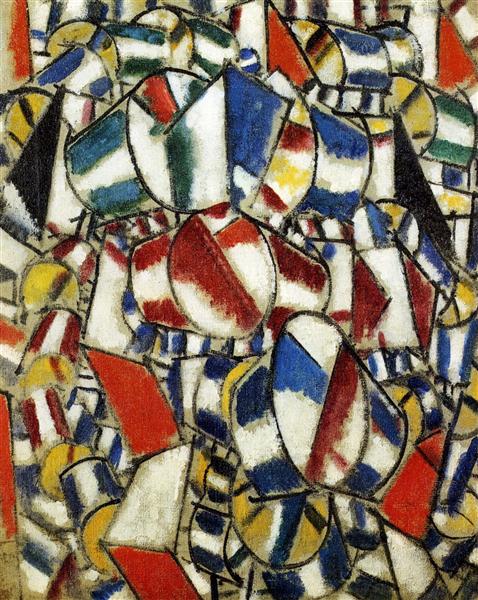
Contrast of Forms – Legar 1913

Fernand Leger, born in Normandy, France in 1881, was an extrovert who successfully kept his private life hidden from the public, expressing himself exclusively through his paintings and films. His early works, before 1908, were strongly influenced by the French impressionistic painters. Dissatisfied with his impressionistic efforts he destroyed all his paintings from this period.

Moving on from impressionism, he circulated with the Parisian modern art crowd, where he began to experiment with the Cubist style, finishing his initial works, La Couseuse and Compotier sur la Table in 1909. After WWI, in which he served on the Verdun front and was wounded, he developed his own style, a modified form of Cubism which he called Tubism, more a foray into pop art than a formal artistic movement. Beginning in the early 1920s he collaborates and directs art films beginning with La Roue followed by Skating Rink and Le Ballet Mecanique.

Till the end of his life in 1955 he continued to paint, lecture, exhibit and travel, cementing his reputation as pioneer in the world of modern art. His reputation continues to grow with his Cubist Contrast of Forms selling at a Christie auction in 2017 for $70,062,500.