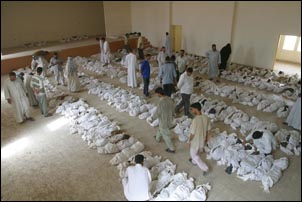
Journalism—CNN’s Sycophants for Saddam Hussein 2003

CNN’s news chief in 2003, Eason Jordan, admitted that the network ignored and suppressed Saddam Hussein’s mass killings of his citizens and other crimes against humanity, to keep their access to the Iraqi thug. Jordan said that telling the truth likely would have meant closing their Baghdad bureau. Franklin Foer of the New Republic wrote in The Wall Street Journal: “CNN could have abandoned Baghdad. Not only would they have stopped recycling lies, they could have focused more intently on obtaining the truth about Saddam.”

CNN lied; Iraqis died.

Human Rights Watch has estimated that 250,000 to 290,000 Iraqis were presumed killed under Saddam.

Eason Jordan resigned from CNN in 2005. It wasn’t possible to discover why he wasn’t fired in 2003 for his efforts to aid Saddam Hussein.

Source: The Washington Post. HRW 2003. Franklin Foer, Wall Street Journal 2003.   Graphic: Iraqi Victims Found in a Mass Grave killed under Saddam’s Rule, GWB Whitehouse Archives, 2003.


Journalism–Brian Williams

NBC journalist and anchor Brian Williams fraudulently and consistently inserted himself into his news reports.

He claimed he was flying in a helicopter in 2003 over Iraq that was hit by an RPG. He wasn’t. Washington Post called it a memory flub. The New York Times, Newsweek, and others suggested it was a false memory.

He claimed to have been at the Brandenburg Gate when the Berlin Wall came down. He wasn’t.

He claimed to have flown to Bagdad with Seal Team Six. He didn’t.

Source: CNN, Medium, New York Post. Graphic: New York Post cover.

Journalism – Make it Up, Get Paid

In an all too familiar case of journalistic malpractice, “Claas Relotius, a reporter and editor, [for Der Spiegel] falsified his articles on a grand scale and even invented characters, deceiving both readers and his colleagues,” wrote Germany’s Der Spiegel in 2018.

Claas Relotius, who won numerous awards for his work with Der Spiegel, falsified significant portions of articles for the news magazine. CNN reported that he admitted to ‘partial fabrications … [t]hat included making up dialogue and quotes and creating composite characters.’

This type of journalistic behavior seems to occur frequently, and it is likely more commonplace than consumers of news are led to believe. Layers and layers of fact checkers and editors never stop the flood tide of false narratives and fake news.

Source: ‘Germany’s Der Spiegel says star reporter Claas Relotius wrote fake stories…’ by Sherisse Pham, 2018, CNN. Graphic: Fake News, AI Generated.