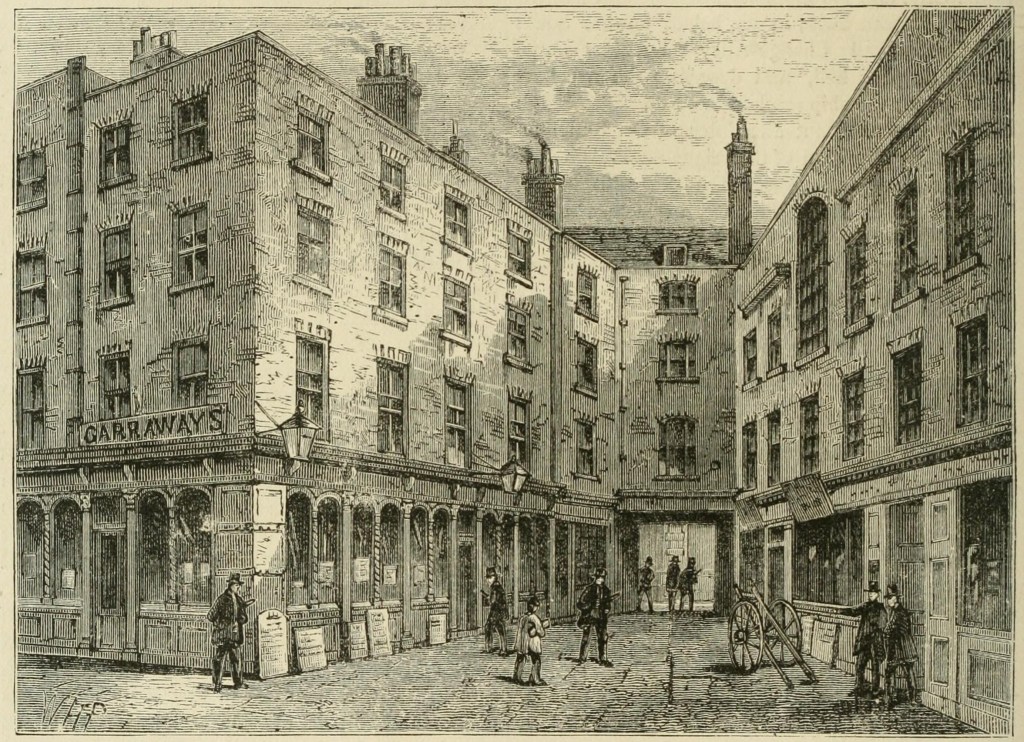
On 20 February 1673, London’s Garraway’s Coffee House, located just north of London Bridge and the Tower of London, held the first recorded wine auction in England. Instead of the traditional “going, going, gone” and a bang of a gavel method, this auction was conducted “to the candle.” In this form of bidding, participants could place bids until a one-inch candle burned out, which typically took only a minute or two. The purpose of this method was to create an unpredictable end time, preventing last-second bids and encouraging bidders to make their best offers early.
London coffee houses in general, and Garraway’s in particular, served as trading houses for commodities and shares. At Garraway’s, tea merchants and trading shares in companies associated with South Sea trade were the main order of business. All that remains today of the coffee house is a plaque informing the public that people of quality frequented this area.
Trivia: Garraway’s Coffee House appears in at least two of Charles Dickens’ novels: The Pickwick Papers and Little Dorrit. In Chapter 37 of The Pickwick Papers, Samuel Pickwick meets his lawyer, Mr. Serjeant Snubbin, at Garraway’s to discuss his case, where he is being sued by his landlady for breach of promise. The opposing lawyer for the landlady is the theatrical blowhard, Mr. Serjeant Buzfuz. Dickens remains the absolute master of character names. In Chapter 21 of Little Dorrit, Arthur Clennam visits “wharves, docks, the Custom House, Garraway’s Coffee House, and the Jerusalem Coffee House” as he attempts to piece together his family’s business and financial affairs.
Source: This Day in Wine History. Novels of Dickens. Wikipedia. Graphic: Photo of Garraway’s Coffee House, 1873. Public Domain.
 elsToday