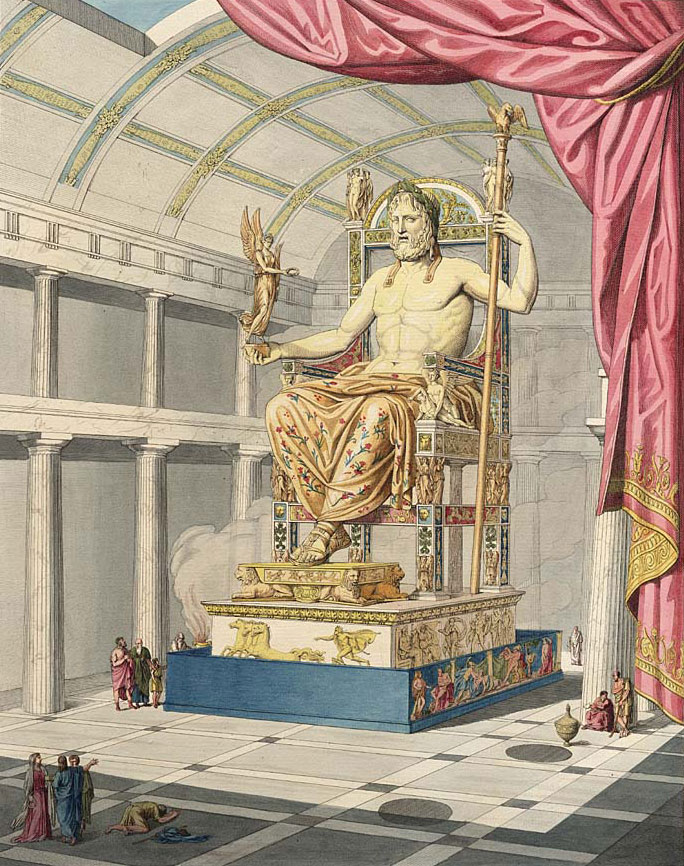
The Statue of Zeus at Olympia

The 40’ tall statue, considered one of the seven wonders of the ancient world, was constructed by the Greek sculptor Phidias around 435 BC during the Golden Age of Athens and the time of Pericles.

The statue was composed of what the ancients called ‘chryselephantine’ or ivory, depicting flesh, and gold, which defined Zeus’ robes and ornaments. The ornaments included his scepter in his left hand and in his right hand he held a statue of Nike, Greek goddess of victory (Bulfinch reverses the hand order in his book on Greek mythology). He is seated on a throne of cedar encrusted with gold and precious stones.

Detailed descriptions of the statue come from the Greek geographer Pausanias and from numerous Greek and Roman coins and engraved gems.

The statue was housed in the Temple of Zeus at Olympia near the western coast of the Peloponnese peninsula and hasn’t been seen since the 5th or 6th century AD. It is believed to have been destroyed by an earthquake and or fire at Temple of Zeus or it was transported to Constantinople and destroyed by a fire there in 474 AD.

Source: Bulfinch’s Mythology edited by Richard Martin, 1991. Statue of Zeus by Britannica, 2024. Graphic: Olympian Zeus Statue as drawn by de Quincy, 1815, Public Domain.
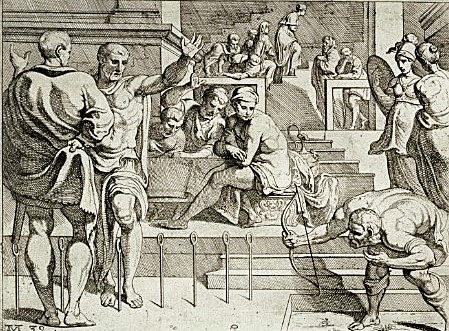
String a Bow and Thread 12 Axe Rings

Ulysses upon leaving Troy traveled for 10 years before returning home to his wife Penelope only to find she doesn’t recognize him, and he has a house filled with suitors seeking his wife’s hand in marriage.

To prove he is the rightful husband and king he shoots an arrow through the rings of 12 axe heads. Upon completing the quest, he kills all suitors for his wife’s hand.

An Excerpt from Book 21 of Homer’s Odyssey:

So the great master drew the mighty bow,
And drew with ease. One hand aloft display’d
The bending horns, and one the string essay’d.
From his essaying hand the string, let fly,
Twang’d short and sharp like the shrill swallow’s cry.
A general horror ran through all the race,
Sunk was each heart, and pale was every face,
Signs from above ensued: the unfolding sky
In lightning burst; Jove thunder’d from on high.
Fired at the call of heaven’s almighty Lord,
He snatch’d the shaft that glitter’d on the board
(Fast by, the rest lay sleeping in the sheath,
But soon to fly the messengers of death).

Now sitting as he was, the cord he drew,
Through every ringlet levelling his view:
Then notch’d the shaft, released, and gave it wing;
The whizzing arrow vanished from the string,
Sung on direct, and threaded every ring.

Source: Bulfinch’s’ Mythology, 1867. Odyssey by Homer. Graphic: Ulysses by Theodore van Thulden, 1632, Public Domain.

The Divine Comedy:

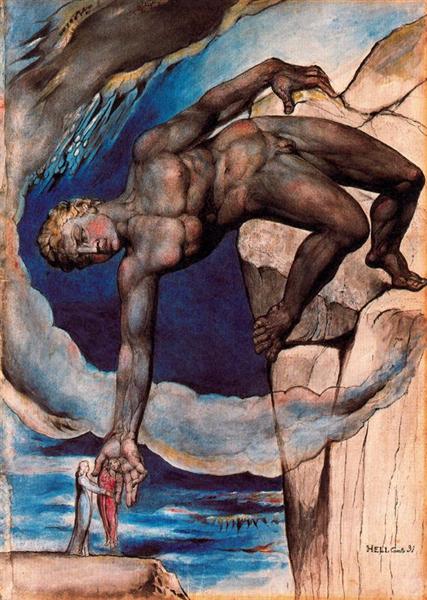
William Blake (1757-1827), in the final years of his life created 102 watercolors and 7 copper plates, most unfinished, for Dante’s ‘The Divine Comedy’. One of the more profound and captivating of these paintings is ‘Antaeus Setting Virgil and Dante into the Ninth Circle of Hell’.

The giant Antaeus, son of Neptune and Gaia, was invincible as long as he remained attached to his mother. Hercules, for his 11th task, had to defeat Antaeus but couldn’t if he touched the Earth, so he lifted him off the ground and strangled him to death.

The Ninth Circle is reserved for the treacherous and is subdivided into 4 rings. The first part is reserved for familial traitors and is named Caina as in Cain and Abel. The second ring, Antenora for Antenora of Troy is for national traitors. Ptolomaea for Ptolemy is the third ring for those who betray their guests. Finally, the inner ring is called Judecca for Judas Iscariot betrayer of Christ and is for the worst traitors: those who turn on their masters. At the center of the Ninth Circle resides Satan.

Finally, as an aside, Dante’s ‘The Divine Comedy’ shouldn’t be interpreted as The Divine Humor, but as The Divine Outcome. The author meant that comedy was the opposite of tragedy. Tragedies begin well and end badly, but Dante’s Comedy begins badly, in Hell, and ends well with Dante reaching his desired destination: Heaven.

Source: Will Blake, The Divine Comedy by David Bindman, 2000. The Divine Comedy by Dante Alighieri, circa 1321. Bulfinch’s Mythology, 1867. Graphic: Antaeus Setting Down Dante and Virgil in the Last Circle of Hell, Blake, 1827, Public Domain.