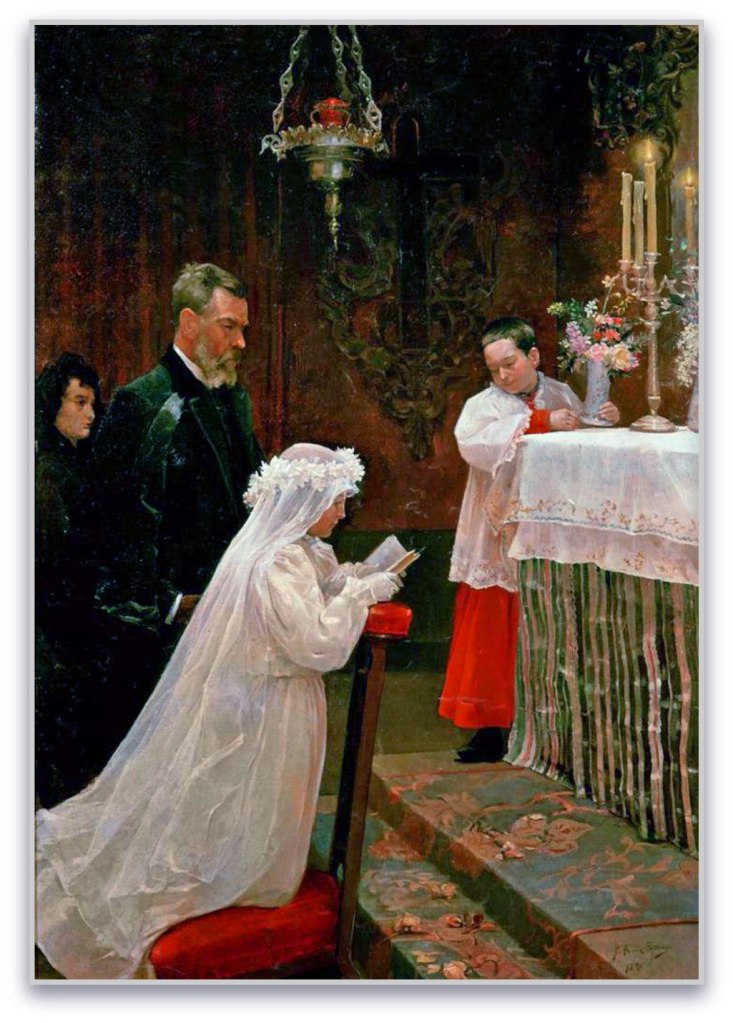
Picasso was recognized as a child prodigy at a very young age. He began to paint with oils when he was eight and by the time he was thirteen he was selling his work. At the age of fourteen, he was admitted to the prestigious Barcelona art school: La Lonja. At the age of fifteen he made his official entry into the professional art world, presenting the painting, “The First Communion” shown to the right, at the Third Exhibition of Fine Arts and Artistic Industries in Barcelona.
“Science and Charity” shown to the left is one of Picasso’s most accessible paintings. He painted it in 1897 at the age of 15. This painting was the culmination of his academic studies and he soon after abandoned this style in pursuit of a more personal, albeit inscrutable, approach to art.
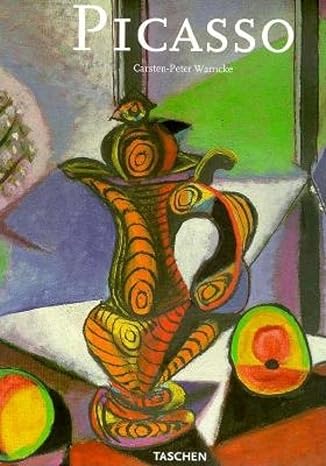
Source: Picasso by Carsten-Peter Warncke. Published 2001. Original publication 1998.
There are only meager snippets of biographical information available on Carsten-Peter Warncke. The inside jacket of this volume on Picasso contains the most detail I was able to find, and I quote it in total below:
“Carsten-Peter Warncke was born in Hamburg in 1947, studied art history, classical archaeology and literature in Vienna, Heidelberg, and Hamburg, and received his doctorate from the last university in 1975. He is Professor of Art History at the University of Gottingen.”
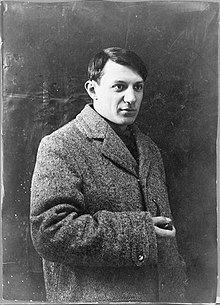
Pablo Picasso was born in Malaga, Spain in 1881 to Don Jose Ruiz Blasco, a painter who taught drawing, and Dona Maria Picasso Lopez. Pablo adopted his mother’s surname somewhere between 1897 and 1901 believing that his paternal surname was too common, plus he was convinced his name needed a double consonant to align with other artists such as Matisse, Poussin, and Rousseau.
Picasso was recognized as a child prodigy at a very young age. He began to paint with oils when he was eight and by the time he was thirteen he was selling his work. At the age of fourteen, he was admitted to the prestigious Barcelona art school: La Lonja. At the age of fifteen he made his official entry into the professional art world, presenting the painting, “The First Communion” at the Third Exhibition of Fine Arts and Artistic Industries in Barcelona.
FootnoteB
In 1900 Picasso exhibited 150 drawings at the Barcelona cafe, “Els Quatre Gats“. The cafe’s name derives from a Catalan expression which means “only a few people” and translates to “The Four Cats”. The expression describes people who are a bit strange or peculiar. The cafe was a popular meeting place for famous artists in the twentieth century including Isaac Albeniz, Gustavo Barcelo, Ramon Casa, Carlos Casegemas, and Santiago Rusinol.
Picasso moved around France and Spain about as often as he experimented with and changed his artistic style. In October of 1900 he moved to Montmartre on the Right Bank of the Seine in Paris to open a studio with Casagemas. Shortly afterward the Paris art dealer, Pedro Manach, offered him 150 francs a month for his 150 aforementioned prints. There is no record of what else was required of Picasso to fulfill the contract, but the contract was either fulfilled or expired at the end of 1902 at which time the painter moved back to Barcelona. Finally, in a Hobbitian maneuver of there and back again, he returned to Paris in 1904 where he stayed until he moved to the French Riviera, initially on a semi-permanent basis, but eventually taking up full time residence in the area in 1952, where he remained until his death in 1973.
FootnoteC
FootnoteD
Picasso was constantly re-inventing himself over the course of his career that spanned three-quarters of a century. He began painting as a realist and gradually morphed into a modern artist laying claim to the greatest surrealist in the twentieth century.
Picasso viewed his art as a diary. He said he had no secrets, sharing his artistic journey with all. He was quoted as saying, “When I paint my object is to show what I have found and not what I am looking for.”
World events, such as war, and personal relationships often influenced his work. Picasso also anticipated the late twentieth century business mindset of “If it ain’t broke, fix it anyway” or more compactly, change for change’s sake. He conceptualized change as “A picture is not thought out and settled beforehand. While it is being done it changes as one’s thoughts change. And when it is finished, it still goes on changing, according to the state of mind of whoever is looking at it.“ This quote has also been paraphrased as “When I know what the picture will be beforehand, why make it?” In the same vein he also stated: “You mustn’t expect me to repeat myself. My past doesn’t interest me. I would rather copy others than copy myself. In that way I should at least be giving them something new. I love discovering things.” Change was religion for Picasso, and he worshiped it.
FootnoteE
Below is listing of the different art periods he laid claim to over the years:
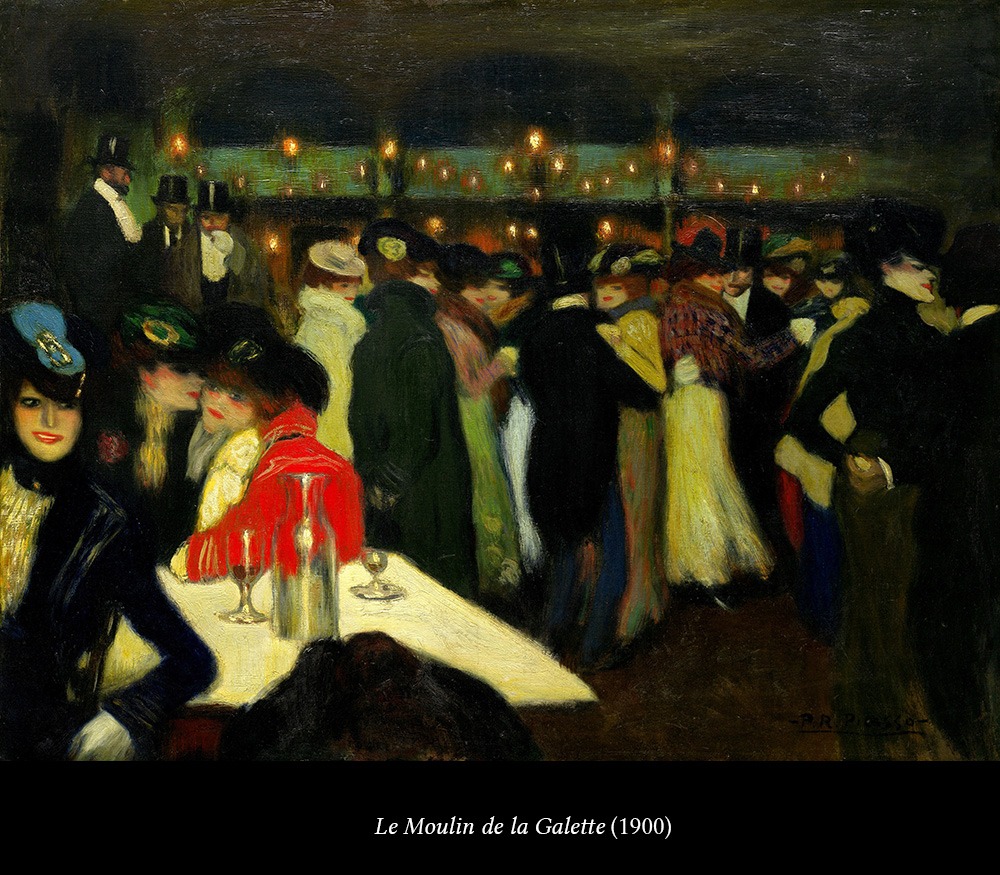
Early Work from 1890-1901: Realistic style influenced by Expressionism and Post-Impressionism. Edvard Munch’s, Expressionist and painter of the 1893 “The Scream“, use of color and various themes resonated with Picasso. Wassily Kandinsky, Expressionist and painter of the 1903 “Blue Rider” moved in the same circles as Picasso and the two likely shared abstract artistic forms and themes. Picasso greatly admired the Post-Impressionist Toulouse-Lautrec with his 1900 “Le Moulin de la Galette” paying homage to Lautrec in style and spirit.
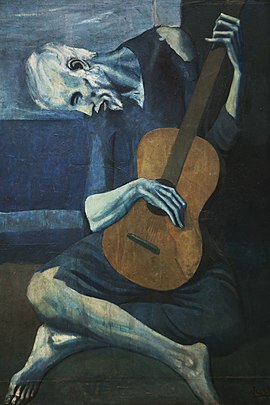
Blue Period from 1901-1904: Monochromatic paintings in shades of blue. Scenes of poverty and despair predominate this period exemplified by one of his most famous paintings from this period; “The Old Guitarist“. The painting, in addition to the characteristic blue, also shows the elongated bodies and fingers which the painter used to evoke emotion and reaction. Poverty and despair weren’t just a stylistic phase for him but a mirror into his personal depression. He was very poor and had lost his close friend Carles Casagemas in 1901. His depression began during his Blue Period and lasted in milder forms till the end of his Cubist Period.
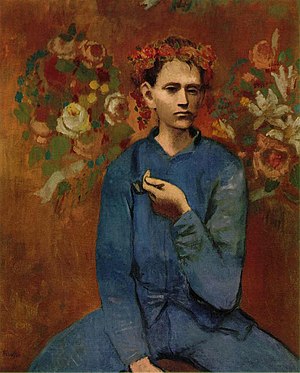
Rose Period from 1904-1906: He used warmer colors than in his Blue Period with more cheerful subjects such as circus performers, clowns, and harlequins. His depression lifted slightly during this period possibly due to his relationship Fernande Olivier, a model and artist that Picasso painted over sixty portraits of. His best-known painting from this period is the 1905 “Boy with a Pipe“. Picasso described the boy, Louis, as an “evil angel” and used the garland of roses on his head to symbolize the blood of the Eucharist. This contrasted with the harsh street life that Louis actually endured along with the innocence of his youth. The garland of roses serves as a powerful symbol in the painting, representing the juxtaposition of innocence and the harsh realities of life. Beauty and thorns, side by side.
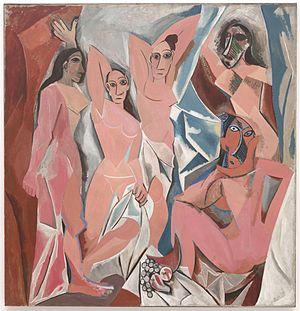
African Influenced Period from 1907-1909: He was inspired by African masks and sculptures. During this period, he experimented with geometric forms and shapes. His best-known work from this period is “The Ladies of Avignon”. This painting is considered a precursor to his Cubist Period and tangentially to his Surrealist Period. Art historian John Richardson said that this painting made Picasso the most pivotal artist in the West. Art Critic Holland Carter said that this work changed history. One can never accuse a critic of being subtle.
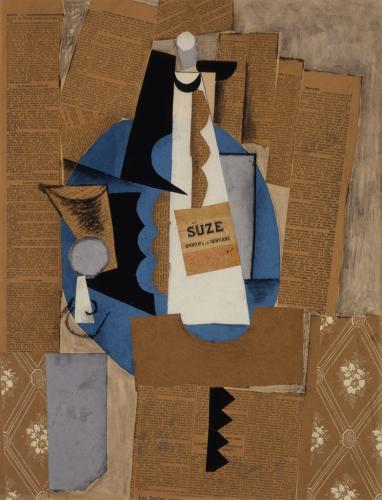
Cubist Period from 1909-1919: This period is divided into two phases: Analytic and Synthetic Cubism. Picasso’s Analytic Cubism from 1907-1912 combined deconstructed objects into overlapping planes from multiple viewpoints using muted colors. His Synthetic Cubism from 1912-1914 eliminated three-dimensional space and introduced extraneous matter mixed with bright subject colors. One of his better-known works during his Cubist Period is “Glass and Bottle of Suze“.
Neoclassicism from 1919-1924: Picasso returned to a more realistic style after WWI. Art critics at the time insisted Cubist art was a product of Germany coupled with the realization that Picasso’s Cubist art promoter was a German, causing the French to reject not only the style but also casting suspicion on the artist. Additionally, Picasso, being Spanish, did not serve in the French military during war causing public opinion to turn against him. To combat the ill feelings toward him he reverted to a more classical style. One of his better-known paintings during this period was “TheLover” which has the appearance of being lifted directly from a Greek or Roman bath.
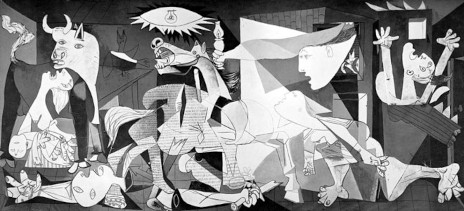
Surrealist Period from 1924-1937: During this period Picasso incorporated elements of the subconscious, dreams, and fantasy into his art, exploring new ways to express emotion and reality. He was particularly interested in eroticism, violence, and primitivism. His art emphasized flowing lines and fragmented bodies which are interpreted to represent Picasso’s personal feelings towards his subjects. His anti-war “Guernica”, a response to Nazi bombing of the Basque town of Guernica during the Spanish Civil War is his most famous Surrealistic painting or possibly his most famous painting in any style. If you didn’t know the story behind the painting and what it represents you would still see and feel the violence flowing from the canvas–knowing full well that supreme evil was in progress, seeping and dripping from the canvass in black and white. Picasso’s approach to Surrealism can be summed up with his words, “I paint objects as I think them, not as I see them.”
Later Work from 1937-1973: Picasso continued to reinvent himself over the last quarter century of his life but with less success in the realm of originality. His paintings remained Surrealistic with occasional bursts of Cubism but were becoming more abstract and confusing. He began to reinterpret the old masters and explore love and death in more exacting detail while also branching out into distinctive and different mediums such as collage, sculpture, ceramics, and printmaking.
FootnoteF
Picasso was a prolific artist, orders of magnitude beyond the output of his contemporaries. As a way of comparison, the post-impressionist Toulouse-Lautrec, who was also considered a prolific painter, painted 737 oil paintings, 275 watercolors, 363 prints, and 5,084 drawings over a period of 20 years while Picasso is estimated to have produced 13,500 paintings, 100,000 prints, 34,000 book illustrations, and three hundred sculptures and ceramics over his 75-year career. On just the painting side of the equation Toulouse-Lautrec created, on average, approximately one painting per week while Picasso finished 3-4 paintings per week. Possibly only QiBaishi, a Chinese painter of whimsical watercolors is known to have created more paintings than him.
The last known estimate of Picasso’s total oeuvre is estimated at over $500 million. Considering that eight of his paintings: “Les Femmes d’Alger” (Cubist/Matisse Adoptive–$179.4 million) “Le Rêve” (Surrealist–$155 million), “Femme à la Montre” (Surrealist–$139.4 million) “Fillette a la Corbeille” (Surrealist–$115 million), “Nude Green Leaves and Bust” (Surrealist–$106.5 million), “Boy with a Pipe” (Blue–$104 million), “Femme Assise Pres d’une Fenetre” (Surrealist–$103.4 million), and “Dora Maar au Chat” (Cubist/Surrealist–$95.2 million) exceed that estimate it would not be unreasonable to conclude that his collection may be worth something approaching 10 times that number or more. Additionally, his art increases in value by about 7.5% per year so the skies the limit.
Literary Criticism:
Warncke’s Picasso attempts the Herculean task of encapsulating the prolific artist in a few hundred pages of text and pictures. It fails but it is probably the best that can be done without overwhelming the reader with his enormous oeuvre. The one person that has attempted a thorough compilation of Picasso’s work is Christian Zervos who spent 46 years at the task. He brought together 16,000 of his paintings and drawings into the thirty-three volume “Pablo Picasso Catalogue Raisonne” which sells for 25,000 Euros (about $27,600). It’s still not everything that Picasso produced but probably more than anyone can digest.
Warncke’s book is a useful romp through the 75 years of the artist’s life, but what was most useful, for me, was the year-by-year biographical breakdown of Picasso’s 33,000 days, plus a few, on this Earth in the back pages of this volume. It provided me with a linear sequence of his progression and growth as an artist. I believe he was at the height of his powers during his Blue Period, but the big money goes to his Surrealistic Period.
Picasso Awards:
FootnoteG
Honorable mention from Madrid exhibition of fine arts, 1897
Gold medal from Malaga provincial exhibition, 1897
Carnegie Prize, 1930
Honorary curator of Prado Museum in Madrid, 1936
Silver Medal of French Gratitude from France, 1948
Order of Polish Renascence commander’s cross from Poland, 1948
Pennell Memorial Medal from Philadelphia Academy of Fine Arts, for lithograph “The Dove of Peace,” 1949
Lenin Peace Prize from Soviet Union, 1950 and 1962

 elsToday