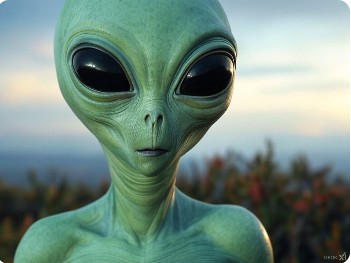
“We are an advanced species; we’ve learned how to blend.” — Ra, Stargate (1994)
Where are the aliens? UFOs, Area 51, aliens—oh my! It’s a swirling bucket of murky fun, brimming with conspiracies, starry-night tales, and probing delights. What’s real? What’s surreal? What counts as proof of life beyond Earth? There’s a flood of chatter out there—grainy videos, “as God is my witness” accounts—but sifting it for substance is like panning for gold in a litterbox.
Speculation about UFOs and Area 51 is a roaring mix of rumors, secrecy, and sci-fi vibes. Take the 1947 Roswell crash: the U.S. military first claimed they’d recovered a “flying disc,” only to pivot hours later, insisting it was just a weather balloon. The rancher who found it, Mac Brazel, described a sprawl of tinfoil, rubber, and sticks—hardly spaceship material. Yet alternate theories snowballed, spinning every extraterrestrial possibility into gospel. Alien wreckage, bodies, anti-gravity tech, even “element 115” (later synthesized by Russia as moscovium)—it’s all been tossed into the pot. Bob Lazar, since 1989, has been the loudest voice pushing these wild claims, though he’s got little beyond his word to prop them up.
More recently, posts on X have revived whispers of an egg-shaped craft allegedly hauled to Area 51 in the ‘80s. A supposed witness linked to EG&G—a firm founded by three MIT grads with deep ties to classified projects, including Area 51—claimed it was so advanced they couldn’t cut it open or X-ray it, hinting at extraterrestrial origins. This comes secondhand, under oath, but there’s no photos, no artifacts—just testimony.
What the government has declassified carries weight but lacks dazzle. The CIA’s 2013 Area 51 release confirmed it as a test site for spy planes like the U-2 and A-12 Oxcart, likely explaining many ‘50s and ‘60s UFO sightings. In 2017, the Pentagon’s Advanced Aerospace Threat Identification Program (AATIP) fessed up to studying UFOs—or UAPs, to dodge the tinfoil-hat vibe. Leaked Navy videos, like the 2004 Tic Tac encounter, show objects defying known tech: no visible propulsion, jaw-dropping acceleration. The 2021 UAP report to Congress didn’t shout “aliens” but didn’t slam the door either—144 cases, one pinned as a balloon, the rest labeled “we don’t know.”
So, where’s the slam-dunk proof of aliens? Not much holds up under a bright Tesla LED. Lazar’s stories are big on panache and spirit, short on bones. Government reports and videos tease the imagination, but never-ending psyops muddy the waters, and nothing crosses the finish line. We’re left with 90% noise—mental candy, heavy on sugar, light on meat. Until ET shakes your hand, it’s probably best to treat the evidence as entertainment.
Source and Graphic: Grok 3.

 elsToday