Brunelleschi’s Dome

Filippo Brunelleschi, a goldsmith, engineer, and relatively inexperienced architect, completed the largest masonry dome in the world in 1436—a record that has never been broken. The world now knows it as Brunelleschi’s Dome, which sits atop the Cathedral of Saint Mary of the Flower in Florence, Italy.

When completed, the dome was 52 meters (171 feet) high, with an exterior diameter of 45.5 meters (149 feet) and an interior diameter at its base of 41 meters (135 feet). The base of the dome sat above the crossing of the Cathedral, which was 55 meters (180 feet) above the ground. Atop the dome was a lantern measuring 21 meters (69 feet) in height, bringing the entire Cathedral structure to a remarkable 128 meters (420 feet). While it was not the tallest structure in the world at the time—Lincoln Cathedral in England, at 160 meters (525 feet), held that distinction—it was certainly an impressive architectural feat.

Trivia: Brunelleschi developed an ingenious mechanical lift to raise materials up to the dome. The modern world knows what that device looked like and how it worked because a young Leonardo da Vinci sketched the hoist when he was apprenticed to the Florentine painter Verrocchio beginning in 1466. Due to that sketch, Leonardo was sometimes mistakenly given credit for inventing the hoist.

Source: Brunelleschi’s Dome by Ross King, 2000. Graphic: Brunelleschi’s Dome by National Geographic, 2013-2019.
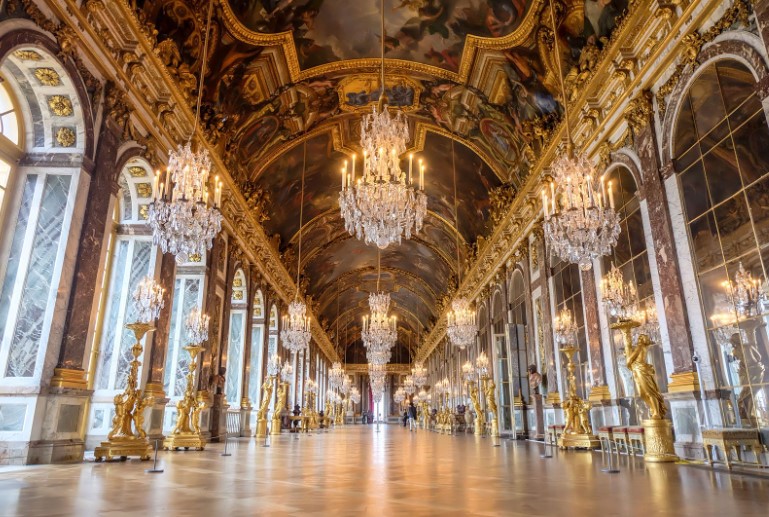
Versailles

The Palace of Versailles is the modern definition of grand opulence. Opulence beyond the comprehension of the common man. Built as a tribute to, and glorification of, himself, King Louis XIV, who stood at the apex of the world stage in the 17th century.

He built the palace to move his court out of Paris, supposedly so he could exert more control over the French nobility.

Initial construction began in 1661 with the Grand Palace and its surrounding gardens and culminated in 1710 with the completion of The Royal Chapel. The entire estate covers about 2000 acres and various estimates suggest that Versailles would cost $2-50 billion to construct today.

The Hall of Mirrors, shown in the graphic, was added, along with the wings to the Grand Palace from 1678-1684.

Source: Versailles by Perouse de Montclos, 1991. Graphic: Hall of Mirrors, Britannica.

Western Taste–Georgian Style

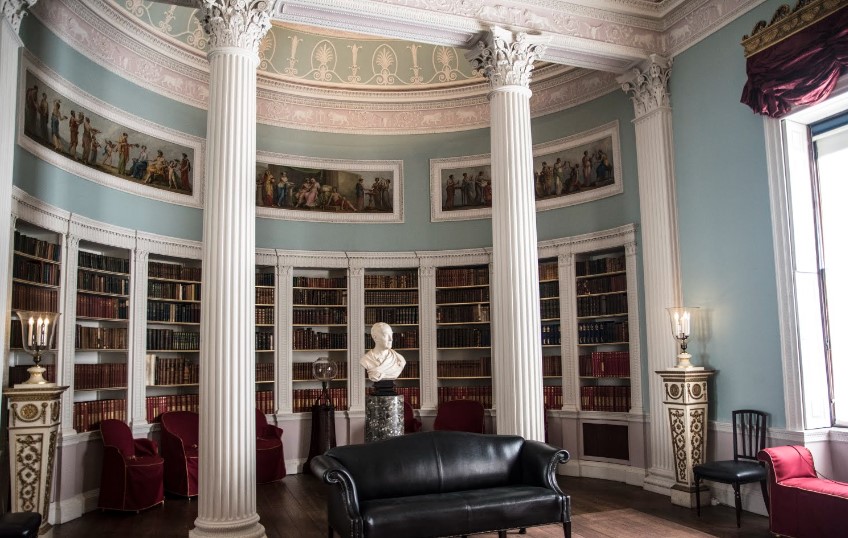
The Great Room or Library at Kenwood House in London, built from 1767-1770, was and still is considered the creme de la crème of English interior architecture during the reign of the Hanoverian Kings.

The designer of the Great Room, Robert Adam was a Scottish neoclassical architect during the Georgian Era. (All the Hanoverian Kings were named George.) This period spanned most of the 18th and early 19th centuries and Adam was singularly responsible for the revival of classical architecture throughout the west from 1760 till the end of the 18th century.

Trivia: Hanoverian King, George III, prime American Revolutionary War antagonist, ruled England during the height of Robert Adam’s influence on architecture and interior design.

Source: Robert Adam by Jeremy Musson and Paul Barker, 2017. Graphic: The Adam Library, Kenwood House on Hampstead Heath, Joe Adamczewski photo, copyright English Heritage.