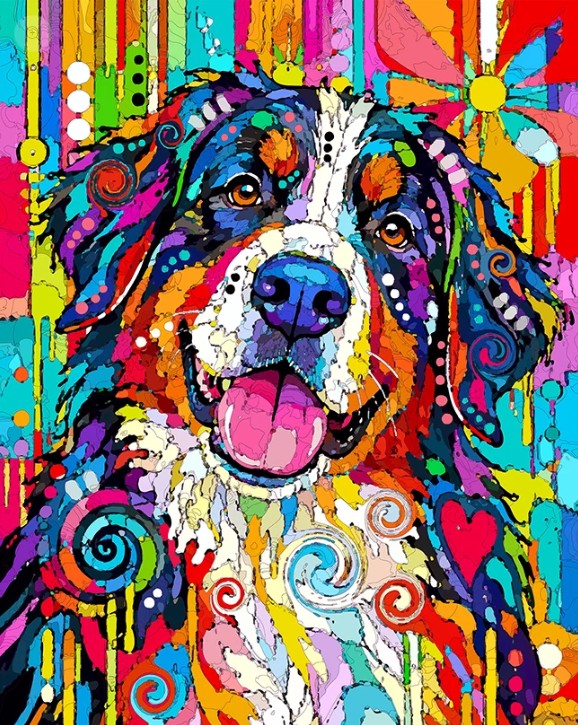
Dean Russo, a Brooklyn, NY based pop artist, is known for his vibrant colors, geometric forms and playful expressions on his animals, especially his rescue dogs. He blends a quirky, noisy style with strong Pop Art influences. At first the effect is jarring, almost cartoonish, even tattoo-like. That visual shock quickly fades, however, once you meet the gaze of the subject.
His cacophony of color and designs initially demand your attention, but they ultimately give way to the expressive eyes of his subjects, deepening the viewer’s connection to the furry side of nature. In paintings of his dogs, and occasionally his cats, the eyes do almost all the work. The eyes are usually rendered with remarkable realism, often approaching photographic accuracy. They look back at you with all the emotion the painting can convey in any static subject. They are full of curiosity, trust, mischief, patience, you name it. If a dog or cat can express an emotion, Russo has found a way to place it in the eyes. Sometimes he brings in a real nose to let the viewer know that the interest in the subject is a two-way street: seeing and scenting for knowing. The dog is looking back at you. Asking, “will you be my friend?”
Around the eyes and nose, Russo builds layers of texture and collage-like depth that create the illusion of three dimensions. Onto that foundation he adds his familiar explosion of colors, patterns, and shapes. These elements complete the portrait visually, but they are not its emotional center. They serve more as presentation than message. Like a Christmas gift made ready for presentation. It’s decorative but at the same time it isn’t the message, it’s the wrapping.
Art critics often label Russo’s work abstract or Cubist. The abstract designation makes some sense given his explosive use of color, though much of it feels more rooted in Pop Art than abstraction. The Cubist label fits not at all. Russo is not reconstructing a subject from multiple viewpoints or fragmenting reality into geometric planes. His animals remain immediately recognizable. A retriever is still a retriever and a bulldog still a bulldog. The colors, shapes, and layered textures are not there to obscure the subject but to celebrate it. Ultimately Russo is far more concerned with emotional realism than visual distortion. The geometric patterns and dazzling colors may be what first attract the eye, but they are not what stay with the viewer. What remains is that unmistakable gaze, a look filled with curiosity, trust, devotion, mischief, or quiet patience. In the end, Russo’s art succeeds for the same reason we love animals themselves: beneath all the noise and personality is a simple, direct connection that asks to be returned.
Source: Dean Russo: A Retrospective. 2018.