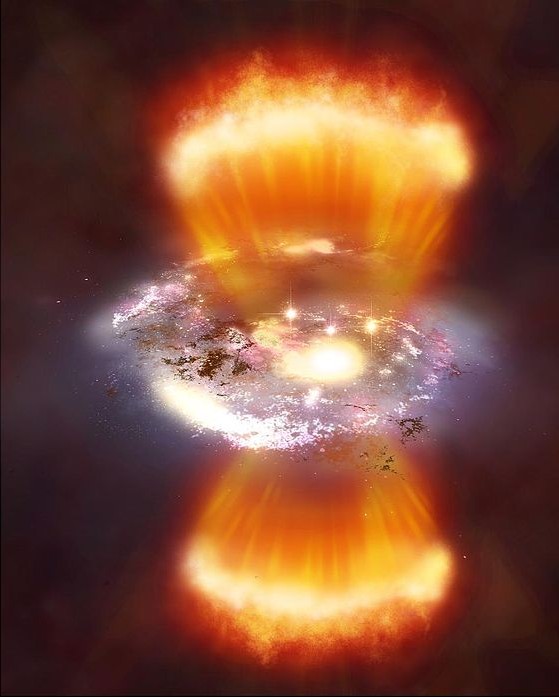
A recent ScienceDaily write‑up titled “Scientists just found the hidden cosmic fingerprints of dark matter” suggests a breakthrough in the elusive substance that binds galaxies together. In reality, the study reports that Lyman‑Alpha emitters are a transient phenomenon, interesting, but nowhere near the revolutionary advance implied by the headline.
For readers uninitiated in cosmology and astrophysics, that’s a lot of jargon at once. So let’s bring it down a notch with some plain definitions.
Dark matter is the invisible mass that holds galaxies together through gravity. Without it, galaxies would fly apart. We infer its existence only because galaxies behave as they do. It makes up about 27% of the universe’s total energy density. By comparison, ordinary matter, the stuff we can see and measure, accounts for a measly 5%. Dark energy, the mysterious driver of cosmic acceleration, contributes about 68%. But that’s a story for another day.
Lyman‑Alpha emitters (LAEs) are distant, generally low‑mass galaxies that shine in Lyman‑alpha radiation: ultraviolet light produced when a hydrogen electron drops from the second energy level to the ground state (n=2 → n=1). Because this light is strongly redshifted by cosmic expansion, LAEs act as beacons of the early universe. Observing the ones implied in the opening science press headline means looking back to a time when the cosmos was less than a billion years old.
Scientists examine the clustering of LAEs across three epochs, each marking a milestone in cosmic evolution, a page from the manuscript of creation. At a redshift of 6, when the universe was about 0.9 to 1.0 billion years old, roughly 12.8 billion years ago, the first galaxies and stars were re‑ionizing neutral hydrogen, lifting the primordial fog and making the universe transparent. This period is known as the Epoch of Reionization.
The next epoch, at a redshift of 5.7 (about 100 million years later, or 12.7 billion years ago), is called the Late Reionization / Transition Epoch. Here, scientists measure how quickly the fog of neutral hydrogen dissipated and how galaxies began to cluster. Clustering serves as a proxy for the gravitational wells of dark matter, which drew in and anchored ordinary matter.
Finally, at a redshift of 3, around 11.8 billion years ago, the Post‑Reionization Epoch reveals a more mature universe with large‑scale structures taking shape. LAEs in this era trace galaxy clustering and help infer the masses of the dark matter halos they inhabit. These halos are vast, spherical envelopes of unseen matter surrounding galaxies and clusters.
With this groundwork, we return to the science press claim that researchers have found the “fingerprints” of dark matter itself. In truth, the fingerprints show no loops or swirls, no identification of what dark matter is or how it is distributed, only confirmation of what is already established. Without dark matter, galaxies would not exist. It is, in essence, a Cartesian maxim: I gather, therefore I am. Nothing more. Nothing less.
There was, however, a genuine insight. Lyman‑alpha emitters are transient, short‑lived luminous phases in galaxies that trace the framework of dark matter. The clustering function does not reveal dark matter’s nature; it just shows how rarely baryonic light, the real stuff of frogs, men, and cybertrucks aligns with gravitational tugs.
This raises a deeper question: why does dark matter clump at all, instead of remaining uniform across the cosmos? The answer lies in gravitational instability. Minute quantum fluctuations in the infant universe were stretched to cosmic scales by inflation, imprinting faint density variations, ripples in spacetime itself (if time exists is another a question for a different day). Cold, non‑interacting dark matter streamed into these wells, not merely seeking density but becoming it, deepening the imprints and laying the invisible scaffolding upon which galaxies and clusters would later rise. In turn, the growing clumps reinforced the very variations that seeded them, a feedback loop that sculpted the universe’s large‑scale structure. Quantum fractures first, dark matter responding.
And yet another knot: where did dark matter come from? If it does not interact, how could it be born from interaction? Perhaps it is not a product of the Big Bang at all. Did it exist outside the Bang, or was it a transformation from an earlier state?
Unto the spirit of dark energy, the expansive gust that stretches spacetime, accelerating the universe’s drift into an ever‑expanding horizon. If dark matter is transformation, is dark energy its continuation, or merely a phase toward dissolution?
Together they form a cosmic tension: cohesion and dispersal, gathering and vanishing. The Big Bang may not be the beginning, but only the first visible flare in a manuscript already dictated eons before the dawn.
In this reframing, baryonic matter: atoms, stars, flesh, machines, is a late arrival. Bone, blood, and silicone are ritual sparks, flaring briefly in the gravitational wells carved by dark matter and stretched by dark energy. We are not the fathers of the universe, but the children of a violent past.
Dark matter is the glue. Dark energy erases the image. We are but the punctuation; marks in a manuscript whose lines were written long before our arrival.
Source: …Fingerprints of Dark Matter, Science Daily, Sept. 2025. ODIN: Clustering Analysis… by Herrera et al, Astrophysical Journal Letters, 2025. Graphic: Lyman-Alpha Galaxy Up Close Illustration by M. Wiss, 2009. Public Domain
 elsToday