Henri Toulouse-Lautrec, born in 1864, was a unique figure among French nobility and artists. Despite his diminutive stature and aristocratic lineage tracing back to Charlemagne, Lautrec defied conventional expectations with his eccentric, mischievous character, and individualistic style. While influenced by the Impressionists, exemplified by masters like Monet and Degas, he later embraced the Post-Impressionist movement alongside Gauguin and Cézanne, leaving a distinctive mark on the art world. Post-Impressionists diverged from their predecessors by infusing their work with deeper emotion, personal experiences, and greater individualism. Their bold brushwork, exaggerated colors, and unconventional techniques laid the groundwork for the future, anticipating Expressionism.
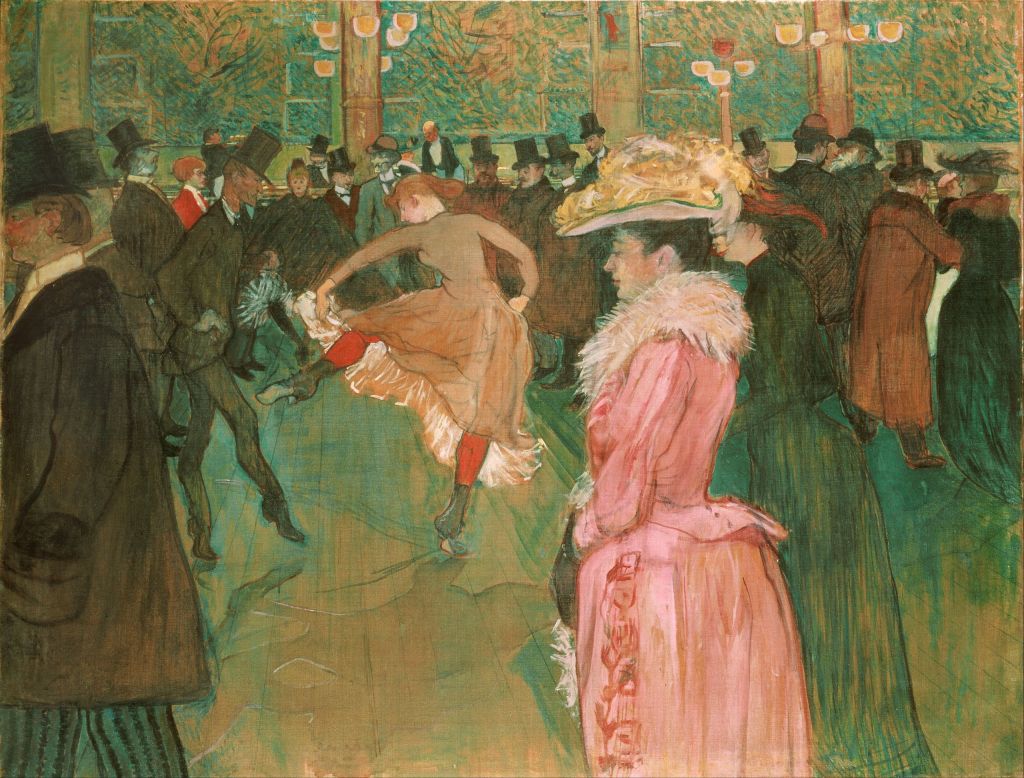
Parisian nightlife was a cornerstone of Lautrec’s art, and At the Moulin Rouge: The Dance stands as his most famous painting, portraying fashionable society and featuring many of his friends and family in a composition of overlapping planes with a perspective that subtly defies reality and logic. The artwork is divided into three distinct planes. The static background features figures such as Lautrec’s father, the poet Yeats, and Jane Avril, a renowned can-can dancer nicknamed “Crazy Jane,” who was both a close friend of Lautrec and a frequent model. In the center, the action unfolds as Valentin le Désossé, a gentleman in a top hat, instructs a cabaret dancer in new steps. The foreground is a detailed study of a contrasting passivity from the central swirl. The viewer’s eye swings between the galloping dancer in earthy tones accented by orange stockings and the quiet, introspective woman in pink.
Lautrec intentionally distorted the painting’s perspective, evident in the mismatched linear lines of the floorboards and fluid, swaying shadows that resemble a confused liquid more than lighting effects. These artistic choices enhance the surreal atmosphere of the scene, amplifying the contrast between the hyper-dynamic dancer and the passive, tranquil surroundings. Through At the Moulin Rouge: The Dance, Lautrec masterfully evokes the opposing vibrant activity and a ‘to be seen’ spirits of Parisian nightlife, providing a vivid outline while inviting viewers to interpret the finer details themselves.
Source: Toulouse-Lautrec by Doughlas Cooper, 1982. Graphic: At the Moulin Rouge: The Dance, Toulouse-Lautrec, 1890. Philadelphia Museum of Art. Public Domain.
 elsToday