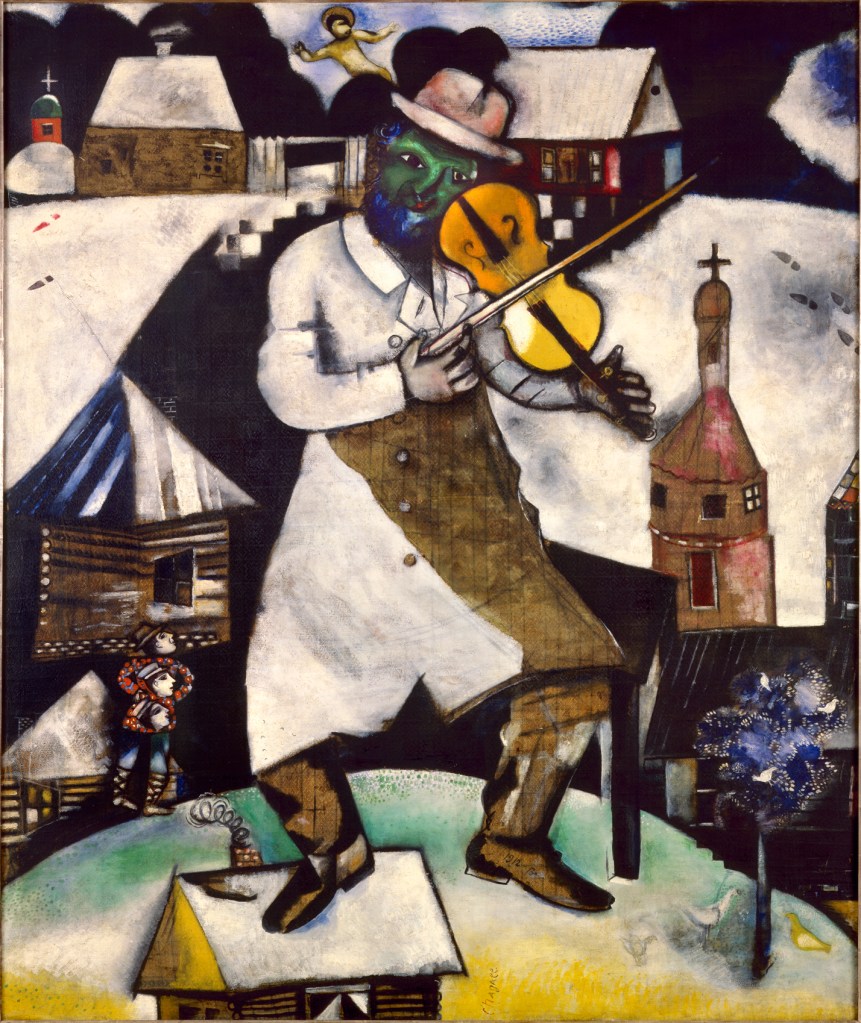
Art critic Raimond Cogniat described Marc Chagall as an artist of opposites, a painter who thrived in the interplay of form and color, color and meaning. Chagall infused his paintings with love and happiness, crafting worlds that felt both fantastical and deeply alive. He shaped reality from his feelings, “making it conform to his inner spiritual logic,” even if, as he once confessed, he wasn’t entirely conscious of his process.
Born Moishe Shagal in 1887 in Vitebsk (now Belarus), Chagall grew up in a Jewish enclave within the Russian Empire. He later embraced France as his adoptive home, blending his Eastern European roots with French artistic flair. Though he briefly explored Cubism during its peak in the early 20th century, he thankfully abandoned that style to carve his own path as an expressionist. Vivid, otherworldly colors, and exaggerated forms defined his style, while his Jewish heritage, evident in depictions of shtetl life, fiddlers, and biblical scenes, remained his anchor. His 1912–1913 painting The Fiddler is said to have inspired the title of the musical Fiddler on the Roof.
In a 1963 speech to an American audience, Chagall reflected on his philosophy: “Any moral crisis is a crisis of color, texture, blood and the elements, of speech, vibration, etc.—the materials with which art, like life, is constructed. Even when mountains of color are piled on a canvas, if one can discern no single object even through great sound and vibration, this will not necessarily give authenticity.” To Chagall, authenticity was more than paint; it demanded the infusion of human experience, blood, and the essence of nature.
Source: Chagall by Raimond Cogniat, translated by Ann Ross, 1977. Graphic: The Fiddler, Chagall, 1912-1913. Public Domain
 elsToday