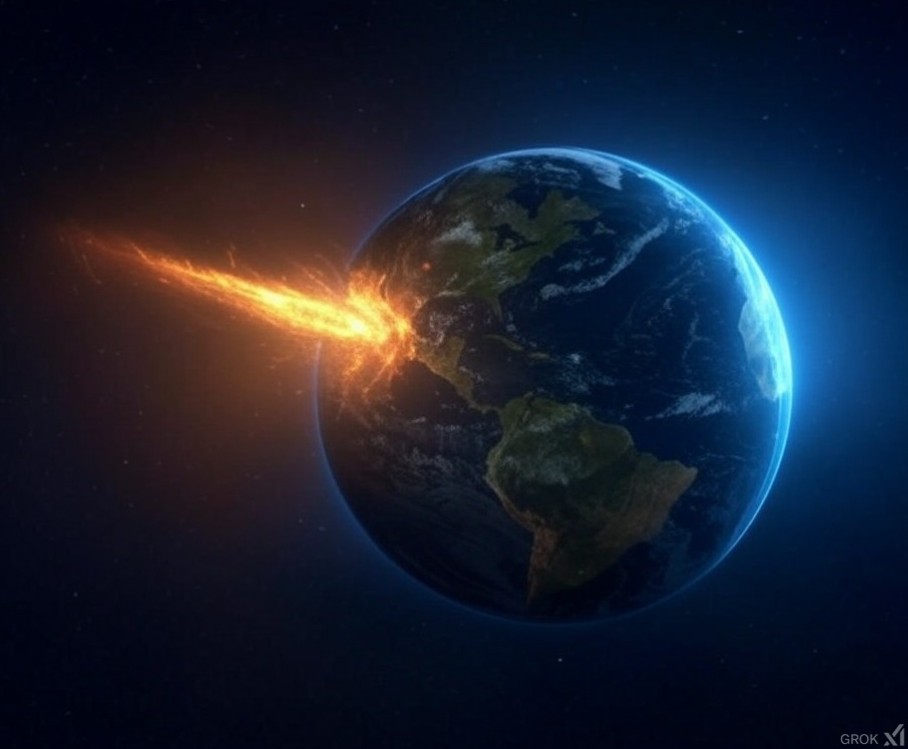
How high’s the water, mama?
Two feet high and rising
How high’s the water, papa?
She said is two feet high and rising” (Johnny Cash Five Feet High and Rising)
The early development of life on Earth relied on two essential building blocks: carbonaceous (carbon) material and water. It has long been postulated that asteroids, comets, and other planetesimals brought these ingredients to our planet. Water in meteorites existed in the form of hydrous minerals and possibly brine.
Researchers from Rutgers University, led by Professor Katherine Bermingham, studied isotopes of molybdenum from meteorites and Earth’s crust. They inferred that water arrived on Earth during its late accretion phase, around 4.1-3.8 billion years ago. The team also suggested that the water was delivered by inner solar system planetesimals such as comets and asteroids.
This is a crucial milestone in Earth’s development timeline, as there are two competing theories about when water was delivered to our planet: the Moon-Forming Event and the Late Heavy Bombardment (LHB). The Moon is believed to have formed about 4.5 billion years ago, shortly after Earth formed around 4.56 billion years ago, caused by a large object crashing into Earth. The LHB is a period of intense bombardment by planetesimals on the inner planets, occurring around 4.1-3.8 billion years ago.
An inference from the LHB is that all planets and moons existing at that time either contained or still contain water.
Trivia: Assuming the median size of planetesimals striking Earth during its early formation was around 15 kilometers (9.3 miles) with an average water content of 5% of their total volume, it would take about 15,688,960 hunks of rock to supply the current volume of water on Earth. Dividing that number by the LHB time interval of 300 million years suggests a significant impact every 227 months, or roughly every 19 years.
Source: Life-bearing Water, by Bermingham et al, Rutgers, 2025. Graphic: Comet Cometh, Grok, 2025.
 elsToday