Claret to Bordeaux

Claret is an English term for Bordeaux wines that traces its origins back to 16th century. The name derives from the French word “clairet,” which described a lighter, more rosé-like style from the Bordeaux region.

Originally, the grapes used to make this wine were Cabernet Sauvignon, Merlot, and Cabernet Franc, similar to today’s right-bank Bordeaux. The left bank added Malbec, Petit Verdot, and Carménère to the mix.

By the 17th and 18th centuries, clarets evolved, through better maceration, aging, and blending techniques, into a darker, full-bodied wine we would recognize today as a Bordeaux. It became a major export to England and the world.

Trivia: Charles Dickens in ‘Martin Chuzzlewit’, ‘The Pickwick Papers’, and ‘Great Expectations’; Wilkie Collins in ‘The Moonstone’; Anthony Trollope in ‘The Belton Estate’; William Thackeray in ‘Vanity Fair’; and George Eliot in ‘Middlemarch’ all mention the drinking of claret, usually at their dinners.

In these novels the claret was diluted with water to reduce the alcohol content, making it more palatable and easier to drink over long meals or gatherings and to stretch the supply.

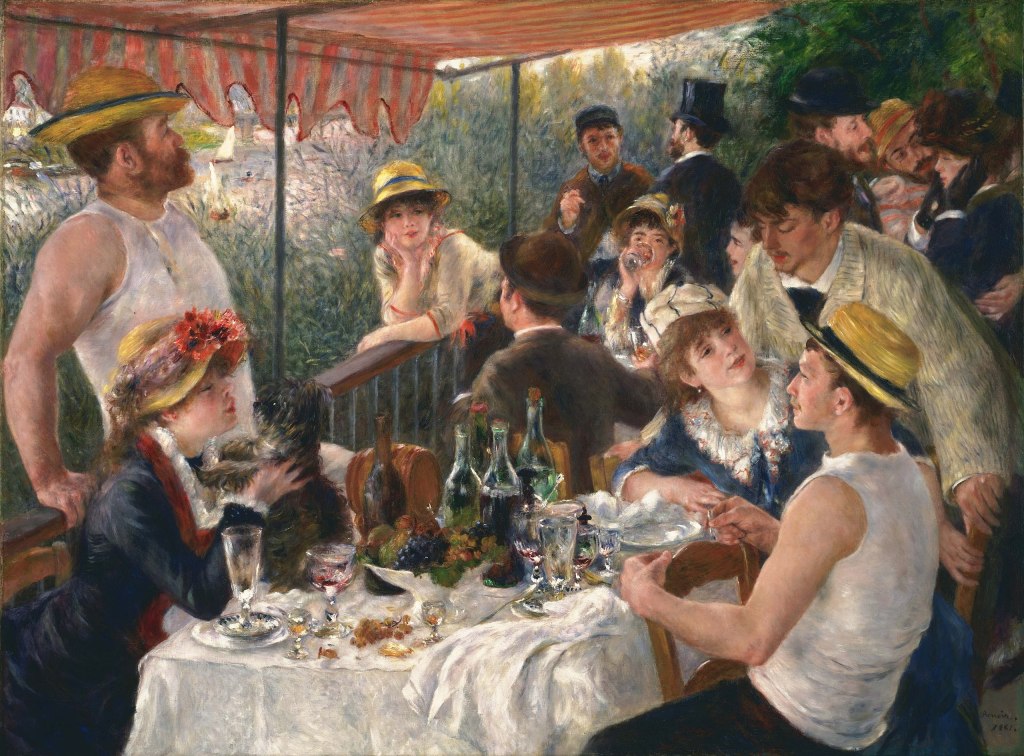
Source: Wine Spectator. Decanter. Graphic: Luncheon of the Boating Party by Pierre-Auguste Renoir, 1881. Public Domain.

You Still Got Me

Beth Hart’s 11th solo studio album, the October 2024 release of ‘You Still Got Me’, follows up her 2022 Led Zeppelin tribute album with 11 original songs spanning the genres of blues, rock, pop, ballads, a touch of jazz, and a delightful tongue-in-cheek country nod to Johnny Cash. All songs are written by her, with a little help from Rune Westberg and Glen Burtnik.

While this may not be her best work—those honors go to her collaborations with the incomparable guitarist Joe Bonamassa—listening to the bluesy evolution of her throaty voice is a joy to be cherished and treasured; an album that captures the pure magic that is Beth Hart.

Source: AllMusic. Rock & Roll Muse with Martine Ehrenclou. Graphic: Album Cover and ‘Wanna Be Big Bad Johnny Cash, Provogue, Mascot, October 2024.

Love and Happiness

The opening line to Tolstoy’s “Anna Karenina”, “All happy families are alike; each unhappy family is unhappy in its own way,” is frequently misunderstood to mean that all unhappy families are sadly similar in that negative dynamics are always present.

What Tolstoy and the original French proverb convey is that unhappy families suffer from unique dysfunctions, such as violence, substance abuse, or incest, while happy families have avoided these destructive traits.

In statistics, this concept is known as the ‘Anna Karenina Principle‘. It states that for an endeavor to be successful, every possible deficiency must be avoided, whereas for it to be unsuccessful, only one negative factor needs to be present.

A similar proverb from 16th or 17th-century Europe, “One bad apple spoils the whole barrel,” began as practical advice to apple farmers and evolved to describe how one negative influence can affect an entire group or family.

Russian authors like Tolstoy and Dostoevsky tend not to write about happy families because, in their view, there is no story, no moral, and no psychological depth without pain and suffering.

English author W. Somerset Maugham brought this idea back into the limelight with a twist when he wrote: “They say that happy people have no history, and certainly a happy love has none. They did nothing all day long and yet the days seemed all too short.”

There is no shame in happiness; life does not need drama or conflict to be meaningful.

Source: Anna Karenina by Tolstoy. Rain and Other South Sea Stories by W. S. Maugham. Graphic: Apple by Tembhekar. Public Domain.

Journalism—CNN’s Sycophants for Saddam Hussein 2003

CNN’s news chief in 2003, Eason Jordan, admitted that the network ignored and suppressed Saddam Hussein’s mass killings of his citizens and other crimes against humanity, to keep their access to the Iraqi thug. Jordan said that telling the truth likely would have meant closing their Baghdad bureau. Franklin Foer of the New Republic wrote in The Wall Street Journal: “CNN could have abandoned Baghdad. Not only would they have stopped recycling lies, they could have focused more intently on obtaining the truth about Saddam.”

CNN lied; Iraqis died.

Human Rights Watch has estimated that 250,000 to 290,000 Iraqis were presumed killed under Saddam.

Eason Jordan resigned from CNN in 2005. It wasn’t possible to discover why he wasn’t fired in 2003 for his efforts to aid Saddam Hussein.

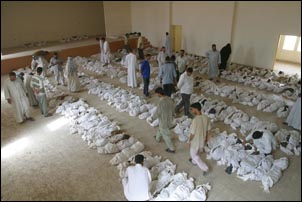
Source: The Washington Post. HRW 2003. Franklin Foer, Wall Street Journal 2003.   Graphic: Iraqi Victims Found in a Mass Grave killed under Saddam’s Rule, GWB Whitehouse Archives, 2003.