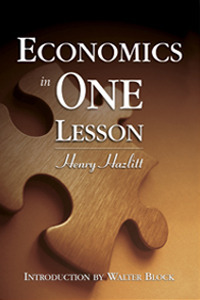
Henry Hazlitt in 1946 published one of the greatest books on economics ever written: ‘Economics in One Lesson’. It’s concise, lucid, factual, and in respect to deductive reasoning on par with Fredrich Hayek’s ‘The Road to Serfdom’ and Adam Smith’s ‘The Wealth of Nations’.
Hazlitt, like Hayek, was a student of the Austrian school of economics which advocated for minimal government intervention, was against central planning, and believed in gold-standard like currencies.
Hazlitt sums up his short book in one sentence, ‘The art of economics consists in looking not merely at the immediate but at the longer effects of any act or policy; it consists in tracing the consequences of that policy not merely for one group but for all groups.’ What’s good for the gander is likely not good for the goose.
He expands this thought by showing that economics is about tradeoffs and choices or to simplify it further, when it comes to government spending there is no free lunch. Spending money on guns means less money spent on butter. When President Johnson, in the 1960s after the book was written, tried to spend money on both guns and butter we received inflation. When our current politicians spent unlimited amounts of money on everything imaginable, we received inflation.
History may not repeat itself, but it rhymes.
Source: Economics in One Lesson by Henry Hazlitt, 1946. Graphic: Economics in One Lesson, Hardcover, 2008 Edition, public domain.
 elsToday