By Frank Zollner
Prestel
Copyright: © 2015
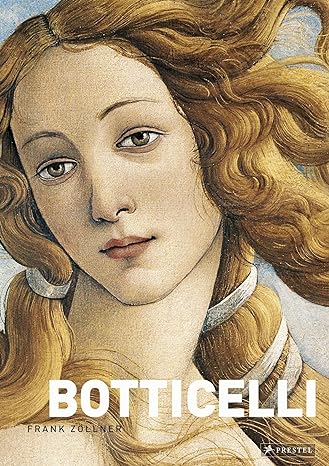
Zollner Biography:

Frank Zollner, born 26 June 1956 in Bremen, Germany, is an art historian specializing in Renaissance painters, specifically Leonardo, but also Michelangelo, Rapheal, and Botticelli. He has been a professor of art history at Leipzig University since 1996.
As an expert in all matters Leonardo, he has been wrapped up in the authenticity of the multiple Mona Lisas that exist around world. The Mona Lisa actually painted by Leonardo that everyone appears to agree on is in the Louvre. Experts also agree that parts of the Isleworth Mona Lisa may have also been painted by Leonardo. Then there is the two Mona Lisas that are most like each other, the Louvre Mona Lisa, and the Prado Mona Lisa in Madrid. The Prado Mona Lisa is acknowledged to have been painted in Leonardo’s workshop but not necessarily by Leonardo himself. The two most famous paintings are the Louvre Mona Lisa and the Washington National Gallery’s Mona Lisa. The National Gallery Mona Lisa is believed to have been painted by one of Leonardo’s followers, possibly Salaì or Francesco Melzi. So, it would appear that there are a lot of Mona Lisa’s floating around but only one fully authentic and completely Leonardo.
Zöllner re-introduced the art world to the ancient concept of aesthetic hedonism. Aesthetic hedonism states that for art to have value one must experience emotional pleasure when viewing or experiencing it. The value related to aesthetic hedonism is derived from empirical observations and experiences. Philosophers, such as Hume and Kant, have argued that aesthetic pleasure is universal, reflecting the intellectual harmony within one’s mind. Plato and others, on the other hand, suggest that empiricism alone is not enough to render value to an object of art. Other subjective factors also need to be considered such as moral, social, or religious values.
Which brings us to an impertinent detour but much needed critique of modern art. Where is the beauty, the pleasure, or at a more essential and primeval level, where is the talent for what passes today as modern art? A deplorable example of modern art totally lacking in artistic talent or merit, unable to provide any visual pleasure, is Vienna’s newest fountain: WirWasser. A cultural devolution that is utterly sad and heartbreaking. Look at the picture of the fountain with the people responsible for that monstrosity. They are smiling. What is wrong with those people?
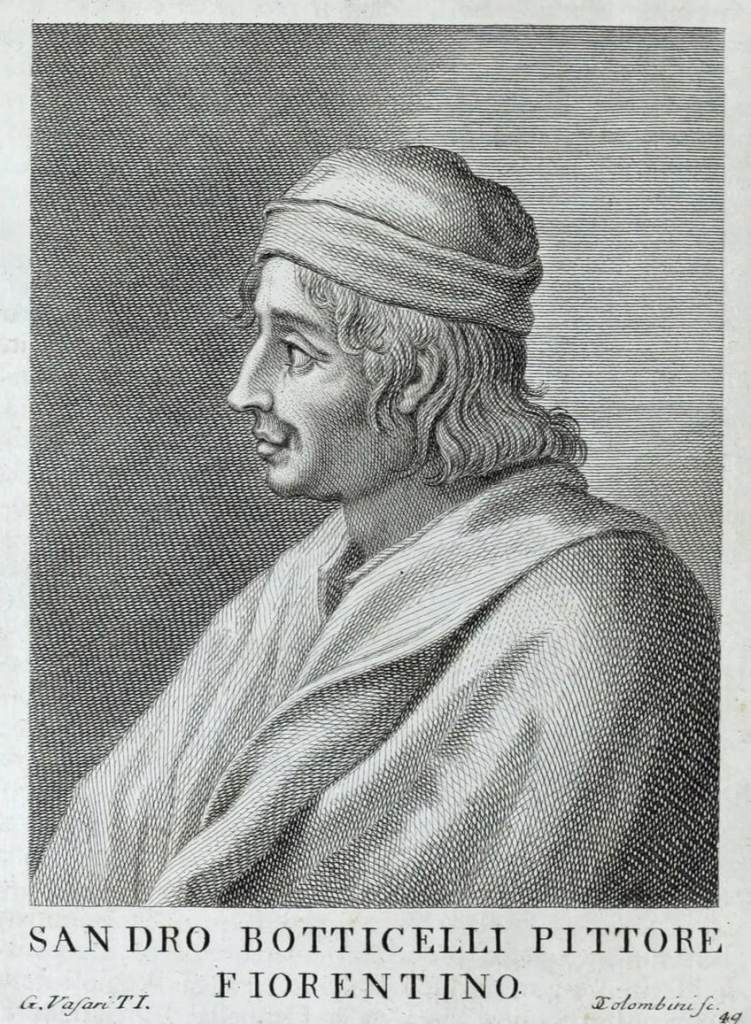
Botticelli Biography:
“By throwing a sponge soaked with deffernet colors at at a wall one can make a spot in which a beautiful landscape can be seen“…Botticelli.
Sandro Botticelli, born Alessandro di Mariano di Vanni Filipep circa 1445, later given the moniker Botticelli by an older brother meaning ‘little barrel’ in Italian, is considered the greatest humanist painter of the Early Renaissance Era.
Botticelli’s art was always about dignity, about maintaining the grace and soulfulness of his subjects. His genus lies in capturing the emotional persona of people populating his paintings along with the technical ability to skillfully show perspective, accurately express anatomy, and the mastery of color and light.

Botticelli died in Florence in 1510 at the age of 64 or 65. His complete oeuvre is unknown but at least 137 artworks have been attributed to him, including panel paintings, works on canvas, frescoes, and drawings for Dante’s Divine Comedy. Among his most famous and recognizable paintings are La Primavera (shown above) and the Birth of Venus (shown below), which today, are synonymous with perfection and Early Renaissance art.
The La Primavera, shown above, was originally in the possession of one of the younger Medicis and was given as a wedding present to Semiranmide Appiani who married Lorenzo di Pierfrancesco de’ Medici in 1482. The painting depicts, beginning on the far left continuing to far right, Mercury in winged shoes poking at the clouds with a wand, the Three Graces in the company of Mercury creating an atmosphere of beauty and what else, grace. The central figure is Venus. The floating cherub above Venus is Cupid, her son by Mars. To the right of Venus is Flora, goddess of flowers, springtime, and fertility. The woman to the right of Flora is Chloris, originally a virginal nymph who was transformed into Flora by the wind God Zephyr shown floating above ground on the far right. Zephyr raped Flora/Chloris but made amends by making her his wife.
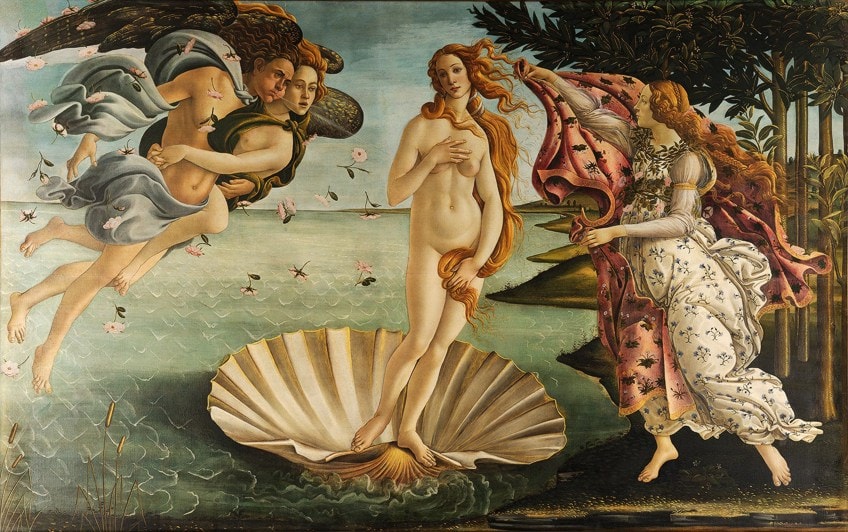
Botticelli’s The Birth of Venus, referred to by some art critics, including Zollner, as the Arrival of Venus, shows the goddess of love on the shores of the island of Cythera. Botticelli based the painting on a poem by Greek poet Hesiod, describing Venus emerging from the sea, formed from the severed genitals of Uranus. Venus is standing on a giant scallop shell, blown by the wind god Zephyr and his companion Aura, a goddess of breeze, and welcomed by one of the Horae, likely a goddess of spring, who offers her a cloak.
Literary Criticism:
Zollner’s Botticelli is a masterpiece in scholarship and beauty. The reproductions of Botticelli’s art are crisp and clear, but the text brings it all together, biography, provenance, technique, and history. To follow a painting from brush to museum, as Zollner has, is itself a work of art and love.
FootnoteA: Frank Zollner. Welt newspaper 2021
Frank Zollner Art Book Bibliography (English):
- Botticelli: Images of Love and Spring. 1998
- Leonardo Da Vinci: 1452-1519: The Complete Paintings and Drawings. 2007 (with Johannes Nathan)
- Bob Dylan: The Drawn Blank Series. 2008
- Leonardo. The Complete Drawings. 2014 (with Johannes Nathan)
- Michelangelo. Complete Works. 2014 (with C. Thoenes and T. Popper)
- Leonardo. 2015
- Michelangelo. The Complete Paintings, Sculptures and Architecture. 2017 (with Christof Thoenes)
- Leonardo. The Complete Paintings and Drawings 2019
- Leonardo. The Complete Paintings and Drawings. Updated. 2022 (with Johannes Nathan)
- Michelangelo. The Complete Works. Paintings, Sculptures, and Architecture 2022
- Raphael. The Complete Works. Paintings, Frescoes, Tapestries, Architecture. 2023 (with M. Rohlmann, R.H. von Gaertringen, and G. Satzinger)
References and Readings:
- Biography of Sandro Botticelli, Birth of Venus Painter. By Bill Lamb. Thought Co. 2019
- Sandro Botticelli. By Mark Cartwright. World History. 2020
- Aesthetic Hedonism. By Mohan Matthen and Zachary Weinstein. Oxford Bibliographies. 2020
- 16 Famous Renaissance Artists Who Achieved Greatness. By Mia Forbes. The Collector. 2021
- Art Historian Frank Zollner: Books Prepare You for the World. By Archyde. Archyde. 2021
- Botticelli: My Worries About the Man of Sorrows. By Frank Zollner. The Art Newspaper. 2022
- La Primavera by Sandro Botticelli – A Primavera Painting Analysis. By Alicia du Plessis. Art in Context. 2023
- Sandro Botticelli: The Life and Works of This Famous Florence Artist. By Isabella Meyer. Art in Context. 2023
- Sandro Botticelli. By Ronald W. Lightbown. Britannica. 2023
- The Birth of Venus (Sandro Botticelli, c. 1485). Uncredited. Artchive. No date
- Botticelli in the Sistine Chapel. Uncredited. Italian Renaissance Art. No date
- Early Renaissance Art and Architecture. Uncredited. The Art Story. No date
- Renaissance. Uncredited. Wikipedia. No date
- Sandro Botticelli. Uncredited. The Art Story. No date
- Sandro Botticelli. Uncredited. Wikipedia. No date
- Frank Zollner. Uncredited. Wikipedia. No date
- Hedonism. Uncredited. Wikipedia. No date
- Isleworth Mona Lisa. Uncredited. Wikipedia. No date
 elsToday